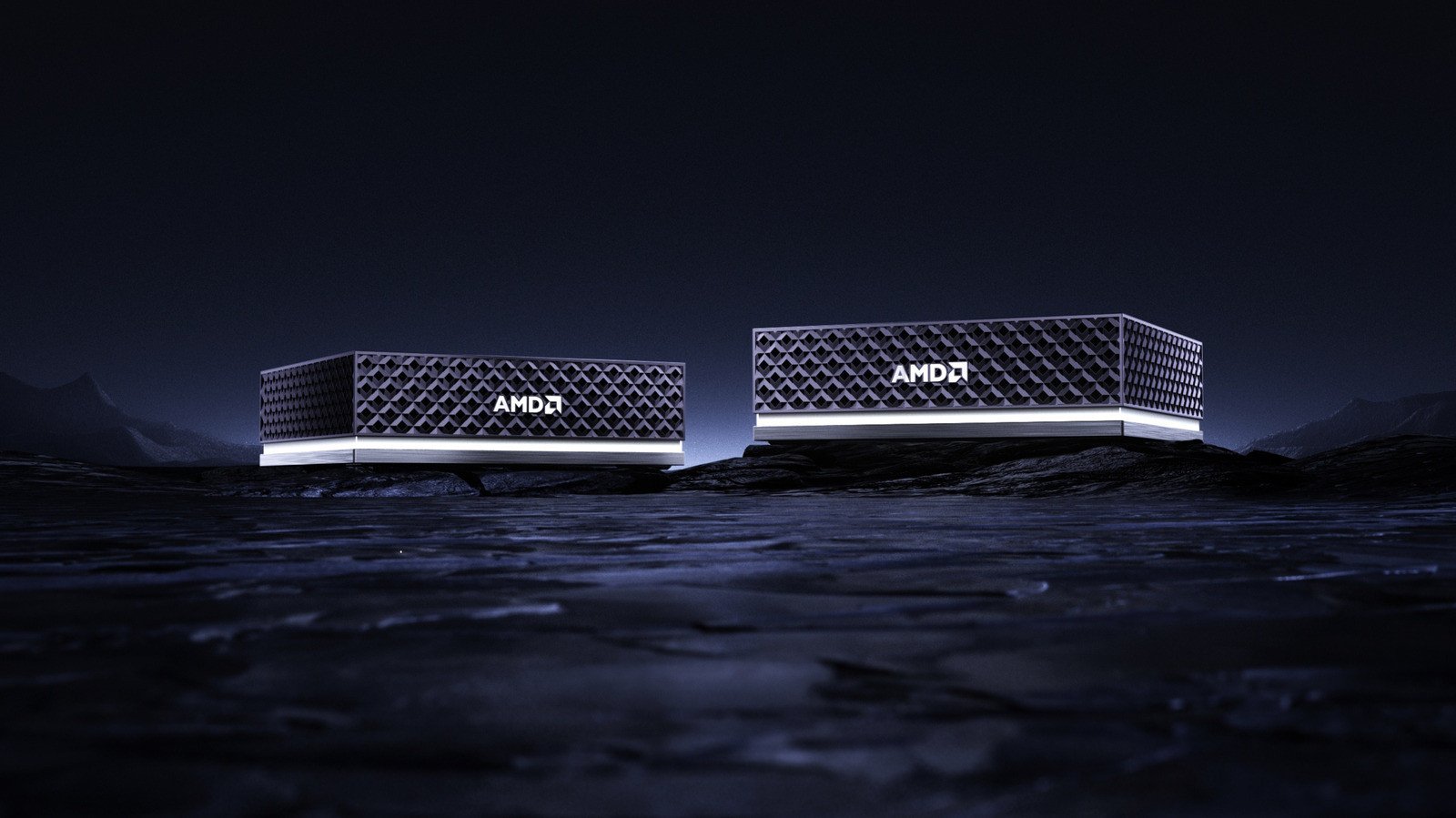

AMD is making a bold statement in the burgeoning field of artificial intelligence, positioning its new Ryzen AI Halo PC as a formidable challenger to cloud-based AI processing and a direct competitor to NVIDIA’s established systems. Unveiled at CES and now priced at $3,999, this Mac Mini-sized powerhouse promises to bring high-performance AI computation directly to the desktop, alongside the announcement of next-generation Ryzen AI Max 400 chips.
AMD’s Vision: Local AI Dominance
The core of AMD’s 2026 strategy revolves around empowering users with local AI capabilities, reducing reliance on costly cloud services. The Ryzen AI Halo PC, starting with Ryzen AI Max 300 CPUs, is designed to handle intensive AI workloads on-device. Preorders are set to begin in June, with a future model incorporating the more advanced Ryzen AI Max 400 chips also on the horizon.
A Cost-Effective Solution for AI Developers
While its $3,999 price tag might seem substantial, AMD is strategically marketing the Halo PC as a financially shrewd investment for AI developers. The company highlights a compelling return on investment: for developers spending approximately $773 monthly on 6 million daily AI tokens — which isn’t an unusual scenario for many developers — the Halo could pay for itself in just six months. For even more demanding tasks, a $4,000 Radeon R9700 Pro GPU could break even in three months for those incurring $2,253 monthly for 18 million daily tokens. This aggressive pricing strategy directly targets the operational costs associated with continuous cloud AI access.
Direct Confrontation with NVIDIA
It’s clear that the Ryzen AI Halo PC isn’t aimed at the average consumer. Instead, AMD is taking aim squarely at NVIDIA’s DGX Spark AI PC. Priced at $4,699 (up from its initial $4,000), NVIDIA’s offering is limited to Linux environments. In contrast, AMD’s x64-powered Ryzen AI Halo boasts the flexibility of running both Windows and Linux, a significant advantage for many developers.
Technologically, the Halo PC distinguishes itself with a robust 50 TOPS NPU and a Radeon GPU featuring 40 compute units, whereas the DGX Spark leans entirely on NVIDIA’s Blackwell GPU for AI acceleration. Both systems, however, share a critical feature for large model execution: 128GB of unified system memory, surpassing the memory capacities typically found in popular AI developer platforms like the Mac Mini or Mac Studio.
Introducing the Ryzen AI Max 400 Series
Looking ahead, AMD is preparing to launch its Ryzen AI Max 400 chips in the third quarter of 2026. Leading this new series will be the AI Max+ Pro 495, a powerful 16-core processor boasting a 5.2GHz boost speed, a 55 TOPS NPU, and integrated Radeon 8065S graphics. These chips will further elevate memory capabilities, supporting up to 192GB of unified memory, which translates to an impressive 160GB of GPU VRAM.
While the AI Max+ Pro 495 offers a slight clock speed bump over its predecessor, the AI Max 395 (5GHz CPU boost), AMD has yet to release comparative benchmarks. Nevertheless, the specifications suggest a continued push towards higher performance and greater memory bandwidth, solidifying AMD’s commitment to leading the local AI revolution.
For more details, visit our website.
Source: Link