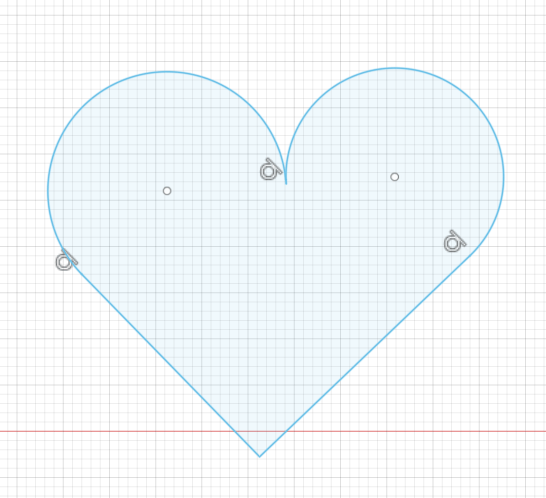

There’s a unique satisfaction in crafting a meticulously defined CAD model. Beyond merely preventing design errors, a perfectly constrained sketch can bring a sense of calm to the diligent engineer. If the disappearance of that final warning icon brings you a sigh of relief, then Hestus Autocomplete for CAD might just be the tool you’ve been waiting for.
The Genesis of Hestus: Born from Necessity
The inspiration behind Hestus stems directly from real-world engineering challenges. We recently spoke with founder Sohrab Haghighat, an aerospace engineer whose journey included leading the space launch startup, SpaceRyde. Competing against industry giants with vast resources, Haghighat’s team couldn’t afford to squander precious time on repetitive, mundane tasks. Yet, he observed skilled engineers dedicating days to the painstaking process of precisely defining intricate model details.
This firsthand experience ignited a vision: to create an intuitive AI tool that would accelerate workflows without impeding the creative process. The goal was clear – free up top talent for more complex, engaging work. Haghighat decided to build the solution he wished he’d had, embodying a refreshing philosophy: to empower engineers, not replace them. Hestus is designed to handle the ‘little things’ exceptionally well, allowing human designers to maintain full control and focus on innovation.
How Hestus Autocomplete Transforms Your Workflow
Hestus operates as a seamless plugin, currently available for Autodesk Fusion with Solidworks support slated for June. As you begin sketching, a discreet window appears, offering intelligent predictions for your next actions. Users can swiftly cycle through and accept suggestions using hotkeys, or simply ignore them if they prefer a different path. While CAD modeling offers immense creative potential, it often involves a significant amount of tedious, repetitive work. Hestus promises to alleviate this burden, streamlining the less exciting aspects of design.

Putting Hestus to the Test: Real-World Application
To truly understand its impact, we integrated Hestus into several design projects. Our initial test involved refining an existing Raspberry Pi case. Despite the original design being functional, a list of desired improvements provided the perfect proving ground. The Hestus helper remained unobtrusive, offering timely suggestions as we worked. Even in its early stages, Hestus demonstrates robust support for a diverse range of geometries.
Many of the suggestions focused on adding constraints and leveraging symmetry. Given the symmetrical nature of our enclosure, these recommendations were consistently valuable. For highly geometric designs, Hestus truly shines. A Lego brick model, for instance, perfectly showcased its strengths, often presenting the optimal solution as its primary suggestion. While attempting a clock face, which blends creative design with strict rules, Hestus proved slightly less adept due to its current lack of radial symmetry recognition – a feature, however, that is firmly on the roadmap. Nevertheless, nearly every sketch benefited from the construction lines and constraints Hestus intelligently added.
The Future of CAD: Smarter, Faster, More Intuitive
Beyond Basic Predictions: Advancing AI in CAD
Looking ahead, the Hestus team is committed to enhancing its predictive capabilities and expanding the range of constraint types, including midpoints, collinear relationships, and sophisticated circle patterns. It’s crucial to understand that Hestus is not a large language model (LLM) based 3D generator. As Haghighat emphasizes, LLMs inherently lack the capacity to grasp physical geometry. This necessitated building a bespoke AI model from the ground up, a testament to the team’s dedication.
Currently, Hestus provides subtle suggestions that anticipate user actions 10-30 seconds into the future. The ambitious vision, however, extends to supporting 3D features like extrusions and offering predictions up to two minutes ahead. Their goal is to deliver “more complex recommendations to our users… such as recommending a new geometry, applying a constraint, and adding a dimension all in one go.” Features like quad mirror and horizontal/vertical constraints are already available, significantly boosting efficiency.
Intelligent Design Intent and Manufacturing Awareness
Haghighat envisions an even more profound role for Hestus. Imagine an AI that comprehends manufacturing processes and design intent, proactively warning engineers about potential issues. What if it could flag walls becoming too thin for machining, or recognize a specific hole diameter as intended for a fastener, then alert if there isn’t sufficient clearance? The core principle remains user control; Hestus would only intervene as a guardian, gently guiding the design back on track if it veers off course.
Conclusion: A Subtle Revolution in CAD Sketching
Hestus asserts that its tool can accelerate CAD sketching by an average of 2.5 times, a figure that will undoubtedly improve as more features are integrated. It’s a sophisticated yet subtle assistant, offering precise actions to refine and tighten sketches. Crucially, it’s not an aggressive autocorrect but an opt-in suggestion system, empowering users with better ideas. Our hands-on experience revealed a consistently helpful and unobtrusive guidance system. In an era of rapid development, it’s refreshing to encounter a product that prioritizes thoughtful, incremental improvement. Hestus is currently available for free download, inviting all CAD enthusiasts to experience this subtle revolution firsthand.
For more details, visit our website.
Source: Link