
Ephemeral by Design: Carlo Ratti Associati Transforms the Everyday at Milan Design Week
As the vibrant energy of Milan Design Week fades, one installation continues to resonate, challenging perceptions and celebrating the familiar in an entirely new light. MIT professor and renowned architect Carlo Ratti, in a groundbreaking collaboration with Italian food giant Mutti, unveiled the ‘House of Polpa’ – a temporary architectural marvel that elevated a humble pantry staple into a profound, immersive experience.
The Ubiquitous Can Reimagined
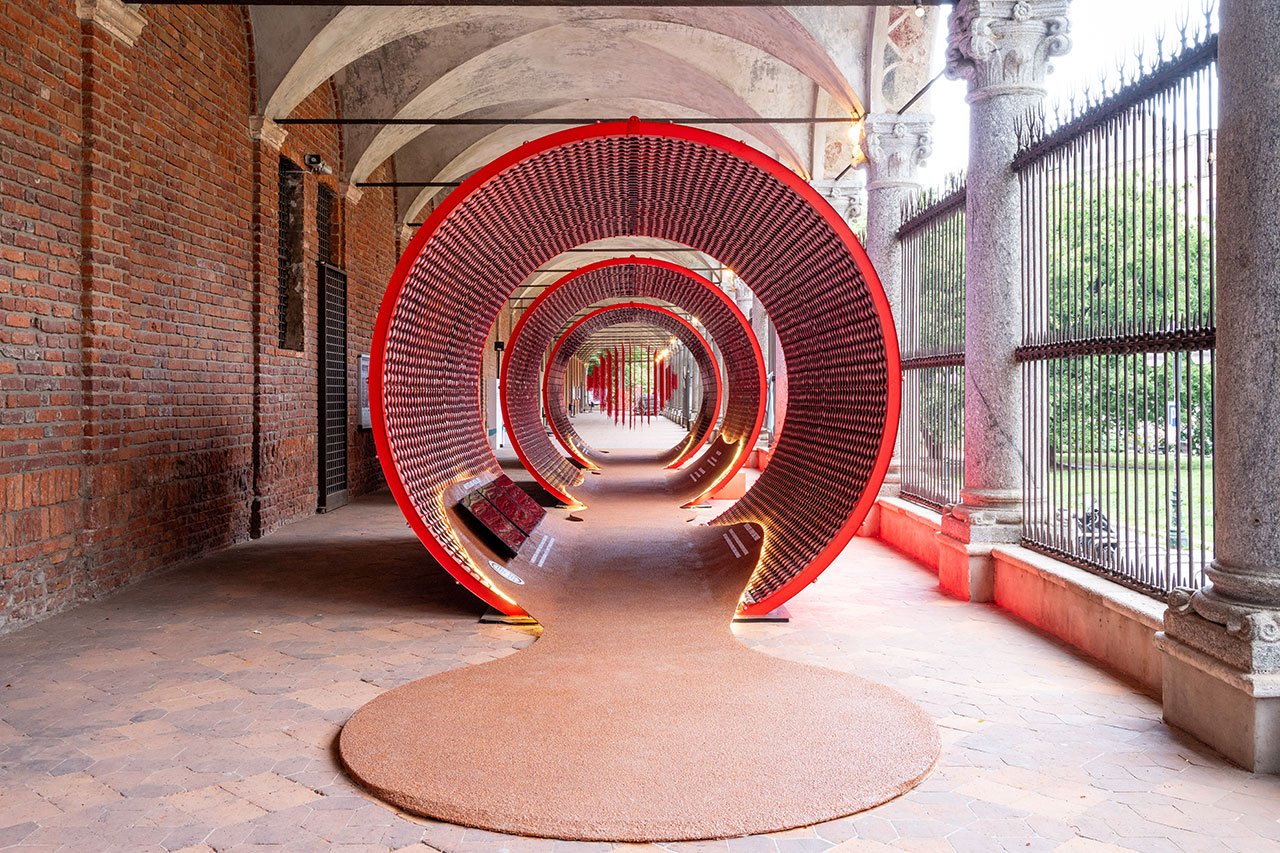
Canned goods, often overlooked in design discourse, hold an undeniable cultural significance, a truth famously highlighted by Andy Warhol decades ago. Ratti and Mutti seized upon this very ubiquity, transforming the basic tomato can from a mere container into the fundamental building block of an architectural exploration. Situated beneath the historic portico of the Università degli Studi di Milano, the ‘House of Polpa’ was constructed from approximately twenty thousand cans of Mutti tomato pulp, meticulously supported by a steel substructure that ensured stability even as cans were gradually removed.
A Journey Through the Senses and Supply Chain
Visitors were invited to traverse a striking 25-meter-long red volume, stepping into an environment where design transcended the purely visual. Inside, a carefully curated symphony of subtle scents, tactile textures, and evocative sounds conspired to create a multi-sensory narrative, artfully referencing the intricate journey of the tomato from field to can. This immersive approach ensured that the experience was not just seen, but felt and understood on a deeper, more visceral level.
Circularity at Its Core: Design Beyond Single-Use
At the heart of the ‘House of Polpa’ lies a profound commitment to circularity and sustainability. Every element of the installation was thoughtfully conceived to underscore cycles of production, use, and reuse. The very flooring beneath visitors’ feet exemplified this ethos, developed using an innovative Mapei resin crafted from dried tomato peels – a clever repurposing of processing waste. This wasn’t mere symbolism; it was a tangible demonstration of how design can actively minimize environmental impact.
Participatory Ephemerality: The Exhibit That Dissolves into Dinner
Perhaps the most compelling aspect of the project was its inherent ephemerality and the invitation for visitor participation. Guests were encouraged to take a can of Mutti Polpa, transforming an act of consumption into an integral part of the exhibit’s dissolution. This ingenious design ensures that the installation’s life extends far beyond Milan, dispersing into countless pasta dinners across the region. Any remaining cans will be thoughtfully donated, reinforcing the project’s dedication to minimizing waste and maximizing utility. The ‘House of Polpa’ brilliantly illustrates how design, by thinking beyond single-use, can guide objects from an exhibition space directly into someone’s kitchen, proving that true innovation can be both impactful and delicious.
For more details, visit our website.
Source: Link