




The AI Gold Rush: Reshaping America’s Heartland
Across the vast expanse of the American heartland, a silent revolution is underway. Tech titans like Meta, Google, xAI, OpenAI, Microsoft, and Amazon are not just innovating in the digital realm; they are physically terraforming the landscape. Farmland and dormant factory shells are rapidly transforming into hyperscale compute factories, colossal structures that rival small cities in their footprint and insatiable demand for electricity.
This unprecedented buildout, however, is being fueled less by readily available cash and more by a historic borrowing binge. Credit markets are flashing signs of unease, with bonds and Credit Default Swap (CDS) spreads widening, prompting analysts to draw parallels with the infamous fiber optic boom of the early 2000s. At the epicenter of this financial web lies OpenAI, whose intricate network of deals with Nvidia, Oracle, AMD, Broadcom, SoftBank, and AWS has been dubbed a “circular” AI economy – a system that, many fear, could buckle under the weight of its weakest link, with power and energized real estate emerging as the ultimate hard constraints.
OpenAI’s Stargate: A Glimpse into the Future
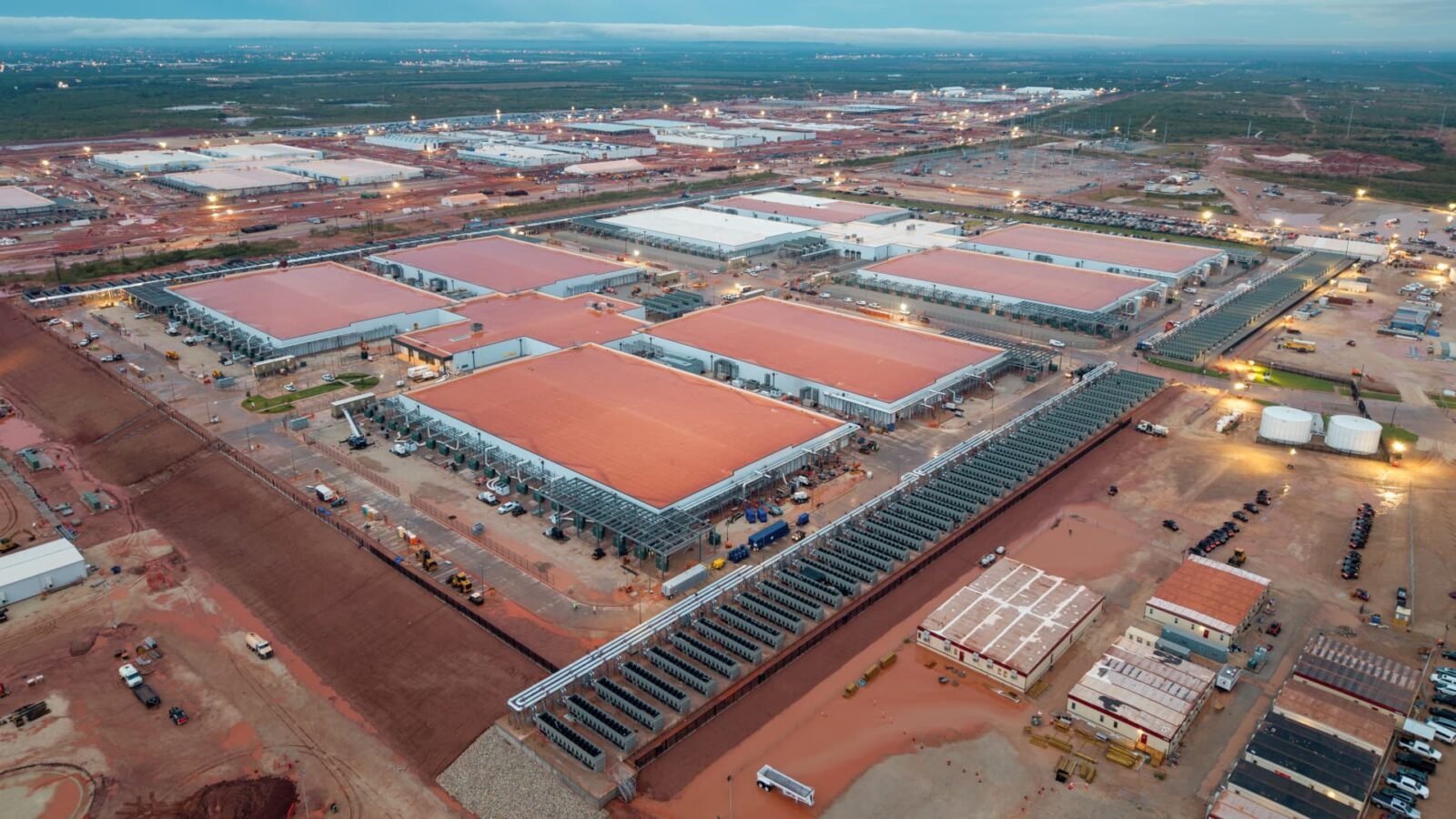
In the iron-tinged, orange-red dust of West Texas, where every breath is a reminder of the arid landscape, OpenAI CEO Sam Altman is orchestrating a project of staggering ambition: Stargate. This rapidly expanding constellation of data centers, backed by powerful partners including Oracle, Nvidia, and SoftBank, is a testament to the sheer scale required for the AI era.
Each morning, six thousand workers’ vehicles converge on the Abilene site, their tires kicking up a constant veil of grit over a construction footprint the size of a small city. This single campus employs more people than OpenAI’s entire global payroll. The environment is unforgiving: roads turn from powder to thick, adhesive mud with a sudden downpour, only to harden again, cracked and chalky, under the relentless sun. Yet, it is these very conditions that paint the sky in spectacular reds and oranges at dusk.
“This is what it takes to deliver AI,” Altman told CNBC from the site. “Unlike previous technological revolutions or previous versions of the internet, there’s so much infrastructure that’s required. And this is a small sample of it.”
A “small sample” indeed. At roughly $50 billion per site, OpenAI’s Stargate projects alone are projected to cost around $850 billion – nearly half of the $2 trillion global AI infrastructure surge now forecast by HSBC. The Abilene campus already boasts one operational data center, with a second nearing completion. OpenAI CFO Sarah Friar revealed that the site could ultimately scale beyond a gigawatt of capacity – enough electricity to power approximately 750,000 homes, a demand equivalent to the combined needs of Seattle and San Francisco.
“The shovels that are going in the ground here today, they’re really about compute that comes online in 2026,” Friar explained, noting the initial push for Nvidia’s new Vera Rubins accelerator chips. “But then it’s about what gets built for ’27, ’28, and ’29. What we see today is a massive compute crunch.” Altman, squinting against the sun, added, “We are growing faster than any business I’ve ever heard of before… And we would be way bigger now if we had way more capacity.” The formula for this expansion is clear: cheap land, willing governments, and a grid that, for now, can be persuaded to bend.
Titans and Their Territories: Beyond Stargate
Altman is far from alone in this monumental endeavor. Other tech giants are carving out their own digital empires across the nation.
Meta’s Hyperion and Google’s Heartland Hub
- In the flatlands of northeast Louisiana, where soybean fields once stretched endlessly, Meta’s Mark Zuckerberg is constructing Hyperion, a four-million-square-foot monument to AI. When complete, it will consume more electricity than the entire city of New Orleans and cover a footprint the size of lower Manhattan.
Across the Mississippi River, in West Memphis, Arkansas, Alphabet’s Google has broken ground on what state officials hail as the largest private capital investment in state history – a multibillion-dollar campus rising from 1,100 acres of scrubland.
Musk’s Colossus and Microsoft’s AI Powerhouse
- Just thirty minutes south, on the Tennessee side of the border, Elon Musk has already begun transforming the industrial wastelands of South Memphis. His supercomputer, Colossus, was built in a mere 122 days inside a shuttered Electrolux factory. Now, he’s constructing Colossus 2, aiming for a million GPUs, and has acquired a third building for further expansion. To power this behemoth, Musk purchased a shuttered Duke Energy power plant across the border in Southaven, Mississippi.
- In southeast Wisconsin, Microsoft is investing over $7 billion in what CEO Satya Nadella describes as “the world’s most powerful” AI data center. This facility is slated to house hundreds of thousands of Nvidia chips when it comes online in early 2026.
Amazon’s Project Rainier
- And in rural Indiana, near Lake Michigan, Amazon has transformed 1,200 acres of farmland into Project Rainier, an $11 billion facility running entirely on custom silicon, built exclusively to train AI models.
The Financial Undercurrents and Looming Constraints
This furious pace of development is underscored by the aforementioned historic borrowing spree. As credit markets signal unease, the question isn’t just about the sheer scale of construction, but the sustainability of its financing. The intricate, almost circular, web of deals that underpins projects like OpenAI’s Stargate – involving a constellation of hardware providers, cloud services, and investors – highlights both the collaborative nature of this new economy and its inherent vulnerabilities. The concern is that this interconnected system is only as strong as its weakest link, with the availability of power and suitable, energized real estate emerging as critical, hard constraints.
The “massive compute crunch” articulated by OpenAI’s leadership is a universal challenge, driving this relentless expansion. The race to secure the physical infrastructure for AI is not merely about technological advancement; it’s a profound economic and geographical reordering of the American landscape, with implications that will resonate for decades to come.
For more details, visit our website.
Source: Link






Comments are closed.