





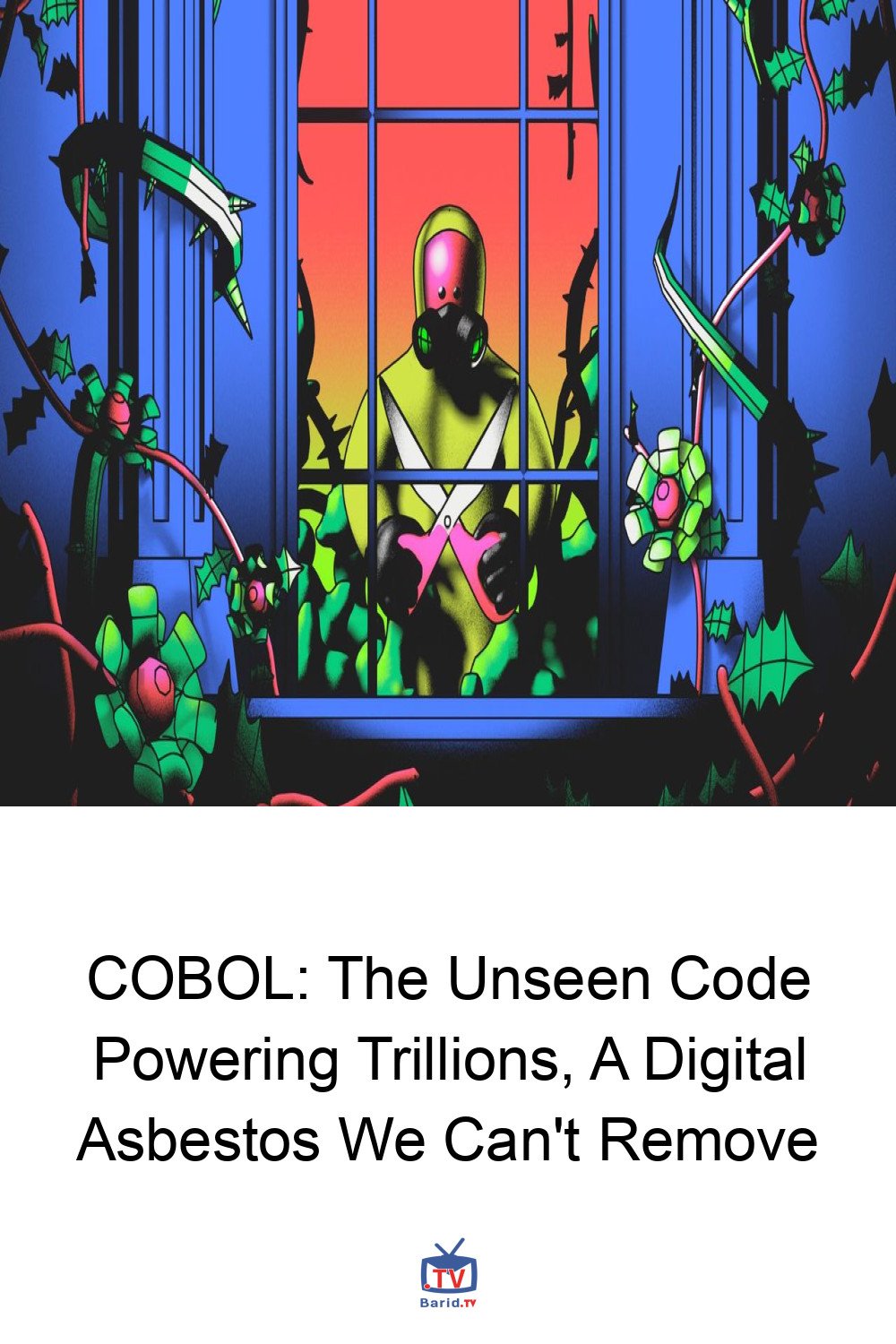
In the early throes of the Covid-19 pandemic, an unexpected admission from New Jersey’s governor sent ripples through the tech world: the state had run out of COBOL developers. Its critical unemployment insurance systems, built on the 60-year-old programming language, buckled under the weight of unprecedented claims. This wasn’t an isolated incident; countless states grappled with the same unwieldy, ancient systems, highlighting a hidden vulnerability in our modern digital infrastructure.
Despite the crisis, COBOL proved resilient. New Jersey’s updated unemployment system, while offering user-friendly improvements, still relied on the venerable language on its backend. This enduring presence leads to a stark realization: COBOL is less a relic of the past and more a form of “digital asbestos” – once ubiquitous, now incredibly difficult, and dangerously expensive, to remove.
The Invisible Giant: Powering Trillions, Costing Billions
COBOL, an acronym for Common Business-Oriented Language, holds the distinction of being the most widely adopted computer language in history. By the turn of the millennium, an astonishing 80 percent of the 300 billion lines of code ever written were in COBOL. Today, it remains the backbone of countless government systems, from motor vehicle records to the very unemployment insurance platforms that faltered during the pandemic. More impressively, it facilitates an estimated 3 trillion dollars’ worth of financial transactions daily.
Yet, this immense scale comes at a cost. Rough calculations suggest that COBOL’s inherent inefficiencies drained the US GDP of $105 billion in 2020 alone. Its pervasive nature and the sheer volume of critical operations it supports make its replacement a monumental, often prohibitive, undertaking.
Born of Necessity: The Dawn of COBOL
The genesis of COBOL dates back to 1959, born from a committee of US computer industry titans, including the visionary Grace Hopper. Their mission was clear: to establish “specifications for a common business language for automatic digital computers.” The burgeoning expense of custom-written programs for disparate machines demanded a universal solution. The Department of Defense, recognizing the strategic value of such standardization, eagerly championed the project.
A Language for Everyone?
COBOL’s design was revolutionary for its time. It aimed for readability, intended to be written in plain English, making it accessible even to non-programmers. Unlike other languages, it allowed for hundreds of common words like “is,” “then,” and “to,” a stark contrast to Java’s mere 68. Some even speculated it was designed to democratize programming, potentially replacing the highly specialized programmers of the 1960s. Its designers also envisioned self-documenting code, streamlining maintenance and saving development time.
The Promise and Peril of Spaghetti Code
The dream of universal readability, however, often clashed with the realities of complex programming. While individual lines of COBOL could be easily understood, this clarity dissolved in programs spanning thousands of lines. The analogy of an IKEA manual holds true: each step is simple, but the overall assembly can be baffling.
A particularly reviled feature of COBOL was the “GO TO” statement – an unconditional branching mechanism that allowed programs to jump erratically from one section to another. This often led to what developers famously dubbed “spaghetti code,” a tangled mess that rendered any notion of self-documentation moot.
A Battle of Minds: Critics vs. Defenders
From its inception, COBOL faced staunch opposition from many computer scientists. Edsger Dijkstra, a towering figure in computer science, famously declared, “The use of COBOL cripples the mind; its teaching should, therefore, be regarded as a criminal offense.” His disdain extended to the “GO TO” statement, which he argued made programs incomprehensible. Critics often dismissed COBOL as a utilitarian language, relegated to “boring” business problems.
Yet, its defenders offered a different perspective. Jean Sammet, one of its original designers, contended that COBOL simply had the unenviable task of representing complex real-world entities, like social security systems. Others argued that “good COBOL” was indeed self-documenting, but its quality hinged entirely on the programmer. Fred Gruenberger of the Rand Corporation summarized this dichotomy: “COBOL, in the hands of a master, is a beautiful tool—a very powerful tool. COBOL, as it’s going to be handled by a low-grade clerk somewhere, will be a miserable mess.”
Why the Legacy Endures
Despite its critics and inherent challenges, COBOL’s widespread adoption was unstoppable. The Department of Defense played a crucial role, mandating COBOL compilers in most of the machines it procured. No computer manufacturer during the Cold War era dared to forgo lucrative federal contracts. Ultimately, COBOL achieved two of its most critical objectives: it was truly machine-independent and could proliferate rapidly, laying the foundation for the digital world we inhabit today.
The “digital asbestos” persists not just due to inertia, but because it works, handling the immense transactional load of our global economy. Modernizing these systems remains one of the most significant, and costly, challenges in contemporary IT, a testament to COBOL’s paradoxical and enduring legacy.
For more details, visit our website.
Source: Link








Leave a comment