




Crafting the Anthropocene: Sumer Singh’s Neo-Scagliola Reimagines Design
In the intricate dance of creation, much like a spider meticulously weaving its web, humanity has spun a complex network of its own. This era, often termed the “Anthropocene,” is characterized by our profound and often indelible impact on Earth’s systems. From plastics to pigments, the materials we produce now form a permanent stratum within the environment, blurring the lines between human innovation and natural processes. These enduring fragments of our technological age, dubbed “techno-relics,” are the very essence that Sumer Singh of MTHARU explores in his compelling new works,
Plote and Prov.
Reimagining Waste: A Dialogue Between Past and Future
Singh’s collection emerges from a critical contemporary dialogue among architects and designers: how can fabrication, computation, and material experimentation address the environmental imperatives of our time? His answer lies in a radical reinterpretation of a centuries-old craft: Scagliola.
The Renaissance Roots of Scagliola
Originating in Renaissance Italy, Scagliola, derived from the Italian word “scaglia” (meaning “chips”), was a masterful technique designed to mimic luxurious marble inlay. Artisans achieved convincing stone-like surfaces for columns, sculptures, and architectural elements by blending plaster of Paris, glue, and pigments, bypassing the arduous labor of quarrying and carving natural marble.
Neo-Scagliola: A Modern Alchemy
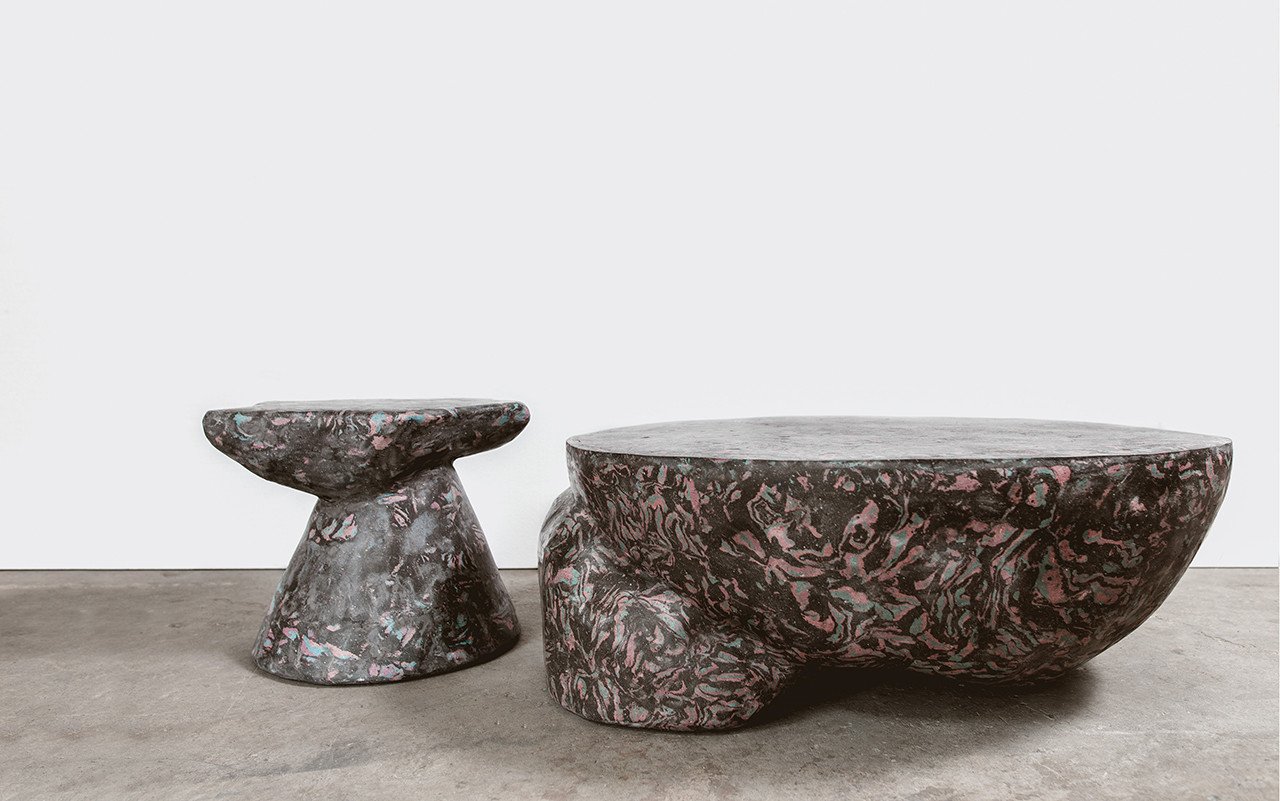
Sumer Singh elevates this historical craft into what he terms “Neo-Scagliola.” His innovative approach replaces traditional plaster and animal glue with a contemporary concoction of cement, basalt fibers, and, crucially, leftover latex paint salvaged from construction sites. This ingenious substitution transforms discarded materials into integral components of the design, embedding fragments of modern building culture directly into the very fabric of the work. The resulting surfaces are a testament to their origins, revealing subtle layers of pigment, flecks of color, and suspended fragments that evoke geological compositions and the passage of time.
Plote and Prov: Sculptural Narratives of Materiality
The Plote Side Table exemplifies this transformative process through its form. A graceful conical base ascends, culminating in a hexagonal plane whose geometry appears gently sculpted by unseen forces. Beneath its satin-polished surface, a myriad of tiny chromatic flecks whisper tales of reclaimed pigments and paints, hinting at the hidden material histories encapsulated within.
In contrast, the Prov Coffee Table adopts a posture of quiet contemplation. A perfectly formed half-sphere seamlessly intersects with the structural clarity of a cylinder, forging a profile that is both grounded and profoundly sculptural. Its meticulously polished surface unveils subtle striations and a rich tonal depth, creating the impression of a geological cross-section – a compressed chronicle of time within a singular object.
Beyond Furniture: A Blueprint for Sustainable Futures
Collectively, Plote and Prov
transcend their function as mere furniture; they are profound material experiments. They showcase a compelling synergy between historical craft and cutting-edge fabrication methods, including digitally milled molds and CNC techniques that enable the precise realization of complex forms. Ultimately, Singh’s work poses a pivotal question for our age: what if designers viewed waste not as an endpoint, but as a fertile raw material for future creation?
As the fields of architecture and design increasingly confront the imperative of sustainability, the most impactful solutions may well emerge from those visionary creators willing to revisit forgotten techniques and seamlessly integrate them with the advancements of modern technology. Sumer Singh’s
Plote and Prov offer a compelling glimpse into this sustainable future.
To delve deeper into Plote and Prov by Sumer Singh of MTHARU, visit mtharu.com. Photography courtesy of Sumer Singh.
For more details, visit our website.
Source: Link





Leave a comment