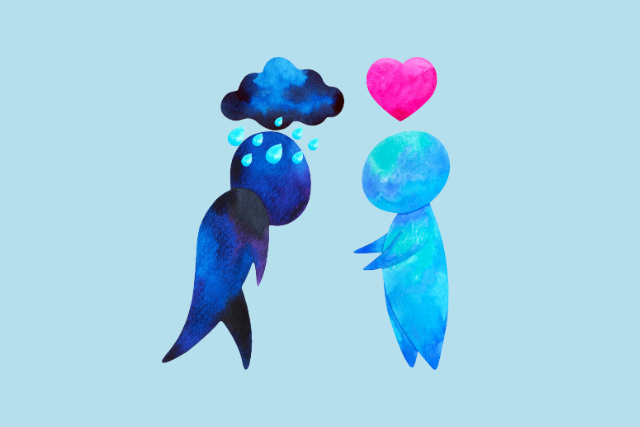

In a world often brimming with intense emotions, it’s easy to find ourselves swept away by the feelings of others. The wisdom of Sarah Crosby reminds us, “It is not your responsibility to figure out what someone else is feeling and why. Let go of the illusion that ‘fixing’ their bad mood will make you feel better.” This profound insight forms the cornerstone of understanding how to navigate the emotional landscapes of those around us without losing our own footing.
When Others’ Emotions Become Your Own Storm
Some years ago, a phone call with my husband became a vivid illustration of this challenge. He expressed annoyance about a work matter, and instantly, my own body reacted with an intense, visceral response. My heart constricted, my stomach lurched, and a runaway train of nausea and discomfort washed over me. It was a familiar, unwelcome pattern: his feelings, however valid, would trigger an overwhelming cascade of my own.
This wasn’t an isolated incident. Our conversations would often spiral into a reactive loop: his annoyance met with my fear, escalating into a messy tangle of shared, yet distinct, emotions. What felt worse than the immediate discomfort was the aftermath – a descent into despair, a frantic search for solutions, or a simmering resentment over his reactions. This pattern extended beyond my husband, touching most relationships in my life, manifesting as an instinctive urge to fix, reassure, or soothe whenever someone appeared upset, often at the expense of my own needs and feelings.
The Unbearable Weight of Others’ Feelings
At times, it felt as though loved ones were intentionally weaponizing their emotions. A family member’s anger would overwhelm me, leading to days or weeks of resentment, as if I were being punished. Witnessing my children’s disappointment or sadness was unbearable; I’d rush to intervene, changing plans, offering treats, or attempting to talk them out of their feelings, anything to alleviate their discomfort – and, by extension, my own.
The fundamental truth is that as human beings, we are constantly encountering others’ emotions. The challenge arises when we find these feelings “challenging” ourselves. In essence, we’re often implicitly saying, “Your feelings are making me uncomfortable; please suppress them because I don’t like them.” This reaction is deeply rooted in our own discomfort with emotions. If we struggle to sit with our own feelings, it becomes exponentially harder to tolerate those of others.
Reclaiming Your Emotional Space: A Journalist’s Journey
How then, do we learn to untangle ourselves from the emotional currents of others? How do we cease having such intense reactions, regardless of the emotion’s origin? How can we prevent others’ emotional responses from derailing our day, consuming our energy, and activating our own deeply uncomfortable feelings?
Step One: Identifying Separate Emotional Realities
For me, the pivotal first step was recognizing the distinct nature of feelings. I had long perceived others’ emotions as happening to me. The crucial shift was understanding: they are having feelings, and I am having feelings. My feelings are separate from yours. Much of the entanglement and messiness in relationships stems from failing to acknowledge this fundamental separation. We often operate under the misconception that one person’s emotion directly causes another’s:
- “Stop being scared! It’s making me scared!”
- “Stop being irritable! It’s making me anxious!”
In reality, no one makes us feel a certain way. Our emotions, like theirs, arise independently. By recognizing, “Oh, I am having my own feelings here!” we create vital space. This awareness allows us to shift our focus inward, attending to our own emotional landscape rather than being consumed by theirs.
Step Two: Understanding Intent – No One Acts on Purpose
Years into my journey of coaching and transforming my own emotional responses, I asked my husband what he valued most about my personal growth. His answer was striking: “I no longer feel tortured by your feelings.” This revelation was profound. I had been so consumed by my own overwhelm from his emotions that it never occurred to me he might experience a similar discomfort with mine. Our emotional reactions differ significantly, yet the underlying struggle to navigate another’s intensity was a shared, unspoken burden.
This understanding underscores another critical point: people are not having feelings
on purpose to upset you. Their emotions are their own internal experiences, often arising from their unique circumstances, beliefs, and past. Recognizing this helps dismantle the perception of emotional attacks and fosters a more compassionate, less reactive stance.
By cultivating these two insights – the separation of feelings and the absence of malicious intent – we begin to build robust emotional boundaries. We learn to witness others’ emotions with empathy, without absorbing them, allowing us to remain grounded, present, and true to our own emotional well-being.
For more details, visit our website.
Source: Link