




Beyond PWM: Mastering Smart Servos with the Oxocard Connect
In the dynamic world of robotics, R/C modeling, and industrial automation, servomotors are the unsung heroes, executing precise rotary movements with unwavering reliability. For years, Pulse-Width Modulation (PWM) has been the go-to control method, a reliable workhorse for many applications. However, as projects grow in complexity and demand for sophistication rises, PWM’s limitations become increasingly apparent. Enter the era of serial servos – often dubbed ‘smart servos’ – a game-changer offering unparalleled control, feedback, and versatility. This article, inspired by Make: Vol. 96, delves into the transformative power of smart servos and demonstrates how to harness their capabilities with the intuitive Oxocard Connect microcontroller.
The Evolution of Servo Control: Smart vs. PWM
Traditional PWM hobby servos are straightforward: they receive a target angle signal and move to that position. Simple, effective, but crucially, a one-way street. There’s no feedback, no confirmation of whether the desired angle was truly achieved, and no insight into the servo’s operational status. This lack of bidirectional communication can be a significant hurdle in advanced applications where precision and diagnostic information are paramount.
Unlocking Intelligence: What Makes a Servo ‘Smart’?
Smart servos are a breed apart. Equipped with their own integrated microcontroller, they communicate via digital packets using serial protocols like UART and RS-485. This digital dialogue opens up a world of possibilities:
- Bidirectional Communication: Unlike their PWM counterparts, smart servos can both receive commands and transmit telemetry data back to the control system.
- Extended Control & Continuous Rotation: They offer larger angle ranges and the ability to operate continuously, making them suitable for a wider array of tasks.
- Integrated Sensors: A position encoder (magnetic, optical, or potentiometer) allows the servo to report its exact angle. Beyond position, they can provide critical data such as input current, temperature, and holding torque.
The Game-Changing Advantages of Smart Servos
The bidirectional communication and integrated intelligence of smart servos translate into significant benefits for engineers and hobbyists alike.
Precision and Feedback Redefined
Imagine a robot arm that not only moves to a commanded position but also confirms its arrival, reports its current load, and even its internal temperature. This is the reality with smart servos. Their ability to directly query the current position means they can function as highly accurate angle measuring devices, independent of a control loop. This is invaluable for:
- Intuitive ‘Teaching’ of Movements: In robotics, a robot arm can be manually guided through a sequence of motions, with the control system recording and storing the precise angles of each servo at every step. This allows for incredibly intuitive programming of complex movement sequences.
- Advanced Diagnostics and Malfunction Detection: The holding torque data, for instance, provides a real-time indication of the servo’s load. An unexpected spike or blockage can signal a malfunction, a principle effectively used in 3D printers for end-stop detection on linear guides.
Simplified Connectivity: The Power of Bus Systems
One of the most compelling features of serial servos is their ability to connect via a common bus system. This means a single microcontroller can theoretically manage up to 253 servos using just two pins – a stark contrast to the pin-intensive nature of PWM control, where each servo typically requires its own dedicated pin.
Introducing the Oxocard Connect and Feetech SCS0009
While serial servo control was once considered technically challenging, the landscape has changed dramatically. Modern microcontrollers and simplified libraries have made integration easier than ever. With the Oxocard Connect, getting started is straightforward.
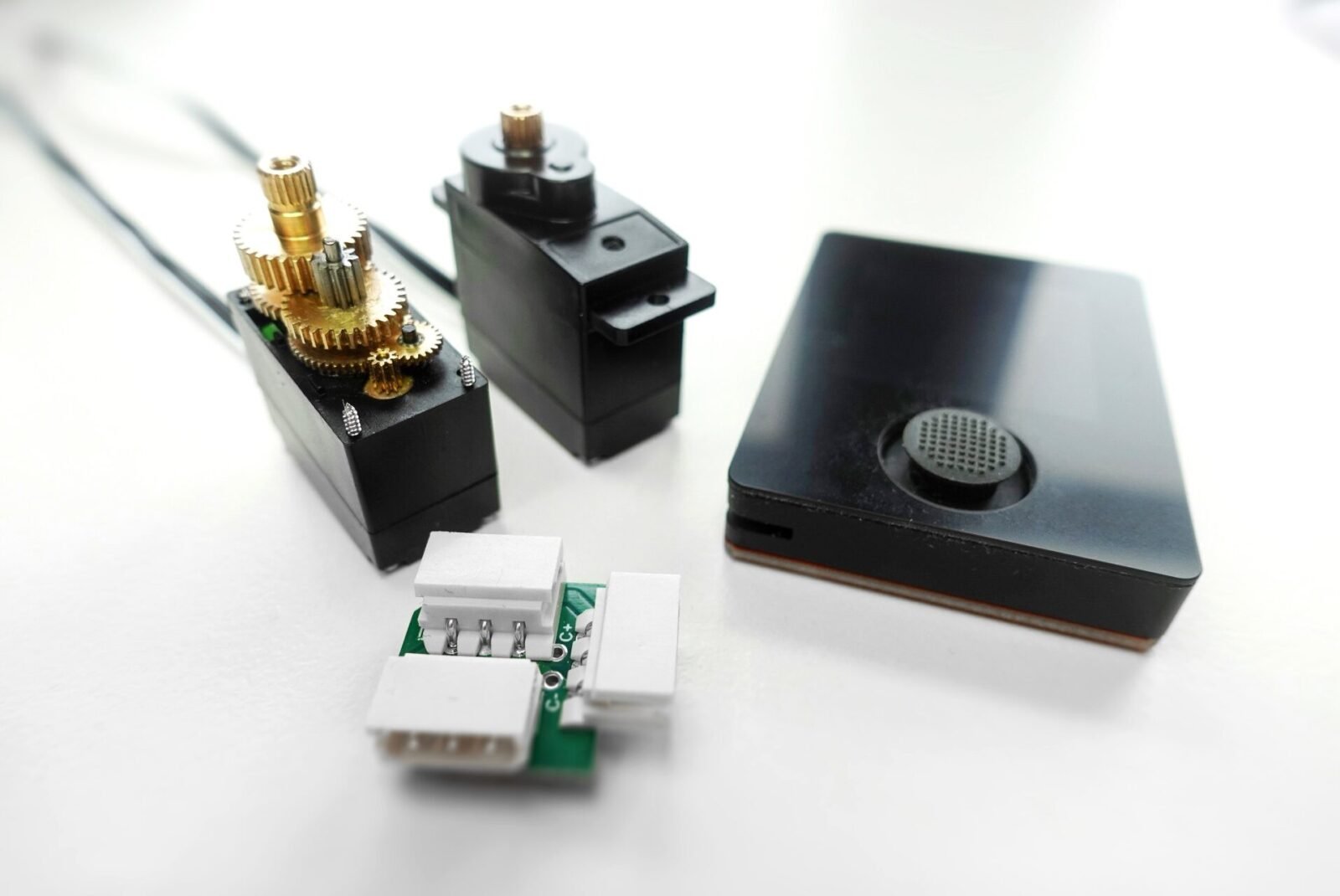
For this exploration, we recommend the Feetech SCS0009. This compact and affordable model, priced at just $9, is ideal for hobby projects. It boasts a holding torque of 2.3kg and an impressive adjustable rotation range of up to 300 degrees – significantly more than many classic analog servos. Beyond its robust mechanics, the SCS0009 offers all the integrated sensor functions and extensive configuration options, including continuous rotation, that define a smart servo.
Your Roadmap to Smart Servo Mastery
Ready to dive in? Just a few lines of code are all it takes to begin your journey with smart servos. This project, designed for easy implementation with the Oxocard Connect, will guide you through the essential steps:
- Set up the Hardware
Set up the Software
- Explore the Extended Range of Motion
- Measure Angles
- Use the Servo as a Motor
Discover how these intelligent components can elevate your next robotics or automation project, bringing unprecedented levels of control and feedback to your creations.
For more details, visit our website.
Source: Link







Leave a comment