



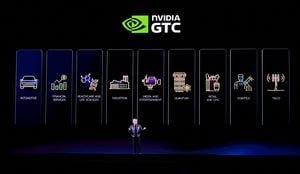

Before Jensen Huang even graced the stage in his signature leather jacket at this year’s GTC, Nvidia ($NVDA) had already begun weaving a powerful narrative. The pre-show atmosphere, complete with a custom-built soundtrack hinting at legends and futures arriving precisely on schedule, felt less like a tech conference and more like a coronation. Phones were raised throughout the arena, capturing Huang’s entrance as if Silicon Valley had booked its own rockstar. For one afternoon, the San Jose Sharks’ home rink transformed into the epicenter of a different kind of power play, as Huang masterfully turned a product keynote into a visionary zoning hearing for the future of artificial intelligence.
Nvidia’s Ambitious Blueprint for the AI Economy
Huang didn’t just promise a tour through “every single layer” of AI; he delivered a compelling argument that Nvidia isn’t merely a vendor in a booming market. Instead, the company is meticulously crafting the very physical plant of the AI economy itself. This encompasses everything from compute power, networking, and storage to software, models, and the factories that produce them. In a move that left little to the imagination, Huang even hinted at the (still theoretical) data centers that might one day orbit in space, underscoring Nvidia’s boundless ambition.
The Four Pillars of AI’s Next Wave
While announcements flew in every direction, Huang’s core message resonated with clarity, aimed squarely at investors, customers, and competitors alike. He emphasized four critical insights:
- Unrelenting Demand:
AI demand continues to surge at a pace that justifies unprecedented levels of investment.
- Inference Takes Center Stage:
The focus has decisively shifted from AI training to inference – the practical application of AI models – which is now the core battleground.
- The Rise of AI Agents: Chatbots are just the beginning; intelligent agents are poised to permeate the daily machinery of office work and beyond.
- Physical AI: The Next Frontier:
Beyond digital AI, the next gold rush lies in physical AI, where robots, autonomous systems, and industrial software will consume even more data and infrastructure.
Indeed, as the adage goes, you can’t spell Nvidia without AI.
The Unshakeable Foundation: CUDA and Software Dominance
Huang strategically opened his address by reinforcing Nvidia’s long-standing competitive advantage: software. He proudly highlighted CUDA’s two-decade legacy as the flywheel behind accelerated computing, reminding the audience that Nvidia’s installed base is ubiquitous, residing “in every cloud” and “every computer company.” This emphasis underscored that Nvidia’s most formidable shield remains its robust software ecosystem, which intricately wraps around its silicon, making its green rectangles far more powerful than standalone chips.
This software-centric logic permeated the entire speech. Huang delved into structured data, labeling it the “ground truth” of enterprise computing. He posited that AI can finally unlock the immense value hidden within oceans of unstructured information – PDFs, videos, speech, and all the “corporate attic junk” companies have hoarded for years without effective means of search or monetization. The message was clear: Nvidia is now staking a claim in the database realm, too.
From Chips to Control: Building the AI Factory
GTC 2024 was not merely about unveiling a faster, better chip. This year’s keynote articulated Nvidia’s audacious bid to own the very economics of AI work itself. This grand vision encompasses the chips, storage, networking, orchestration layer, digital twins, open-model politics, agent runtimes, and even whatever comes after traditional data centers once Earth’s digital real estate feels constrained. The event, effectively an inference keynote, an agent keynote, and an AI-factory keynote rolled into one, used hardware as compelling proof of concept rather than the sole plot point.
A Trillion-Dollar Horizon: Defying Skepticism
Perhaps Huang’s most impactful declaration was numerical. Celebrating CUDA’s 20th anniversary, he asserted that computing demand has skyrocketed “1 million times over the last few years.” He then dramatically raised the financial stakes, projecting at least $1 trillion in revenue opportunity from 2025 through 2027, a significant leap from the previous $500 billion forecast for Blackwell and Rubin demand through 2026. Nvidia shares saw a modest 1.6% rise on Monday, signaling market approval, if not immediate full conversion.
This staggering figure, and Huang’s strategic framing of it, served as the keynote’s organizing principle. Nvidia aimed to convey, loudly and publicly, that the AI buildout is still in its nascent stages, continuously expanding, and vast enough to make current spending appear like a mere down payment. This projection also subtly addressed persistent market questions that plague any company at the forefront of a capital-spending boom: How long can this momentum last? What happens when hyperscalers prioritize cost-cutting? How much of the next phase will be siphoned off by custom chips and cheaper alternatives?
The Inference Inflection Point
Huang’s answer to these queries was to broaden the perspective, painting a picture of an ever-larger market with increasingly complex workloads. He declared that “the inference inflection has arrived,” building the core of his keynote around a simple yet profound argument: AI has matured to a point where it can now perform productive work. And once AI becomes a utility for productive work, the demand landscape fundamentally transforms, ensuring sustained, exponential growth for the architects of this new industrial revolution.
For more details, visit our website.
Source: Link







Leave a comment