




The Holy Grail of High-Energy Plasma Toys: A DIY Reality
For enthusiasts of high-energy physics and hands-on engineering, the concept of a stable, glowing plasma toroid has long been a captivating, almost mythical pursuit. Now, thanks to an innovative open-source design featured in Make: Magazine, this mesmerizing phenomenon is within reach for the dedicated DIYer. Prepare to conjure your own shimmering halo of stable plasma, a true marvel of modern maker culture.
This ambitious project, requiring 5–10 hours and an estimated $500 investment, is rated as ‘Hard’ – a testament to the intricate blend of high-voltage, high-frequency electronics and precise magnetic induction at its core. But for those up to the challenge, the reward is a breathtaking display of physics in action.
The Mesmerizing Dance of Plasma: What is a Toroid?
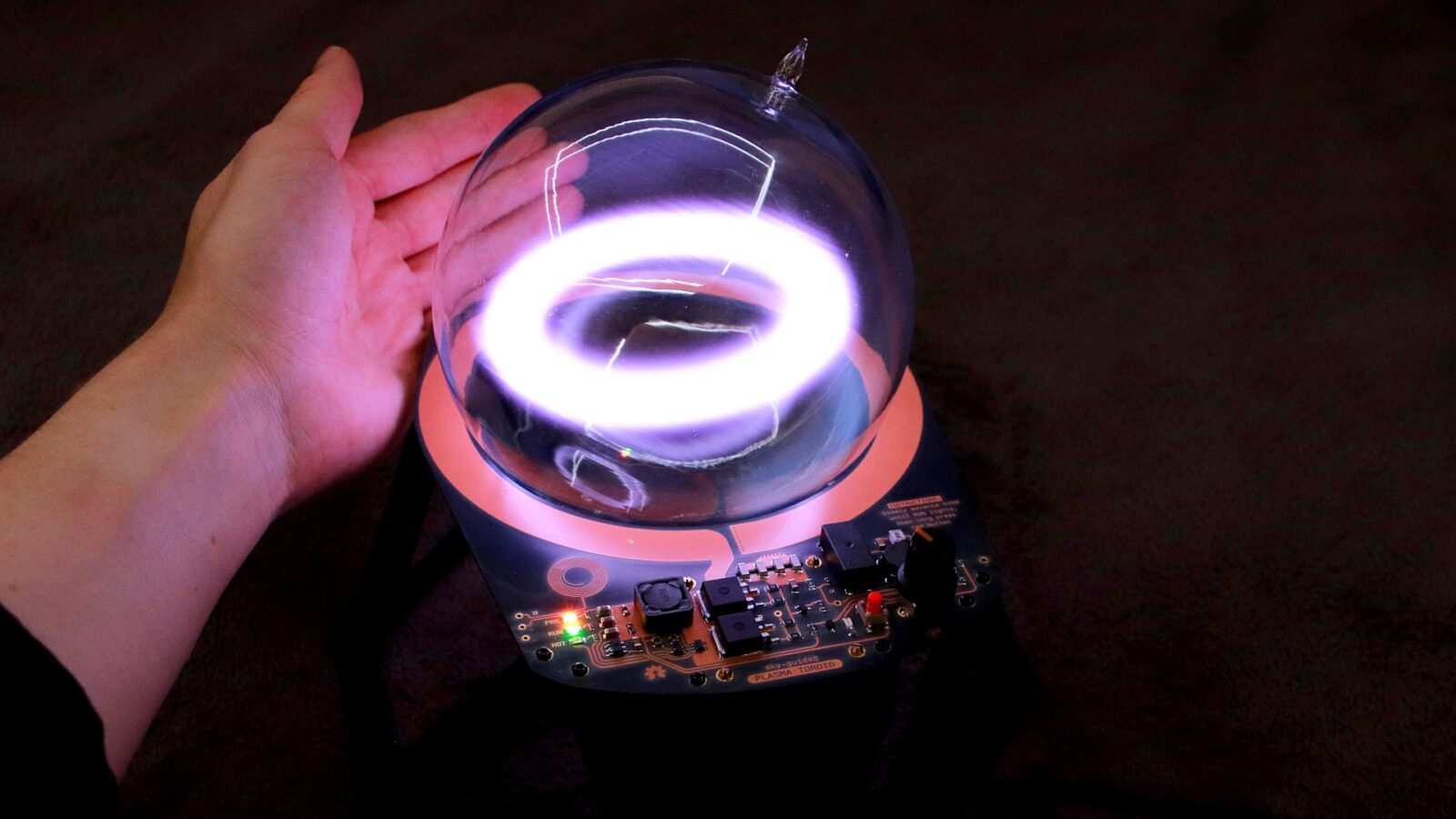
Imagine a sealed glass vessel, evacuated to a near-vacuum and filled with xenon gas. Now, introduce a precisely tailored magnetic induction driver, and watch as a luminous, toroidal (doughnut-shaped) ring of plasma materializes, drifting and undulating within the low-pressure environment. This is the inductively coupled plasma toroid, a phenomenon often dubbed ‘blazing bagels’ for its captivating appearance.
Unlike a traditional Tesla coil, which operates at extremely high voltages, this generator employs lower voltages (600–1,000 volts) but at significantly higher frequencies—around 10–15 megahertz (MHz). The design prioritizes reproducibility and manufacturability, leveraging modern surface-mount components and integrating much of the functionality directly into the printed circuit board (PCB) itself.
The Ingenious Induction Coil: Etched into the PCB
At the heart of the toroid effect is an intense, rapidly oscillating magnetic field. Rather than conventional wound wires, this generator’s two-turn induction coil is ingeniously etched directly into the front and back copper layers of the PCB, encircling the globe’s circumference. This coil is then energized by a high-voltage alternating current at approximately 12MHz.
The Science Behind the Spectacle: How it Works
The magic unfolds through fundamental principles of electromagnetism:
Faraday’s Law in Action: Driving the Plasma
As electrical current surges through the PCB coil, it generates a magnetic field at its center. Because the coil is driven by AC, this field’s orientation flips back and forth an astonishing 12 million times per second. According to Faraday’s law of induction, a changing magnetic field exerts forces on charged particles. In this setup, instead of inducing current in a metal loop (like in a transformer), the rapidly changing magnetic field acts upon the mobile electrons within the low-pressure xenon gas inside the globe.
This force ionizes the xenon, creating a conductive loop of plasma. The driving magnetic coil continuously pumps energy into this plasma loop, allowing it to remain ionized and stable, glowing brightly as it gently drifts and undulates within the convection currents of the gas. The result is a truly mesmerizing and beautiful display.
Engineering the Glow: Understanding the Electronics
Producing and sustaining this plasma toroid demands sophisticated high-voltage, high-frequency electronics.
The High Voltage/High Frequency Oscillator: The Heartbeat
The primary drive coil serves a dual purpose: it generates the magnetic fields for the plasma toroid and acts as a crucial inductor within a self-oscillating resonant high-frequency/high-voltage generator. Energy continually sloshes back and forth between the inductor (the coil) and an array of ceramic chip capacitors. This dynamic is perfectly analogous to a mass bouncing on a spring, where energy oscillates between kinetic and potential forms.
The Resonant Tank Circuit: Amplifying the Power
This series arrangement of the primary inductor and capacitors forms what’s known as a resonant tank circuit. Like any harmonic oscillator, feeding this circuit at its precise natural resonant frequency steadily builds up the total energy within the system. This amplification is exactly what’s needed to generate the high voltages required to initiate and sustain the plasma toroid.
Precision Switching: The MOSFET Driver
The resonant tank is fed by rapidly switching a MOSFET (Metal-Oxide-Semiconductor Field-Effect Transistor) on and off. When the MOSFET switches off, current from a feeder inductor is redirected into the resonant tank, providing the necessary energy boost. An analog feedback network, comprising capacitors Cp and Cg, forms a capacitive voltage divider. This divider converts the tank’s high-voltage AC oscillations into a lower-voltage AC signal, which, combined with a DC bias, precisely drives the MOSFET’s control pin, turning it on for half of each cycle.
While the simplified explanation covers the core, the actual circuit is more robust, incorporating four parallel capacitors and two MOSFETs to handle real-world power levels, along with small gate resistors for optimal switching performance.
A DIY Dream for the Modern Maker
This Plasma Toroid Generator project from Make: Vol. 96 represents a significant leap in accessible high-energy physics demonstrations. Its fully open-source nature and ‘design for manufacturability’ approach, utilizing modern components and PCB integration, make it a truly remarkable and reproducible endeavor for anyone passionate about science, electronics, and the sheer wonder of plasma.
For more details, visit our website.
Source: Link








Leave a comment