




“Trauma is not what happens to you, but what happens inside you as a result of what happens to you.” ~Dr. Gabor Maté
In a world increasingly grappling with mental health, we often associate trauma with fear-inducing events. Yet, some of our deepest wounds stem not from terror, but from profound betrayal—a violation of our core moral compass by those we believed would safeguard us. This isn’t merely the pain of a bad experience; it’s the lasting psychological and relational aftermath of a moral line being crossed, leaving an indelible mark that reverberates through a lifetime. This is the essence of moral injury, a concept many carry without a name, particularly those whose earliest experiences taught them that truth does not always lead to protection.
When Trust Crumbles: A Childhood Betrayal
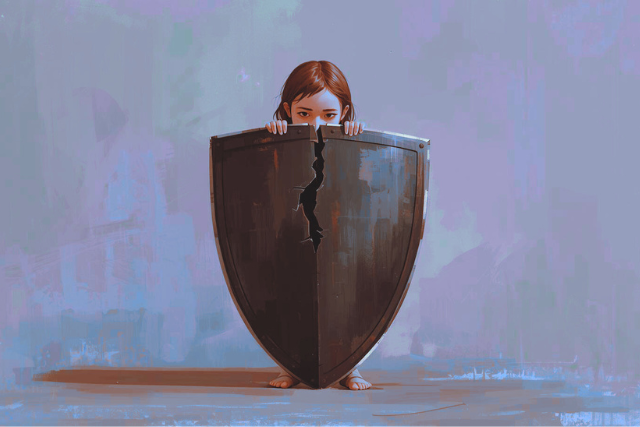
For one individual, this understanding began in childhood, long before the language of moral injury existed. Picture a child in a classroom, physically present but mentally miles away, overwhelmed by unspoken burdens. A teacher, noticing the child’s distress, offered a lifeline: a promise of safety if the truth was revealed. This promise, however, was complicated by the very authority figure who made it – a teacher known to use a paddle on other students. Yet, in that moment, she represented the last bastion of adult trust.
Believing in her power to intervene, the child confided in her, detailing the beatings, the fear of home, the abuse from a stepmother and stepsister. The teacher vowed to make it stop. But it didn’t. Child Protective Services arrived, found no one home, and left. The consequence for the child? More trouble. The deepest wound wasn’t just the abuse; it was the subsequent abandonment, the shattering of a promise by an adult and a system meant to protect. What festered inside wasn’t panic, but a quieter, more insidious pain: shame instead of fear, guilt instead of anger, and the chilling conviction that speaking up was dangerous.
Understanding Moral Injury: Beyond Fear
Moral injury manifests when an individual witnesses, participates in, or is betrayed by actions that fundamentally violate their deeply held moral beliefs. It can stem from what someone does, what they fail to do, or, critically, from the betrayal of power—when those in authority fail to uphold their responsibilities. In this narrative, the transgression wasn’t solely the abuse; it was the systemic failure, the broken promise, and the subsequent abandonment that cemented the moral injury.
The Unseen Blueprint: How Past Betrayal Shapes Adulthood
The echoes of such profound betrayal often dictate the trajectory of adult life. For the author, this manifested as a powerful gravitation towards helping professions—teacher, then school counselor. This wasn’t accidental; it was an unconscious quest to prove that goodness could prevail, that harm, once named, would be met with protection. She became a fierce advocate, reporting abuse, documenting cases, and navigating complex systems, often fighting alone while others retreated from the difficulty.
For years, there was a belief that sheer persistence could redeem the system. Yet, reality proved a harsh teacher. Despite doing everything ‘right,’ the system continued to fail, children remained harmed, and truth was acknowledged but often neutralized. Letting go of the naive belief in automatic justice brought an unexpected grief, a profound disillusionment with the very structures she sought to uphold.
When Helping Becomes Reenactment: Breaking the Cycle
The journey of self-discovery eventually led to a more challenging truth: much of this relentless drive to protect others wasn’t purely altruism. It was, in part, a trauma reenactment. Each vulnerable child encountered became a reflection of the unprotected little girl within, activating an urgent, unconscious plea: “This time, it will be different.”
The deeper realization was that this fight was, in essence, a desperate attempt to validate her own worth, a truth that had become contingent on external acknowledgment. Unconsciously, she believed that by protecting another child, she could, in turn, affirm the value of the little girl who was once left unprotected. This wasn’t a conscious strategy but a nervous system’s attempt to complete an unfinished narrative, to repair a moment where care was absent and power failed to protect.
The challenge wasn’t a lack of compassion, but one of scope. It was an individual’s valiant, yet ultimately unsustainable, effort to mend systemic failures through personal sacrifice, taking on a burden of responsibility that no single person could bear. Recognizing this distinction is the first step towards true healing, allowing for the separation of personal worth from systemic shortcomings, and paving the way for a more sustainable, authentic path forward.
For more details, visit our website.
Source: Link







Leave a comment