



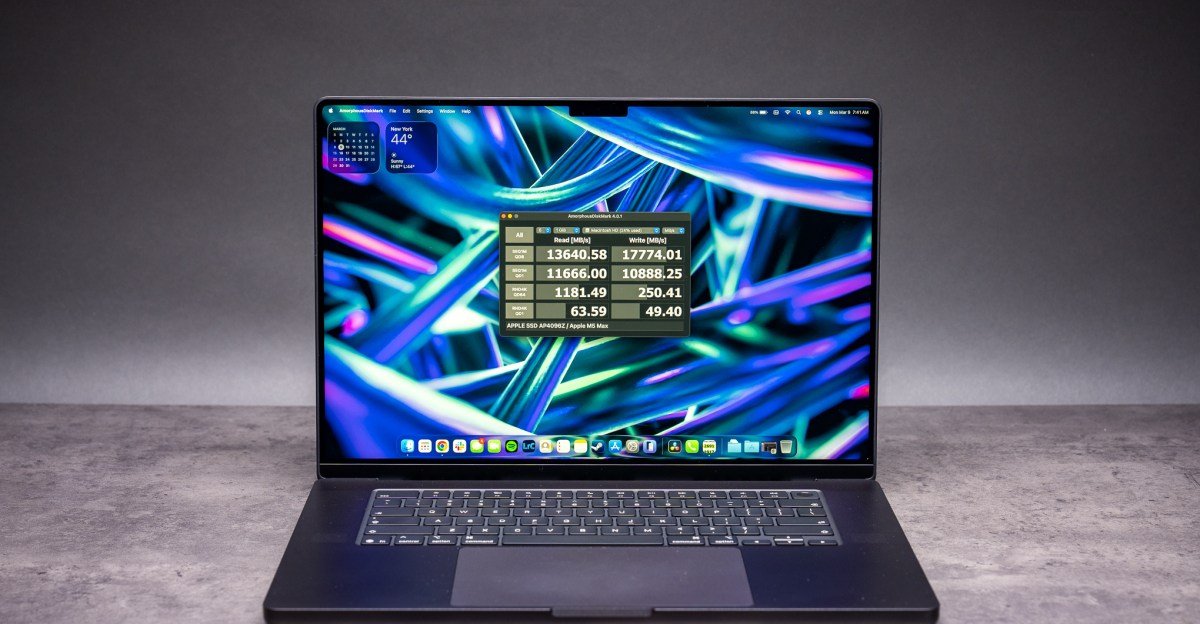


Apple’s latest high-end silicon, the M5 Max, has arrived, and while year-over-year upgrades often feel incremental, this new chip delivers a truly transformative experience for a specific segment of users: those still clinging to MacBooks from three or more years ago. Our extensive testing reveals that while M4 Max owners might not find a compelling reason to jump ship, the M5 Max offers a monumental leap for those on older hardware, primarily driven by an astonishing boost in SSD performance.
Unprecedented Speed: The SSD Revolution
Perhaps the most striking improvement in the M5 generation, and particularly with the M5 Max, lies in its storage capabilities. Apple boldly claimed “up to 2x” sustained read and write speeds over M4 laptops, and our benchmarks not only confirmed this but often exceeded expectations. The 4TB SSD in our 16-inch M5 Max MacBook Pro review unit achieved a blistering 13.6GB/s sustained read speed and an even more impressive 17.8GB/s write speed. This translates to an 86 percent faster read speed and a staggering 123 percent faster write speed compared to the 4TB drive in our M4 Max review unit. Such a dramatic increase profoundly impacts workflows involving large files, video editing, and complex software, making the M5 Max a game-changer for professionals.
The Brains Behind the Power: M5 Max’s Core Architecture
The M5 Max, configured with 18 CPU cores and 40 GPU cores alongside 128GB of memory and a 4TB SSD, introduces a significant architectural shift. Moving beyond the traditional performance and efficiency core split of the M4 Max (12 performance, 4 efficiency), the M5 generation debuts a third core type: the “super core.” The M5 Max boasts six super cores and 12 redesigned performance cores, optimized for power-efficient, multi-threaded workloads. While efficiency cores remain on the base M5 chip, they are absent from the Pro and Max variants.
CPU Performance: A Nuanced Leap
In single-core CPU tests like Geekbench 6 and Cinebench, the new super core grants the M5 Max a respectable 8-9 percent edge – a typical generational gain. Multicore performance, however, presents a more intricate picture. Despite having 12.5 percent more cores than its M4 Max predecessor, the M5 Max shows about a 10 percent speed increase in Geekbench CPU multicore and 14 percent faster performance in Cinebench 2026. This suggests that the M4 Max’s 12 performance cores were remarkably efficient, holding their own against the M5 Max’s six super cores in certain multi-threaded scenarios. Further extensive testing will be crucial to fully understand the M5 Max’s multicore potential under sustained, heavy loads.
Visual Dominance: GPU Enhancements
The M5 Max’s graphical prowess is more straightforwardly impressive. Its 40 GPU cores deliver a substantial 26 percent improvement using the OpenCL framework and an appreciable 18 percent gain with Metal graphics rendering compared to the M4 Max. This translates into tangible real-world benefits, such as shaving eight seconds off our 4K Premiere Pro export test – a roughly 10 percent difference. For creative professionals working with demanding visual applications, these GPU advancements offer a clear performance advantage.
The Upgrade Dilemma: M5 Max for Every User?
It’s clear that an upgrade from an M4 Max to an M5 Max isn’t a necessity for most users, given the incremental year-over-year CPU gains and the M4’s already robust performance. However, the narrative shifts dramatically when considering older machines. For users with a 2023 M2 Max MacBook Pro (featuring 12 CPU cores and 38 GPU cores), the M5 Max represents a colossal upgrade. Single-core CPU performance in Geekbench 6 is a staggering 55 percent faster, while multi-core performance nearly doubles. Metal rendering performance in GPU tests shows a remarkable 64 percent improvement. These figures underscore the M5 Max’s position as a truly compelling upgrade for those on hardware from three years ago, offering a revitalized experience that justifies the investment.
In conclusion, while the M5 Max might not be the revolutionary leap for M4 users, it stands as an undeniable powerhouse for anyone still operating on an M2 Max or older MacBook Pro. The unprecedented SSD speeds, coupled with significant GPU and respectable CPU advancements, make the M5 Max a compelling proposition for professionals seeking to future-proof their creative and computational workflows.
For more details, visit our website.
Source: Link





Leave a comment