





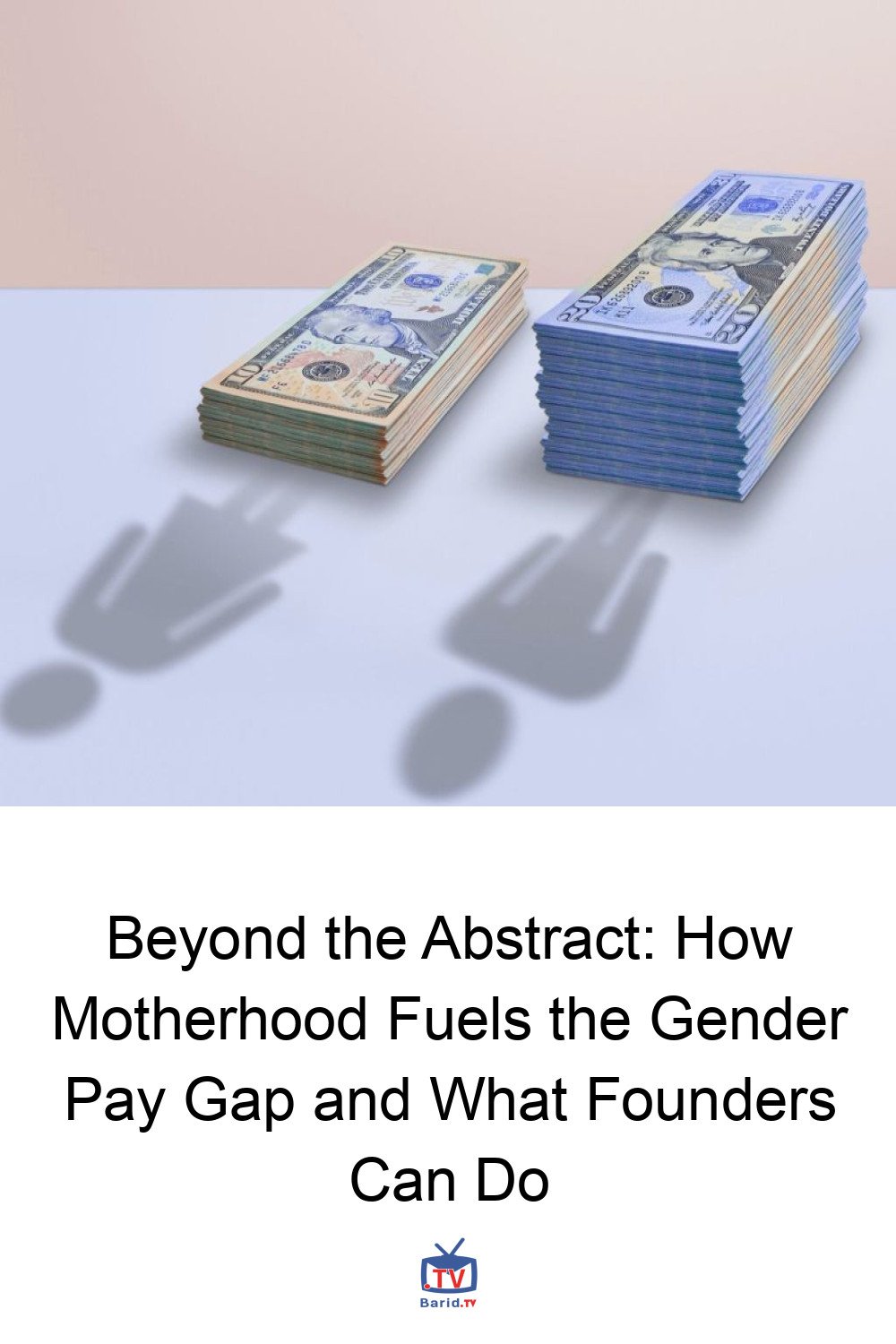
Unmasking the Motherhood Penalty: The Hidden Driver of the Gender Pay Gap
The gender pay gap is often discussed in abstract terms: percentages, averages, national statistics. But for founders, and especially for mothers, the reality is far more tangible. It doesn’t appear overnight; it emerges at a critical juncture – when a woman has a child – and then quietly, relentlessly, compounds year after year.
While numerous factors contribute to the gender pay gap, a growing body of research unequivocally points to motherhood as one of its most significant drivers. Studies consistently show that women’s earnings frequently stagnate or decline after childbirth, a phenomenon starkly contrasted by the “fatherhood bonus,” where men’s earnings often rise. Economists reveal that a substantial, sometimes majority, portion of the persistent gender pay gap during prime working years can be attributed to the economic repercussions of parenthood, rather than disparities in education, skill, or ambition. This isn’t just theory; it’s a lived reality for countless professionals and a silent challenge for many businesses.
The Stark Reality: Motherhood Penalty vs. Fatherhood Bonus
The “motherhood penalty” encapsulates the financial and career setbacks women encounter after becoming parents. For many, earnings growth decelerates or even reverses, particularly during their children’s formative years. Research commonly quantifies these declines at roughly 10–15% per child.
Conversely, fathers frequently enjoy a “fatherhood bonus.” Men are often perceived as more stable, committed, and deserving of advancement once they become parents, with studies estimating their earnings can increase by 3–10%. This creates a widening chasm from the same starting line.
A Tale of Two Trajectories: Sarah and John
Consider Sarah and John, both in identical roles, with similar performance and a $100,000 salary. After their first child, Sarah returns from maternity leave to a subtle shift: fewer high-visibility assignments and a modest raise, bringing her to $103,000. John, however, is lauded for “stepping up” as a new dad, receiving a promotion and a raise to $110,000.
Two years later, with a second child, Sarah transitions to a more flexible role to manage childcare logistics – a decision often dictated by rigid workplace norms, not a lack of ambition. Her pay growth slows further, reaching $108,000, significantly below the $140,000 she might have earned on her original path. John, meanwhile, continues his ascent, now earning $121,000. Same talent, same starting point, vastly different outcomes. This illustrates how the gender pay gap isn’t a single dramatic event, but a cumulative effect of subtle, often unconscious, biases compounding over time.
Deconstructing the Disparity: Why Parenthood Impacts Genders Differently
This gap isn’t merely a sum of individual choices; it’s deeply embedded in how workplaces are structured and operate. Decades of research, coupled with firsthand experience, reveal recurring patterns:
- The “Always-Available” Ideal: Workplaces continue to reward employees who appear to have no caregiving responsibilities, implicitly penalizing those who do.
- Disrupted Momentum:
Maternity leave and postpartum recovery often disrupt career momentum in ways companies rarely address effectively, leading to a loss of trajectory.
- Unfounded Assumptions: Mothers are frequently, and unfairly, assumed to be less ambitious or committed, even when their performance remains unchanged.
- “Protective Sidelining”: Managers may “protectively sideline” mothers from challenging assignments, inadvertently blocking their path to promotions and higher earnings.
- Undervalued Flexibility:
Flexible roles, often sought by mothers, are structurally undervalued and frequently placed in lower pay bands, despite their potential for high productivity.
- Double Standards: The very same caregiving behaviors that are praised in fathers are often penalized when exhibited by mothers.
Individually, these decisions might not seem overtly discriminatory. Collectively, however, they form a powerful engine driving long-term pay inequality.
The Workplace Mirror: Another Example
Imagine an associate attorney, a mother, and a father, both starting with identical performance, ambition, and a $150,000 salary. After children, the mother returns from a standard three-month maternity leave and is subtly given fewer “difficult” cases, ostensibly to help her balance work and home life. The father, however, is perceived as newly motivated to provide for his family and is assigned higher-visibility projects. His pay grows faster, despite similar workload or output, purely due to perception, not performance. Same starting line, same life transition, different outcomes. This isn’t necessarily intentional discrimination, but the cumulative impact of numerous small, well-meaning choices consistently advantages fathers and disadvantages mothers.
Pioneering Parity: How Founders Can Build Equitable Workplaces
As a founder, I’ve made a conscious effort to dismantle systems that inadvertently push women out, particularly at the peak of their experience and institutional knowledge. Here’s how:
1. Flexibility as the Default, Not a Perk
Commitment isn’t measured by hours spent in a chair; it’s measured by outcomes. If someone delivers great results, that’s what matters, not where or when they work. Embracing true flexibility means trusting employees to manage their time and responsibilities, fostering an environment where parents, especially mothers, can thrive without sacrificing career progression.
For more details, visit our website.
Source: Link






Leave a comment