



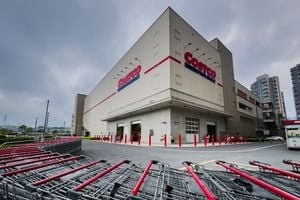

In a retail landscape often characterized by volatility and shifting consumer habits, Costco Wholesale Corporation ($COST) continues to stand as an anomaly, consistently delivering robust and predictable growth. Its latest earnings report for Q2 FY2026 isn’t just a testament to its enduring appeal; it’s a masterclass in turning high traffic and a loyal subscriber base into an almost unstoppable financial engine.
The Unstoppable Engine: Membership Fuels Record Performance
Costco’s “no surprises” brand promise extends beyond its warehouse aisles to its financial statements. For the second quarter of fiscal year 2026, the retail giant once again exceeded expectations, reporting net sales that climbed an impressive 9.1% to $68.24 billion. Net income followed suit, rising to $2.04 billion, translating to $4.58 per diluted share. These figures comfortably surpassed analyst predictions, who had broadly anticipated $4.55 EPS on $69.3 billion in revenue.
The true heart of Costco’s financial success, however, lies in its membership fees. These recurring revenues, which investors often view as the bedrock of its stability, soared by approximately 14% from a year ago, reaching $1.36 billion. When combined with net sales, total revenue hit $69.6 billion. This “subscription business” model, where customers pay for the privilege of access, effectively transforms raw sales volume into healthy operating margins, with operating income growing to $2.61 billion.
Beyond the Bulk Buy: E-commerce and Global Expansion Drive Growth
Costco’s growth isn’t solely confined to its physical warehouses. The company reported a strong 7.4% increase in comparable sales companywide for the quarter. Crucially, “digitally-enabled” sales surged by 22.6%, underscoring the increasing importance and effectiveness of its e-commerce operations as a significant second revenue stream. Even when stripping out the volatile impacts of gasoline prices and foreign exchange rates, comparable sales were still up a healthy 6.7%, with digitally-enabled sales maintaining a 21.7% rise.
Geographically, the U.S. market continued its reliable mid-single-digit growth. However, Canada and the “Other International” category proved to be dynamic growth drivers, reminding observers of Costco’s potent global brand appeal. The February sales update further highlighted this, with “Other International” sales grabbing headlines with a 17.9% increase, albeit partially boosted by the later timing of Lunar and Chinese New Year.
Over the first 24 weeks of fiscal 2026, the company’s financial strength is clear: membership fees totaled $2.68 billion, total revenue reached $136.9 billion, and operating cash flow came in at a robust $7.68 billion. Costco also continued its shareholder-friendly practices, reporting $419 million in share repurchases and $1.15 billion in dividends paid during this period.
Navigating the Headwinds: The Tariff Challenge Looms
While Costco’s recent performance paints a picture of resilience, the company is not immune to external pressures. Its risk disclosures explicitly flag “geopolitical conditions (including tariffs)” alongside energy and commodities, a clear indication that global trade dynamics are a significant concern. This concern is particularly pertinent given that approximately one-third of the products Costco sells in the U.S. are imported.
Recent comments from Treasury Secretary Scott Bessent, suggesting a potential increase in the U.S. global tariff rate to 15% “this week,” cast a shadow of uncertainty. For Costco, tariffs are not an abstract “macro headwind” but a tangible operational and financial challenge. The company’s proactive stance is evident in its December lawsuit against the U.S. government, seeking to preserve its ability to collect tariff refunds following the Supreme Court’s rejection of President Donald Trump’s “Liberation Day” tariffs. With an estimated $175 billion in U.S. tariff collections potentially subject to refunds and thousands of importers already suing, the legal landscape promises to be complex and protracted.
A Retailer Apart: Contrasting with Competitors
Costco’s consistent performance stands in stark contrast to some of its peers. Target ($TGT), for instance, recently reported a quarter where comparable sales fell 2.5% and net sales were down 1.5%, reflecting a consumer base increasingly “editing the cart in real time.” Kroger, another retail giant, appears to be leaning on the fundamental strength of grocery repetition, reporting identical sales (excluding fuel) up 2.4%.
These comparisons highlight Costco’s unique ability to thrive by protecting its value proposition, leveraging immense volume, and, critically, monetizing access through its membership model. In an economy where consumers are more discerning than ever, Costco’s formula continues to resonate, proving that sometimes, the most predictable path is the most profitable.
For more details, visit our website.
Source: Link





Leave a comment