



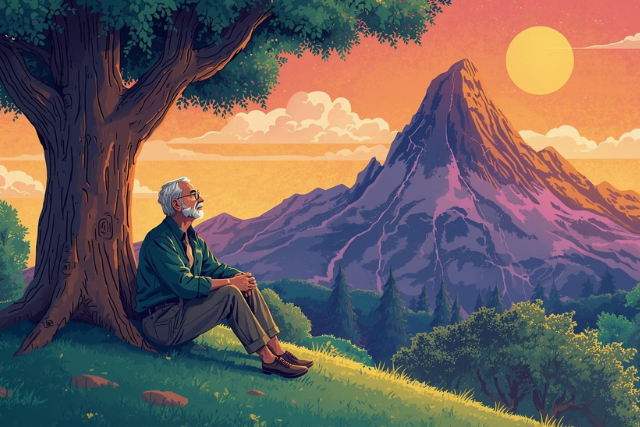

In a world constantly pushing us towards improvement, the pursuit of “better” often feels like an inherent good. It’s the engine of progress, the whisper of potential, the promise of a more fulfilling tomorrow. For many, including myself, this aspiration has long served as a powerful fuel, driving us through challenges and towards imagined pinnacles of success: financial stability, globally recognised creative work, a profound sense of arrival after years of relentless effort. The vision was clear: teaching or creating without struggle, work fully valued, a future predictable enough to finally relax into. This idyllic picture, though not an obsession, was a constant north star, guiding my days. “Better” wasn’t a luxury; it was direction. “Best” was the silent pact I made with myself to keep going when uncertainty loomed.
The Seductive Trap of “Better”
For a considerable period, this future-oriented approach worked. It provided motivation, helped endure hardship, and offered a sense of upward momentum. Yet, subtly, almost imperceptibly, the light of “better” began to cast a long shadow. Without realising it, the future transformed into a demanding yardstick for the present. Phrases like “This isn’t enough yet,” “I’m not enough yet,” or “I’ll be okay when…” became the unspoken soundtrack of my life. Even genuinely meaningful moments – crafting an honest piece of writing, guiding a student, completing a creative project – felt provisional, valuable but incomplete. They were always a stepping stone, pointing towards some grander achievement that needed to materialise before true peace could be found.
When Aspiration Becomes Attachment
This relentless internal dialogue illuminated a profound truth embedded in Buddhist teachings: the distinction between simple desire and true craving, or grasping. It’s the kind of wanting that tightens around specific outcomes, making inner peace conditional. On the surface, it sounds entirely reasonable: “I just want things to improve,” “I just want stability,” “I just want this to work out.” But beneath these seemingly innocuous statements lay a more fragile, demanding undercurrent: “I can’t rest until the future cooperates.” This wasn’t merely striving; it was clinging, a desperate hold on an imagined tomorrow that held my present hostage.
The Breaking Point: A Journey to Presence
The catalyst for change wasn’t a sudden epiphany, but a profound exhaustion. I was weary of carrying invisible deadlines for happiness, tired of perpetually postponing contentment, and utterly drained by living as if my real life was perpetually on hold. This was particularly poignant as the certainties of time, health, and future prospects became increasingly less negotiable. I realised I was leaning so heavily into the future that I was barely inhabiting the present. It was then that the crucial difference between healthy forward movement and excessive leaning – clinging – became starkly clear. One is productive effort; the other, a self-imposed prison.
Redefining Hope: Direction, Not Demand
Buddhist wisdom didn’t advocate for the cessation of desire, but rather a transformation in its quality. If outcomes were no longer guaranteed, what direction truly mattered? My chosen path became clear: to remain steadfastly committed to presence, honesty, and service, irrespective of whether recognition, security, or resolution followed. This meant continuing to write truthfully even without immediate validation, mentoring individuals one at a time rather than waiting for an ideal platform, and prioritising integrity and attentiveness over the promise of an eventual payoff. Hope, in this new paradigm, ceased being a rigid contract with the future and blossomed into a dynamic relationship with the present.
Embracing Freedom: Wanting Without Ownership
One of the most liberating realisations was the capacity to want something deeply while simultaneously remaining at peace if it didn’t unfold as hoped. I began to pose a simple, yet powerful question: “If this doesn’t happen the way I want, can I still stay present with my life?” There were moments when the answer was a resounding “yes.” I continued writing and submitting essays, detached from acceptance rates or future prospects, because the act of writing itself felt aligned and fulfilling, regardless of external validation. Yet, there were also times when the answer was a painful “no.” These were the moments of clinging – compulsively checking results, tying my self-worth to responses, or feeling crushed by silence. Recognising this boundary, I learned to step back, to rest, and to return to what I could offer without ownership: my attention, my care, my honesty, my presence. True freedom, I discovered, resides in this space.
Cultivating an “Awake Today”
Where I once sought refuge in elaborate visions of a perfect future, I now practice something gentler. Instead of asking, “How do I get to the perfect version of my life?” I inquire, “What would a slightly more awake version of today look like?” Perhaps it’s listening with greater intent, choosing rest over relentless pushing, or simply crafting one honest paragraph. This subtle shift allows for continuous growth and connection without the heavy burden of conditional happiness, transforming the elusive chase for “better” into the profound embrace of “enough.”
For more details, visit our website.
Source: Link






Leave a comment