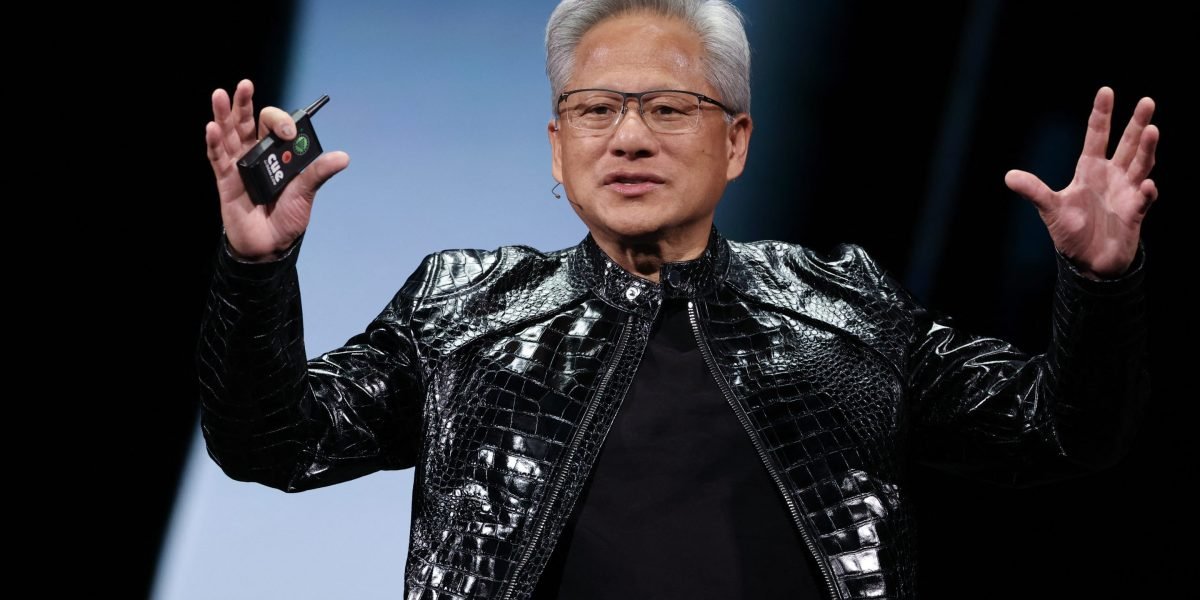

In the high-stakes world of technology, few pronouncements carry as much weight—or risk—as those made by industry titans. Nvidia CEO Jensen Huang’s recent comments during his company’s Q4 earnings call have ignited a fervent debate: are we witnessing the peak of an AI bubble, or merely the dawn of an unprecedented technological era?
Nvidia’s Unstoppable Ascent and the Hyperscaler Engine
Nvidia’s latest financial results were nothing short of spectacular, defying expectations and underscoring the insatiable demand for its cutting-edge AI chips. The final three months of 2025 saw revenue skyrocket by an astounding 73% to $68.1 billion, with projections for the current quarter hinting at an additional 200% expansion. Yet, despite these heroic figures, Nvidia’s stock barely budged, hinting at underlying investor apprehension.
The Titans Fueling the Boom
A significant factor in Nvidia’s meteoric rise is its reliance on a handful of colossal “hyperscalers” – tech giants like Google and Amazon (though not explicitly named by Nvidia, their identities are an open secret). These behemoths are locked in a fierce race to acquire as many of Nvidia’s GPU chips as possible, funneling them into the sprawling AI data centers they are constructing globally.
The scale of this investment is staggering. Many of these hyperscalers have pledged to double their capital expenditures this year. Meta, for instance, plans to escalate its capex from $72 billion in 2025 to a projected $135 billion this year. Google is set to increase its spending from $91 billion to an astonishing $185 billion. Collectively, these dominant players are earmarking nearly $700 billion for capital expenditures in the current year alone.
Is This Spending Spree Sustainable?
The sheer magnitude of these investments naturally raises a critical question: how long can this level of spending realistically continue? Analysts on Wall Street are voicing concerns, noting that these hyperscalers are already outspending their prodigious free cash flow, resorting to debt to finance their ambitious AI infrastructure buildouts. A hypothetical scenario where these five companies double their capex annually paints a picture of $2.8 trillion in spending by 2028, escalating to an unimaginable $5.6 trillion by 2029.
Jensen Huang’s Vision: Beyond the Bubble
Unperturbed by the skepticism, Jensen Huang presented his rationale for perpetual growth with the calm assurance of a seasoned academic. He argues that AI represents a fundamental shift in computing, not a transient trend. “This new way of doing computing is not going to go back,” he asserted, predicting a continuous expansion of capacity.
Huang posits that if the world previously invested $300-$400 billion annually in classical computing, and AI demands 1,000 times more computation, then the current $700 billion is merely a fraction of what’s truly needed. “The amount of token generation capability that the world needs is a lot more than $700 billion,” he explained, referring to the basic data units processed by AI models. His confidence remains unshaken: “I’m fairly confident that we’re going to continue to generate tokens, we’re going to continue to invest in compute capacity from this point out.”
The Next Wave of AI Applications
Driving this sustained demand, according to Huang, are emerging applications. He highlighted the recent “inflection point” reached by “agentic AI” in just the last few months, creating a fresh surge in demand. Looking further ahead, he envisions “physical AI,” where advanced models are seamlessly integrated into robotics and manufacturing, unlocking entirely new industries and efficiencies.
“AI is here. AI is not going to go back. AI is only going to get better from here,” Huang declared, painting a picture of an endlessly expanding technological frontier. For the Nvidia CEO, the AI party has only just begun, and the music shows no signs of fading.
For more details, visit our website.
Source: Link