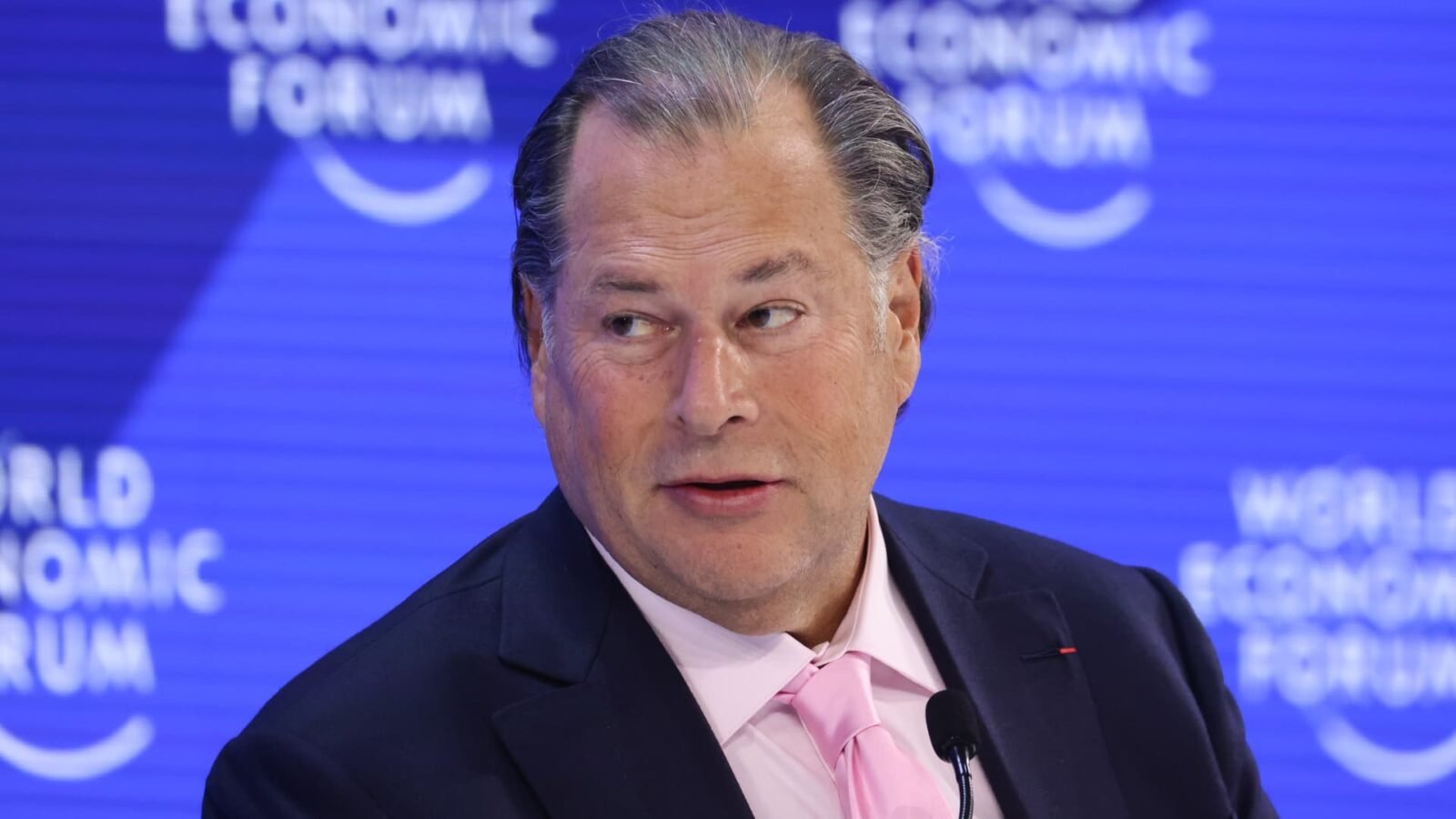


Salesforce, the cloud software giant, finds itself at a pivotal juncture, delivering a robust fourth-quarter performance that outstripped analyst expectations while simultaneously presenting a cautious full-year revenue outlook that sent its shares tumbling. Amidst this mixed financial landscape and growing investor anxieties over the disruptive potential of generative artificial intelligence, the company made a bold statement: a staggering $50 billion commitment to new share buybacks, signaling a strong belief in its undervalued stock.
Q4 Triumph: Strong Growth in a Challenging Market
For its fiscal fourth quarter, ending January 31, Salesforce reported impressive figures that largely surpassed LSEG consensus estimates. The company posted adjusted earnings per share of $3.81 against an expected $3.04, on revenue of $11.20 billion, slightly above the $11.18 billion forecast. This represented a significant 12% year-over-year revenue growth, marking Salesforce’s fastest expansion rate in two years.
Net income also saw a healthy increase, reaching $1.94 billion, or $2.07 per share, up from $1.71 billion, or $1.75 per share, in the prior year. Furthermore, the current remaining performance obligation (CRPO), a key indicator of future revenue, stood at $35.1 billion, exceeding StreetAccount’s consensus of $34.53 billion.
A $50 Billion Vote of Confidence: The Buyback Strategy
Despite the strong quarterly results, Salesforce’s stock experienced a notable decline, extending losses into Thursday’s pre-market trading. This downturn follows a period where Salesforce shares had already fallen approximately 28% year-to-date in 2026, contrasting sharply with the S&P 500’s 1% gain. It was against this backdrop that CEO Marc Benioff announced the colossal $50 billion share buyback program, candidly stating, “because these are some low prices.” Benioff also highlighted the company’s “under-leveraged” balance sheet, suggesting ample capacity for such a significant financial maneuver.
Navigating the AI Tsunami: Innovation and Investment
The broader software sector has recently been rattled by investor fears concerning the impact of generative AI models on future growth. This sentiment was underscored by IBM’s 13% stock drop after Anthropic’s Claude Code AI tool showcased its ability to modernize legacy code. Salesforce, however, is not merely observing from the sidelines; it’s actively engaging with the AI revolution.
AI-Powered Offerings and Strategic Stakes
During the quarter, Salesforce rolled out an AI-enabled Slackbot assistant for its paying Slack clients, enhancing team communication.
Its Agentforce AI technology, designed to automate customer service and corporate functions, has seen significant adoption, with annualized revenue exceeding $800 million. Morgan Stanley analysts suggest these efforts are still in their “early innings.”
- Salesforce’s strategic investment in Anthropic, a leading AI startup, continues to pay dividends. The company reported an $811 million gain on strategic investments in the quarter, a substantial leap from $96 million a year prior. CEO Benioff revealed an additional $100 million investment, bringing Salesforce’s total stake to around $330 million, representing approximately 1% of Anthropic. He expressed a wish for an even larger investment, underscoring the perceived value of the AI frontier.
Strategic Expansion: Acquisitions and Long-Term Vision
Beyond AI, Salesforce has been busy with strategic acquisitions aimed at bolstering its ecosystem and future revenue streams. The $8 billion acquisition of data management software company Informatica was completed during the quarter, contributing $399 million in revenue. The company also announced plans to acquire marketing firm Qualified.
These strategic moves underpin Salesforce’s ambitious long-term vision. The company has raised its fiscal 2030 revenue target to $63 billion, up from over $60 billion projected in October, with Informatica playing a role in this revised outlook. Benioff also highlighted competitive successes, noting that five ServiceNow customers migrated to Salesforce’s IT service management product during the quarter.
Mixed Outlook and Investor Reaction
While Salesforce’s first-quarter fiscal guidance for adjusted earnings per share ($3.11 to $3.13) and revenue ($11.03 billion to $11.08 billion) largely met or exceeded analyst expectations, the full-year fiscal 2027 revenue forecast proved to be the sticking point. The company projected $45.8 billion to $46.2 billion in revenue, implying 10% to 11% growth, which, while healthy, slightly trailed Wall Street’s more optimistic $46.06 billion consensus. This slight miss, coupled with broader market anxieties about AI disruption, appears to have fueled the negative investor reaction, despite a quarter of strong operational performance and a bold commitment to shareholder value.
For more details, visit our website.
Source: Link