
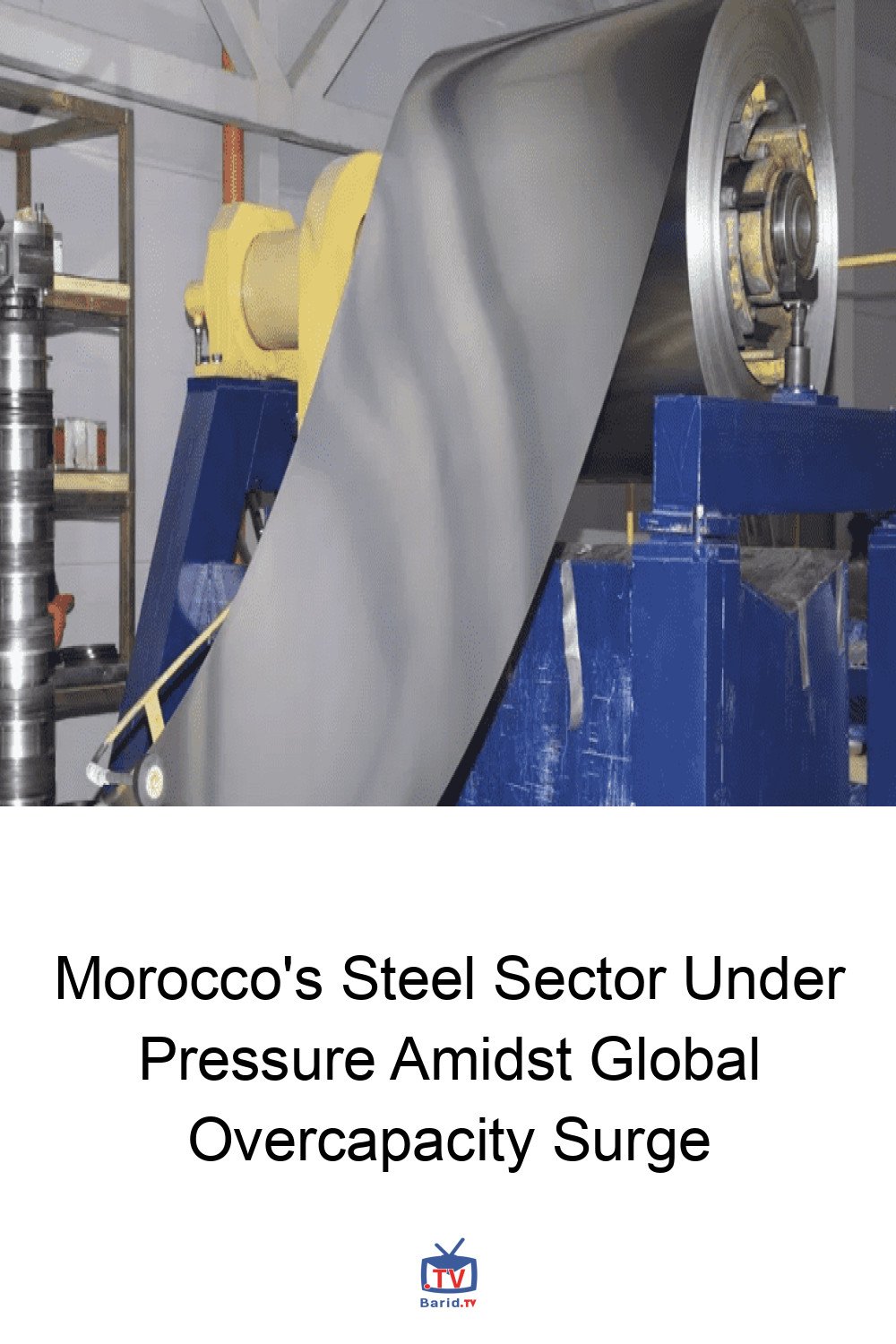
The global steel market is currently experiencing a significant imbalance, with production capacity far outstripping demand. This worldwide surplus is casting a long shadow, and Morocco’s steel industry finds itself directly in the crosshairs, grappling with its own domestic overcapacity amidst a fiercely competitive international landscape.
Global Steel Market: A Widening Chasm
According to the latest monitoring bulletin from the Global Forum on Steel Excess Capacity (GFSEC), the gap between global steel production capacity and actual demand reached a staggering 179.6 million tons in the third quarter of 2025. This represents a 1.4% increase from the previous year, signaling a deepening crisis for producers worldwide.
Demand Slump, Not Production Surge
Crucially, this widening gap isn’t primarily due to a sudden boom in new steel factories. Instead, the GFSEC report for February 2026 clarifies that global capacity has remained largely stable. The primary culprit is a significant weakening of demand across the globe. As local markets absorb less, steel producers are increasingly turning to exports to maintain output, with exports accounting for 27.8% of total global steel production in Q3 2025.
This reliance on foreign markets has inevitably driven down international prices. Export prices for flat steel products, for instance, saw an average decline of 6.7% in 2025. The report also highlights a stark price disparity, with export prices within GFSEC member countries remaining approximately 1.7 times higher than those from China, underscoring the intense competitive pressure.
Morocco’s Steel Sector Under Siege
Morocco is explicitly identified by the GFSEC as one of the nations where installed steel capacity significantly exceeds domestic demand. This classification comes at a critical juncture, as global consumption slows and producers worldwide intensify their export efforts.
Rising Competition on the African Continent
The African market, in particular, is experiencing heightened competition. Imports from economies with excess capacity constituted 20.5% of regional steel demand in the third quarter of 2025. For Morocco, this translates into intense pressure from major suppliers like China, Turkey, and various European countries. Flat products and certain semi-finished goods used in transformation are particularly vulnerable to this influx of competitively priced imports.
Domestic Challenges and Cost Disparities
Lower international prices are squeezing profit margins for Moroccan steel producers. They face a structural cost disadvantage compared to the massive scale and efficiency of large Asian manufacturers. Furthermore, the domestic market alone does not offer the robust growth needed to offset these external pressures.
Strategic Responses and Future Outlook
In response to these challenges, Morocco has begun to deploy trade defense mechanisms. The GFSEC notes the initiation of anti-dumping investigations in October 2024, specifically targeting certain steel imports, including products originating from China. This mirrors a global trend, with 64 new trade defense cases launched worldwide in the first nine months of 2025, predominantly anti-dumping measures. However, the forum cautions that the volumes covered by these measures remain relatively small compared to the vast scale of global steel trade.
The current situation compels Morocco’s steel industry to confront a fundamental question: Can the local market eventually absorb existing capacity, or must Moroccan producers strategically pursue stronger export positions and deeper regional integration to restore balance and ensure long-term viability?
For more details, visit our website.
Source: Link