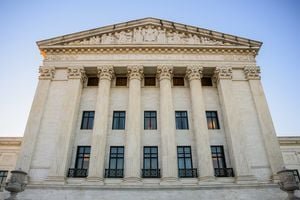


In a landmark decision reshaping the boundaries of presidential authority, the U.S. Supreme Court on Friday delivered a significant blow to former President Donald Trump’s trade agenda, striking down his controversial “Liberation Day” tariffs. The 6-3 ruling, stemming from the case of
Learning Resources, Inc. v. Trump
, firmly asserted that the power to impose import taxes rests solely with Congress, not the executive branch.
A Constitutional Rebuke: Congress Holds the Purse Strings
The high court’s majority opinion, penned by Chief Justice John Roberts, underscored a fundamental principle of American governance: tariffs are a form of taxation, and the Constitution explicitly grants the power to tax to the legislative branch. Roberts emphasized that for over half a century, no president had invoked the International Emergency Economic Powers Act (IEEPA) to impose tariffs, let alone on the scale seen under the Trump administration.
“It is also telling that in IEEPA’s half century of existence, no President has invoked the statute to impose any tariffs, let alone tariffs of this magnitude and scope,” Chief Justice Roberts wrote. “The President must ‘point to clear congressional authorization’ to justify his extraordinary assertion of that power. He cannot.”
This decision effectively dismantles a key component of Trump’s second-term economic strategy, which sought to leverage tariffs as a primary tool for trade negotiation and deficit reduction.
The ‘Liberation Day’ Tariffs and Billions in Limbo
At the heart of the dispute were the “Liberation Day” tariffs, imposed by Trump last April under the guise of emergency authority granted by IEEPA. This unprecedented application of the law quickly drew legal challenges from over a thousand businesses, including major players like Costco and Goodyear, which argued against the president’s unilateral power to levy such taxes.
The ruling leaves a colossal question mark hanging over the $142 billion in tariff revenue collected under IEEPA through 2025, according to an analysis by the Yale Budget Lab. While the Supreme Court punted on the immediate question of refunds, Justice Brett Kavanaugh, in his dissenting opinion, warned of the “mess” that awaits the U.S. government if it is obligated to return these billions to importers.
“The Court says nothing today about whether, and if so how, the Government should go about returning the billions of dollars that it has collected from importers,” Kavanaugh stated. “But that process is likely to be a ‘mess.'”
Trump’s Defiance and New Tariff Threat
Unsurprisingly, President Trump swiftly vowed to reverse the court’s decision, announcing plans to revive his tariff regime through alternative legal avenues. Hours after the ruling, he declared a new 10% tariff under Section 122, a separate authority not addressed by the Supreme Court’s decision, set to take effect on Monday. This move signals his continued commitment to using import taxes, despite the judicial setback.
During a press conference, Trump expressed frustration with the court’s omission of the refund issue, stating, “They take months and months to write an opinion and they don’t even discuss that point. I guess it has to get litigated for the next two years.”
A Critical Test for Separation of Powers
The Supreme Court’s decision, though anticipated by many observers following skeptical questioning during November’s oral arguments, is widely regarded as a pivotal moment for the separation of powers in American governance. Jacob Jensen, a trade expert at the American Action Forum, described it as “one of the most consequential decisions for trade law, tariffs, and executive authority in the modern era.”
For months leading up to the ruling, Trump had publicly pressured the court to side with his administration, arguing that tariffs were essential to prevent national bankruptcy and secure favorable trade deals. His assertion that “the language is clear: I have the right to do it as president” directly contrasted with the court’s ultimate interpretation of congressional authority.
Echoes of the Past, Billions in the Balance
The prospect of significant tariff refunds is not without precedent, though the scale this time is vastly larger. In the late 1990s, the U.S. government refunded $750 million to importers after a harbor maintenance tax was struck down by the Supreme Court. That process took several years for a much smaller sum, hinting at the complexity and protracted litigation that could ensue for the current $140 billion-plus at stake.
While some of Trump’s tariffs, imposed under different legal authorities on goods like steel, aluminum, and lumber, remain intact, the “Liberation Day” ruling marks a clear judicial check on the executive’s ability to unilaterally impose broad import taxes. The battle over trade policy and presidential power, however, appears far from over.
For more details, visit our website.
Source: Link