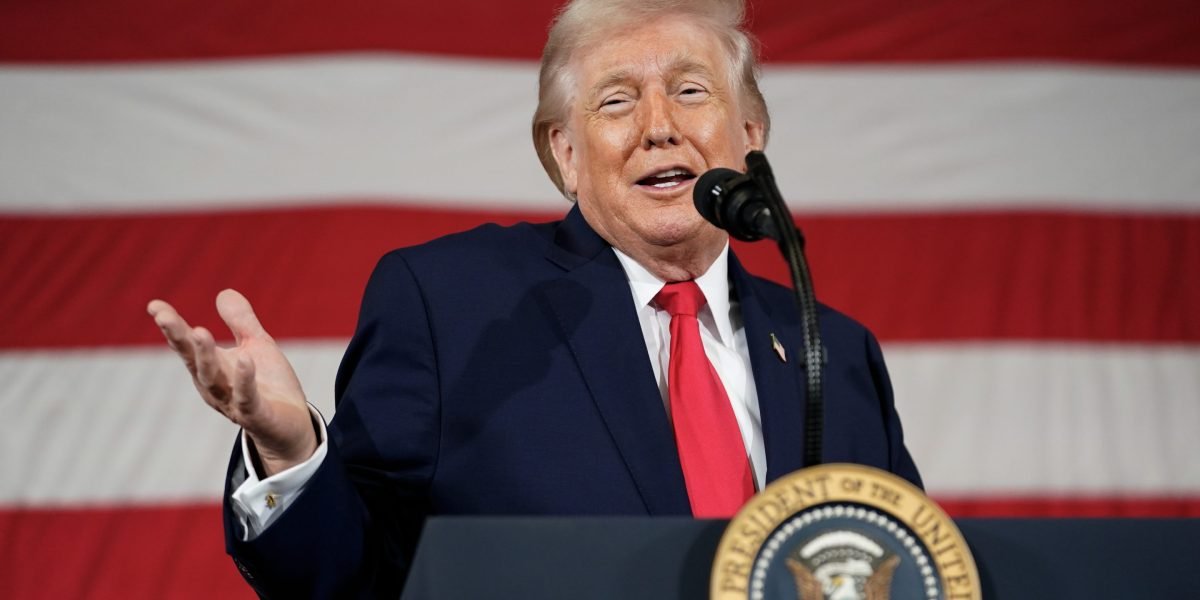

In a swift and decisive move following a significant legal setback, former President Donald Trump on Friday signed an executive order imposing a 10% global tariff on foreign goods. This action, announced via social media, is a direct response to the US Supreme Court’s decision earlier in the day to strike down several of his previously enacted levies, aiming to salvage and reshape his ambitious trade agenda.
Trump’s New Global Tariff: A Strategic Pivot
The executive order, details of which were not immediately public, establishes a baseline 10% duty on imports from all countries. Trump indicated that this new measure is being implemented under Section 122 of the Trade Act of 1974. This provision grants the president unilateral authority to impose tariffs, but crucially, it comes with a 150-day time limit, after which congressional approval would be required for any extension. “It is my Great Honor to have just signed, from the Oval Office, a Global 10% Tariff on all Countries, which will be effective almost immediately. Thank you for your attention to this matter!” Trump posted, signaling the urgency of his administration’s response.
The Supreme Court’s Landmark Ruling
The impetus for this rapid policy shift came from a 6-3 Supreme Court decision that deemed Trump’s previous “reciprocal” tariffs unlawful. These duties, ranging from 10% to 50%, were imposed last April under the International Emergency Economic Powers Act (IEEPA). The justices invalidated tariffs applied to numerous US trading partners, including Canada, Mexico, and China, which were controversially linked to addressing fentanyl trafficking. The ruling also cast a shadow over IEEPA tariffs on goods from Brazil and India, raising questions about their legality.
Navigating the Complex Trade Landscape
Despite the new global tariff, Trump affirmed his intention to maintain existing import taxes under Section 301 and Section 232. He also signaled plans to initiate further trade investigations. Section 301 tariffs, notably used against Chinese exports, automobiles, and metals, necessitate country-specific probes, public hearings, and evidence of trade agreement violations or practices that burden US trade. The president suggested these investigations could run concurrently with the 10% baseline, potentially replacing it over time, though he did not rule out seeking an extension for the Section 122 levies. Discussions also included potential tariffs on foreign cars, ranging from 15% to 30%.
Economic Projections and the Refund Battle
Bloomberg Economics estimates that the new 10% global duty could significantly impact the average US effective tariff rate, potentially lifting it from 13.6% to 16.5%, or lowering it to 11.4% if current exemptions are preserved. However, the Supreme Court’s ruling has ignited a far more immediate and contentious debate: the fate of billions in collected tariff revenue.
Over 1,500 companies had already filed lawsuits in trade court in anticipation of such a ruling, a Bloomberg analysis revealed. The justices, however, deliberately avoided addressing whether importers are entitled to refunds, deferring this complex issue to a lower court. Trump expressed his frustration at this ambiguity, lamenting during a White House press conference, “It’s not discussed. We’ll end up being in court for the next five years.”
The $170 Billion Question
The potential refunds could total an staggering $170 billion, representing more than half of the total revenue generated by Trump’s tariffs. Despite this looming financial uncertainty, Treasury Secretary Scott Bessent offered an optimistic outlook. Speaking to the Economic Club of Dallas, Bessent stated, “Treasury’s estimates show that the use of Section 122 authority, combined with potentially enhanced Section 232 and Section 301 tariffs will result in virtually unchanged tariff revenue in 2026.” This assertion suggests the administration believes its new strategy can offset the financial implications of the Supreme Court’s decision.
As the dust settles on this latest chapter in US trade policy, the implications for global commerce, domestic industries, and the legal framework of presidential power remain profound and far-reaching. The coming months will reveal the true impact of this strategic pivot and the ongoing battle over trade and revenue.
For more details, visit our website.
Source: Link