

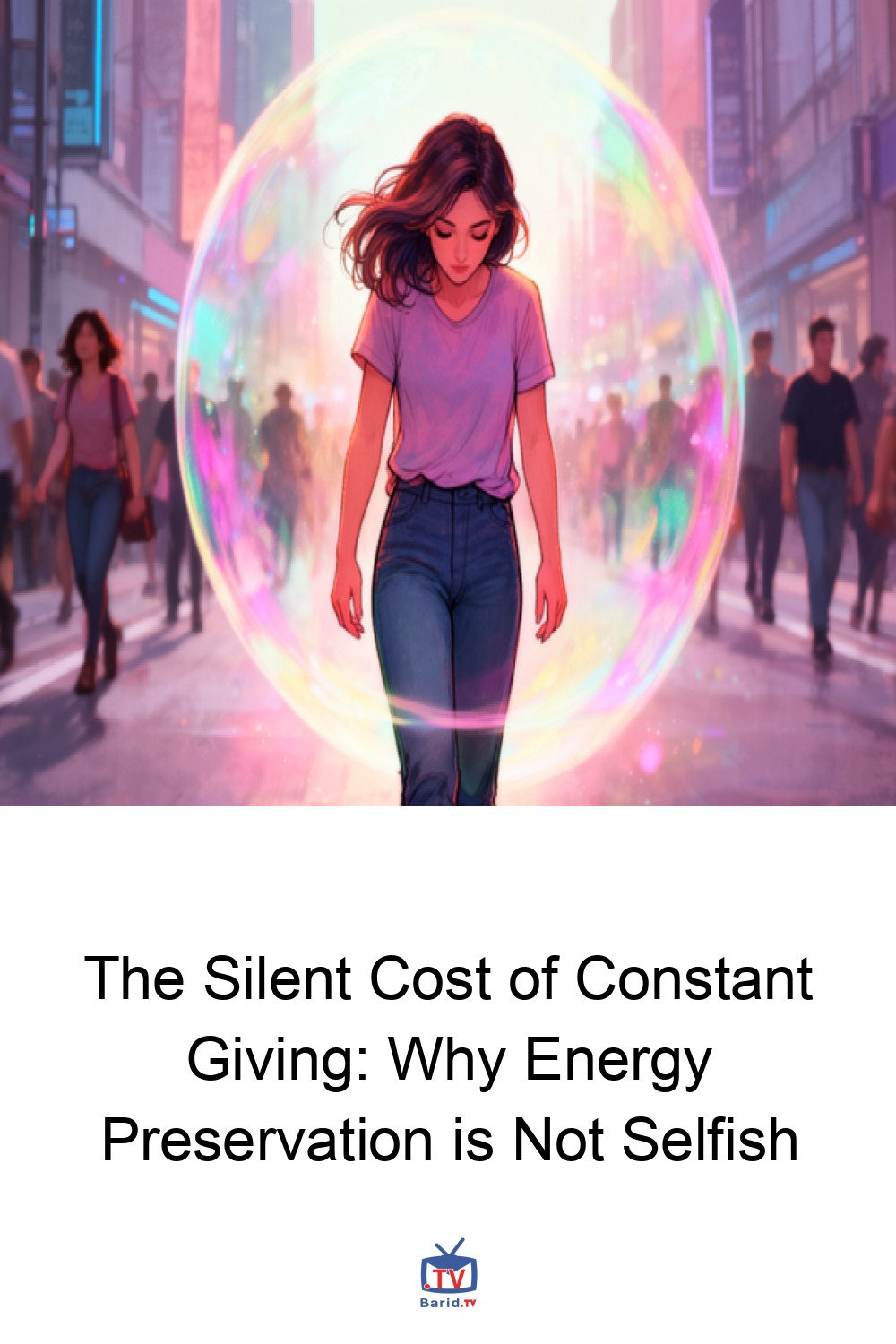
The Silent Cost of Constant Giving: Why Energy Preservation is Not Selfish
In an increasingly demanding world, many of us find ourselves perpetually drained, feeling as though every interaction, every obligation, chips away at a dwindling reserve. The pervasive sentiment that we must always be ‘on,’ always available, often leads to a profound sense of exhaustion. But what if the act of pulling back, of conserving your inner resources, isn’t a moral failing but a biological imperative? This article delves into why protecting your energy is not selfish, but a crucial act of self-preservation.
The Hidden Cost of Cordiality
Consider the seemingly innocuous ‘How are you?’ A friend recently shared an anecdote about her mother, a woman who, in her later years, has stopped engaging in such casual pleasantries. While walking, she now simply keeps her eyes forward, bypassing the customary exchange. My friend felt a pang of discomfort, suggesting that a simple ‘I’m fine’ costs nothing. My immediate, almost reflexive, response was, ‘It costs energy. And she’s tired.’ In that moment, I realized I wasn’t just speaking of her mother; I was speaking of myself.
This small interaction illuminates a larger truth. We often perform emotional labor without conscious thought, believing it to be a harmless social lubricant. Yet, for those operating on depleted reserves, even the briefest eye contact, the most perfunctory small talk, can feel like an additional burden. It’s the subtle softening, the emotional padding we add to daily interactions, that extracts a hidden toll. For many, especially women conditioned as caretakers, the idea of not ‘doling out energy like candy’ can feel shameful, yet it’s a reality born of profound depletion.
Energy: A Finite, Allocated Resource
The laws of physics dictate that energy is conserved, not endlessly generated. Similarly, within our biological systems, energy is a finite resource that must be carefully allocated. Our nervous systems, responsible for everything from vigilance to emotional regulation, draw from a limited supply. When this supply is consistently overdrawn through prolonged emotional labor, chronic stress, or over-responsibility, the body doesn’t seek permission to conserve; it simply initiates a protective shutdown.
Social engagement, emotional buffering, and constant responsiveness are often the first casualties. This isn’t a deliberate moral choice or a relational statement; it’s a biological necessity. In these moments, conservation isn’t selfishness; it’s the system obeying its inherent limits. For many, particularly those shaped by codependent patterns, energy has been spent reflexively, driven by a deeply ingrained need to scan, anticipate, soothe, and accommodate. We learned that being pleasant and available was key to stability, a lesson that, over time, accumulates a significant energetic debt.
Beyond Boundaries: The Triage of Depletion
We often discuss boundaries as a conscious, empowered choice, a clear articulation of preferences born from a place of abundance. However, when deep depletion sets in, the act of withholding energy transforms from a boundary into a state of triage. It’s no longer about preference; it’s about survival.
When the body’s reserves are critically low, saying ‘no’—energetically or emotionally—becomes a desperate measure to prevent further collapse. The consequences of not conserving become stark: health suffers, relationships with loved ones are strained, and professional performance diminishes. Research on burnout, notably by Maslach and Leiter (2001), highlights that chronic emotional labor often leads to emotional withdrawal as a protective response. It’s not a sign of caring less, but of a nervous system pushed to its absolute limit. If you find yourself in this space, grappling with guilt, understand that your body is making a necessary choice, even if your mind’s conditioning hasn’t yet caught up.
The Peril of Misjudging Capacity for Character
A critical error we often make is judging someone’s character without adequately considering their capacity. When we observe someone withdrawing, becoming less responsive, or seemingly ‘cold,’ we are quick to moralize their behavior, attributing it to a flaw in their personality. Yet, what we might be witnessing is a nervous system at its breaking point, a person in a state of energetic triage.
For many, especially women, giving has historically equated to safety and belonging. The reflex to give persists even when the internal well is dry. Recognizing this isn’t an excuse for unkindness, but an invitation for empathy—both for ourselves and for others. It’s an acknowledgment that protecting what little energy remains is a fundamental act of self-preservation, not a sign of indifference.
Conclusion
In a culture that often glorifies relentless giving, the act of protecting one’s energy can feel counter-intuitive, even shameful. Yet, understanding energy as a finite, precious resource—one that demands conscious allocation and fierce protection—is paramount for well-being. It’s time to shed the guilt and embrace the biological reality: conserving your energy isn’t selfish; it’s a vital, non-negotiable act of self-care that allows you to show up authentically for yourself and for those who truly matter.
For more details, visit our website.
Source: Link