
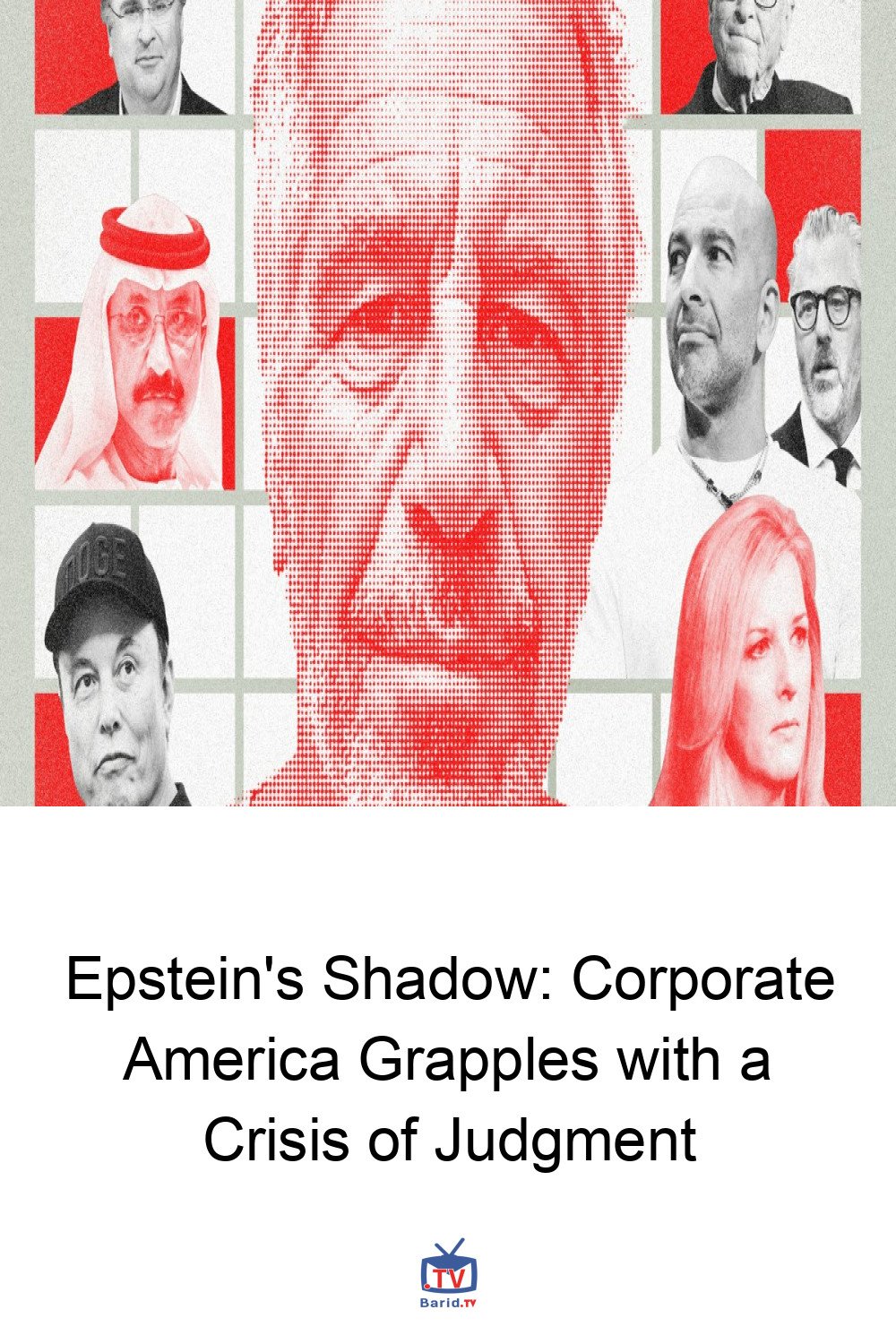
The recent deluge of documents from the U.S. Justice Department’s investigation into Jeffrey Epstein has cast a long, unsettling shadow over the upper echelons of corporate America. Two weeks after 3 million files unveiled a network of business elites—spanning Hollywood, New York, and Dubai—who maintained ties with the late, disgraced financier, the corporate world finds itself entangled in a murky paper trail, grappling with profound questions of accountability and ethical leadership.
The Uncomfortable Reckoning: Who Knew What, and When?
Boards and business leaders are now confronting a series of thorny dilemmas: What was the extent of their executives’ knowledge regarding Epstein’s criminal activities? Did their association cross the line into criminal behavior, or was it merely a catastrophic lapse in judgment? And, perhaps most critically, what standard of conduct should be applied in a society increasingly desensitized to scandal?
While the corporate world’s initial response has been notably cautious, signs of a reckoning are beginning to emerge. Goldman Sachs announced the departure of general counsel Kathryn Ruemmler, effective June, following revelations she maintained close contact with Epstein until 2019, even referring to him as “Uncle Jeffrey” in gratitude for lavish gifts. Similarly, Dubai-based logistics giant DP World signaled the exit of its chair and CEO, Sultan Ahmed bin Sulayem, whose emails with Epstein reportedly contained references to sexual experiences. These high-profile ousters echo earlier resignations in the U.K. public sector, including former U.S. ambassador Peter Mandelson and Prime Minister Keir Starmer’s chief of staff, Morgan McSweeney.
The Grey Area: Why Consequences Remain Uneven
Despite these significant departures, a striking number of Epstein’s associates within the business world have yet to face professional repercussions. This uneven application of consequences highlights a perplexing aspect of the Epstein saga: the released documents, while damning, do not uniformly provide proof of criminal behavior among all his correspondents. This ‘grey area’ often allows inaction to become the most convenient path in a corporate governance landscape where poor judgment, no matter how egregious, isn’t always a fireable offense.
The Cost-Benefit Calculus of Accountability
Public pressure mounts on companies employing individuals named in the files, with questions like “Why haven’t they been fired?” echoing across online platforms and from clients. However, the decision to terminate an executive for bad judgment is rarely straightforward. Jill Fisch, a professor of business law at the University of Pennsylvania’s Penn Carey Law School, explains it often boils down to a cost-benefit analysis. “Bad judgment,” she notes, “is weighed against whatever we think the virtues or advantages or strengths of this particular person are.” For instance, Ruemmler, a former counsel to Presidents Clinton and and Obama, was widely regarded as a corporate superstar.
Factors Diluting Corporate Action
Several other factors appear to be tipping the scales in favor of Epstein’s associates:
- Widespread Network: The sheer breadth of Epstein’s network among business elites means public outrage is diffused, making it harder for boards to justify widespread shunning.
- MeToo Fatigue: There’s a perceived desire among decision-makers to be more deliberate than during the MeToo era, which saw swift—and sometimes arguably rash—corporate cancellations.
- Societal Desensitization:
N. Craig Smith, chair in ethics and social responsibility at INSEAD, suggests a broader societal shift where “scandalous, unethical behavior today is just another story.” He argues the business world may be mirroring the example of the Trump White House, which often weathered controversies that would have sunk previous administrations.
Optics Over Ethics?
This environment fosters a situation where optics, rather than strict ethical rules, often dictate consequences. What was once grounds for dismissal—private conduct reflecting poorly on a company—is now frequently overlooked. “There’s sort of an environment where stuff that previously would have been sanctioned is no longer being sanctioned,” Smith observes.
And then there’s the distinct class of figures who appear to operate above accountability: the Elon Musks, Bill Gateses, and Reid Hoffmans of the world, all of whom deny any wrongdoing. Their immense wealth and influence seem to place them in an orbit where traditional corporate governance rules simply don’t apply. Even Ruemmler’s departure, according to her own statement to the Financial Times, was framed as her decision, citing “the media”.
As the corporate world continues to navigate the fallout from the Epstein files, the unsettling truth remains: the lines between poor judgment, ethical compromise, and outright culpability are blurring, revealing a system where accountability is often selective, and the tolerance for scandal alarmingly high.
For more details, visit our website.
Source: Link