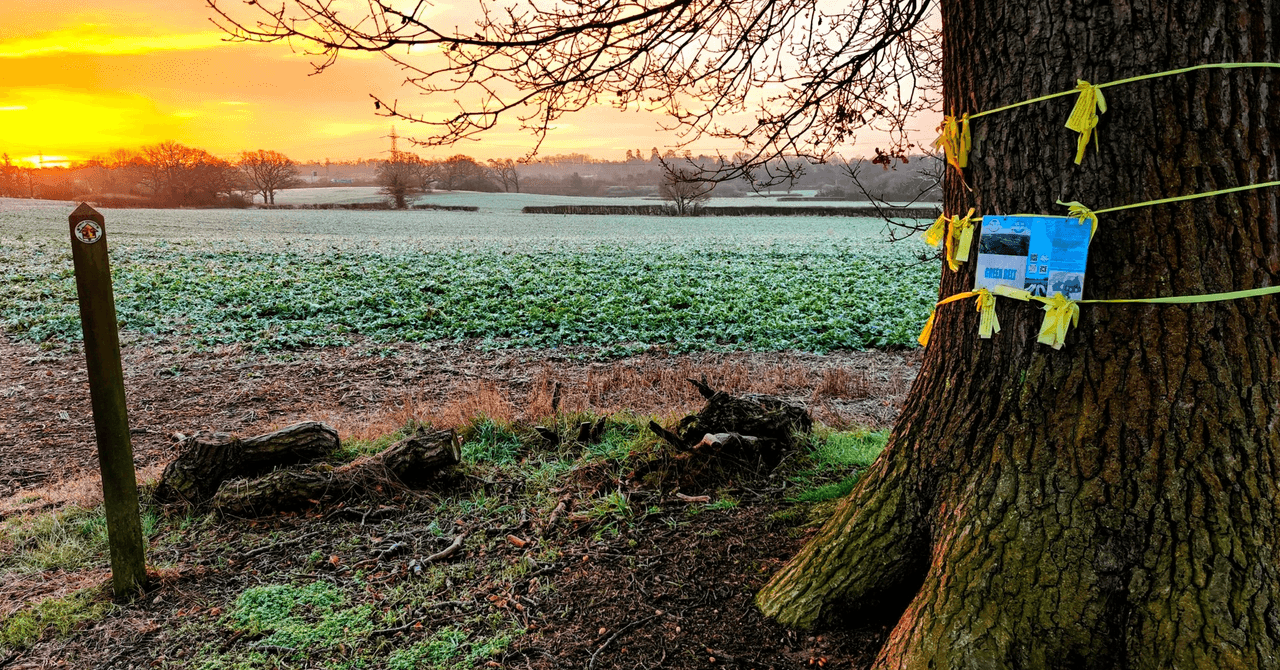

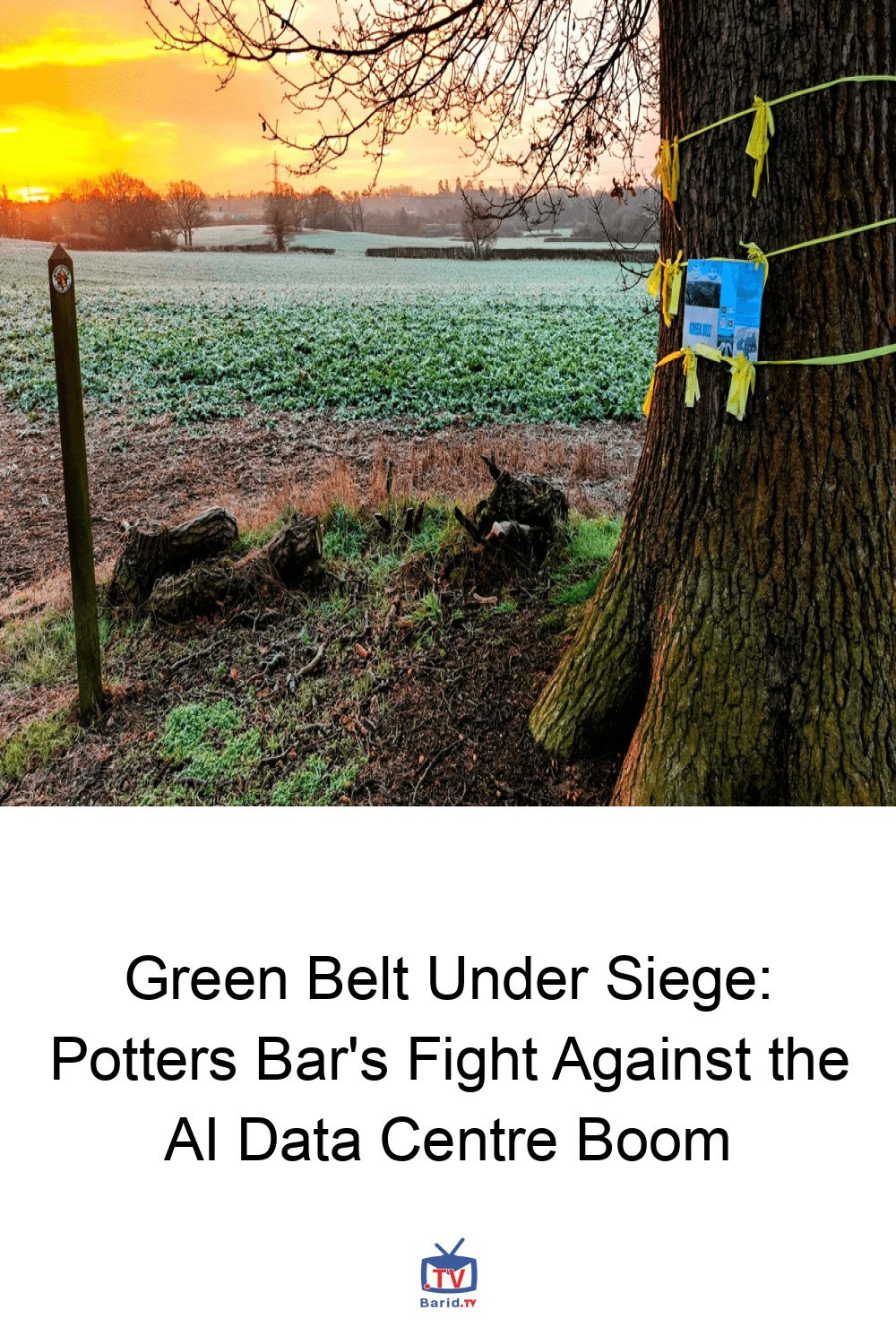
Just a short journey from the bustling heart of London, the serene landscape separating Potters Bar from South Mimms unfolds across 85 acres of verdant farmland. Here, ancient hedgerows crisscross the fields, and a solitary oak tree stands sentinel, a familiar landmark along a public footpath. Lately, however, this tranquil spot has become a focal point of fervent protest, marked by a stark poster tied to its trunk: “NO TO DATA CENTRE.”
The Battle for Potters Bar’s Green Heart
The quiet community of Potters Bar was thrust into the global spotlight in September 2024, when a property developer sought permission to construct an industrial-scale data centre on this very farmland – a facility poised to be one of Europe’s largest. The news galvanized locals, who swiftly formed a Facebook group, attracting over a thousand members united in their determination to block the project.
Despite significant public outcry, the local government proceeded to grant planning permission in January 2025. By October of the same year, multinational data centre giant Equinix had acquired the land, with plans to break ground imminently. This decision has left residents feeling unheard and deeply concerned about the future of their cherished green spaces.
A Community’s Concerns: More Than Just Bricks and Mortar
On a bleak January afternoon, I joined Ros Naylor, a key administrator of the protest group, and six other residents at a gate overlooking the contested farmland. Their objections are multifaceted, but a central concern is the irreversible loss of green space. For them, this land is more than just fields; it’s a vital conduit to the countryside, a crucial buffer against the nearby highway, and an essential haven for mental health and wellbeing.
“The beauty of walking in this area is coming through this space,” Naylor emphasized. “It’s incredibly important for mental health and wellbeing.”
As the UK government accelerates its efforts to meet the insatiable demand for data centres—critical infrastructure for training AI models and running advanced applications—similar colossal facilities are slated for construction nationwide. Yet, for those living on the front lines of these developments, the promise of economic growth or enhanced smartphone capabilities offers scant comfort. They view these projects as a profound disruption to their rural way of life, a sacrifice too great for the abstract benefits of artificial intelligence.
The Shifting Sands of UK Planning Policy
For decades, London and its surrounding areas have been safeguarded by the ‘green belt’ – a protective ring of farms, forests, meadows, and parks. UK law strictly limits construction on green belt land to “very special circumstances,” aiming to prevent urban sprawl and preserve distinct rural identities.
From Green to Grey: A Policy Paradigm Shift
However, a significant policy shift occurred after the current government took power in 2024. The introduction of a new land classification, ‘grey belt,’ now designates underperforming green belt parcels where development might be more readily permitted. Concurrently, data centres were controversially reclassified as “critical national infrastructure.” These combined changes have effectively paved the way for a surge of new data centre developments across the UK, often bypassing traditional environmental protections.
Globally, the world’s leading AI labs are committing trillions to infrastructure, fueling an unprecedented demand for data centres. This global ambition, however, is consistently met with organized resistance from local communities grappling with the direct impacts of such large-scale industrialization.
Conflicting Visions: Local Value vs. National Interest
The local planning authority, in approving the Potters Bar data centre, justified its decision by deeming the farmland to meet the ‘grey belt’ definition. They also cited the government’s explicit support for the data centre industry, concluding that the infrastructure and economic benefits outweighed the loss of green space.
“People have this slightly romantic idea that all green belt land comprises pristine, rolling green fields. The reality is that this site, along with many others, is anything but that,” stated Jeremy Newmark, leader of Hertsmere Borough Council. “It’s a patch of very low-performing green belt land.”
The protest group vehemently disputes this reclassification. They highlight a recent council decision to veto a housing development on an adjacent field specifically to preserve green belt and agricultural land. This apparent inconsistency raises a critical question: how can one field be deemed invaluable, while its neighbour is dismissed as dispensable ‘grey belt’?
“Turn around, cross the road, come to this field—and it’s grey belt,” remarked Eamonn Lynch, a local resident, underscoring the perceived absurdity of the distinction.
A Process Perceived as Predetermined
Residents also express a profound sense of being steamrolled by the planning process. During the initial public consultation, only 775 nearby properties were directly notified. Simon Rhodes, another resident, took it upon himself to canvass door-to-door, collecting hundreds of objections. Despite these efforts, and with local objections outnumbering support signatures by almost two-to-one, the council pressed ahead with planning permission.
Undeterred, the protest group continues its fight, having lodged multiple letters of objection, appealed to a third-party ombudsman and the UK’s Office of Environmental Protection, and even filed a complaint against Council Leader Newmark personally, accusing him of acting improperly in the process.
The Broader Implications
The struggle in Potters Bar is a microcosm of a larger national and global debate. It pits the urgent demands of technological advancement and economic growth against the deeply held values of environmental preservation, community wellbeing, and democratic participation. As the AI revolution gathers pace, the decisions made in small English towns like Potters Bar will echo far beyond their hedgerows, shaping the landscape and the future for generations to come.
For more details, visit our website.
Source: Link