





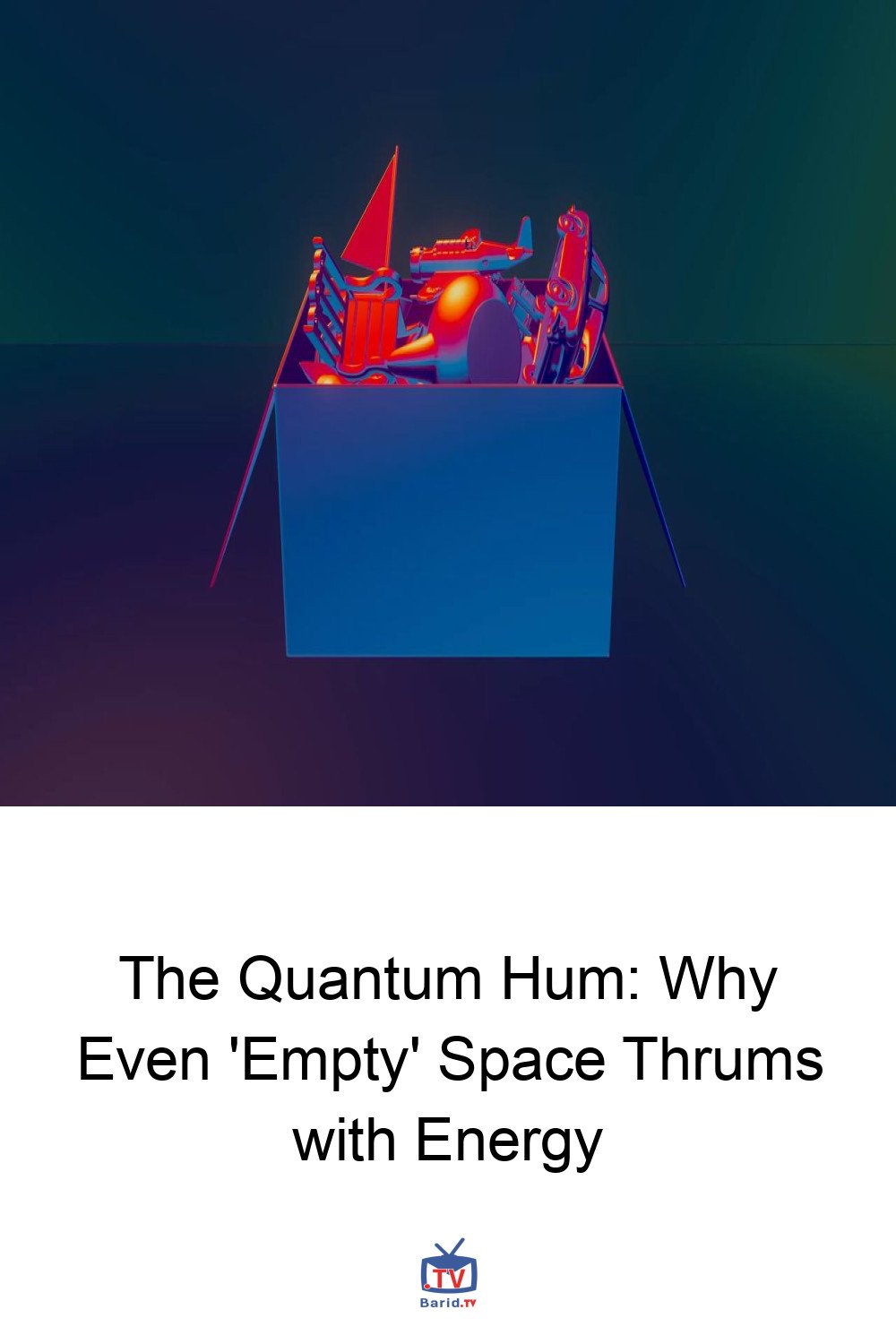
Imagine the ultimate act of emptying. You take a box, remove every visible object, pump out all gases, and even—with a touch of science-fiction—evacuate elusive dark matter. What remains within this seemingly perfect void? According to the enigmatic laws of quantum mechanics, the answer is far from nothing. In fact, your meticulously ’emptied’ box still hums with an irreducible, pervasive energy, barely dented by your efforts. This is the profound and often counter-intuitive realm of zero-point energy.
The Unavoidable Quantum Residue
This persistent, unavoidable energy is known as ground-state energy or, more commonly, zero-point energy (ZPE). It manifests in two fundamental forms: one associated with omnipresent fields, such as the electromagnetic field, and another linked to discrete entities like atoms and molecules. Even if you dampen a field’s vibrations to their absolute minimum, a faint trace of its presence endures. Similarly, atoms and molecules retain a baseline energy, defying complete stillness even when cooled to temperatures infinitesimally close to absolute zero. The underlying physics governing both phenomena is remarkably consistent.
Zero-point energy is an inherent characteristic of any material structure or object that experiences even partial confinement, such as an atom held within the electric fields of a molecule. Picture a ball resting at the bottom of a valley. Its total energy comprises both potential energy (due to its position) and kinetic energy (due to its motion). To truly eliminate both components—to bring the ball to a complete, absolute halt at a precise location—would require assigning exact values to both its position and velocity simultaneously. This, however, is precisely what the Heisenberg Uncertainty Principle forbids. The quantum world dictates an inherent fuzziness, ensuring that a system can never be entirely devoid of energy or motion.
Pioneers and Early Revelations
The concept of zero-point energy first emerged in 1911, introduced by the visionary Max Planck. However, it was Albert Einstein, as noted by quantum vacuum theorist Peter Milonni, who truly embraced its significance. Einstein and his contemporaries leveraged ZPE to elucidate a range of perplexing phenomena. These included the subtle, persistent vibrations of molecules and crystal lattices, even when in their lowest energy states, and the curious refusal of liquid helium to solidify under ordinary pressure, even at temperatures so frigid that atoms would typically lock into place.
A Glimpse into the Quantum Void: Modern Evidence
The reality of zero-point energy continues to be explored and confirmed by cutting-edge research. A compelling recent example, published in 2025, comes from researchers at the European X-Ray Free-Electron Laser Facility near Hamburg. The team cooled iodopyridine, an organic molecule composed of 11 atoms, to near absolute zero. They then subjected it to a laser pulse designed to break its atomic bonds. What they discovered was remarkable: the motions of the freed atoms were correlated, providing direct evidence that the iodopyridine molecule, despite its extreme chill, had been vibrating due to its intrinsic zero-point energy. As experimental physicist Rebecca Boll remarked, “That was not initially the main goal of the experiment. It’s basically something that we found.”
The Casimir Effect: A Force from Nothing
Perhaps the most celebrated manifestation of zero-point energy within a field is the Casimir effect. Predicted by Hendrick Casimir in 1948, first glimpsed in 1958, and definitively observed in 1997, it describes a peculiar force between two closely spaced, electrically uncharged plates. Casimir theorized that these plates, acting like a quantum guillotine, would restrict long-wavelength oscillations of the electromagnetic field between them. This restriction skews the zero-point energy, creating a scenario where, in essence, the energy outside the plates is infinitesimally higher than the energy within. This subtle energy difference generates a measurable attractive force, pulling the plates together.
The Infinite Enigma: ZPE and the Universe
Quantum field theorists conceptualize fields as collections of countless oscillators, each possessing its own zero-point energy. Given the infinite number of such oscillators within a field, this implies an infinite amount of zero-point energy. When physicists first grappled with this “infinity problem” in the 1930s and ’40s, it initially cast doubt on the theory. However, they soon developed methods to manage these infinities. In most areas of physics, it is energy differences that truly matter, allowing physicists to carefully subtract one infinity from another to extract meaningful, finite results.
Yet, this elegant mathematical maneuver falters when confronted with gravity. As early as 1946, Wolfgang Pauli recognized a profound paradox: an infinite, or at least gargantuan, amount of zero-point energy should, according to general relativity, generate a gravitational field so immensely powerful that it would cause the universe to immediately collapse into a black hole. This fundamental discrepancy between quantum mechanics’ inherent energy and general relativity’s description of gravity remains one of the most significant unsolved puzzles in modern physics, hinting at a deeper, unified theory yet to be discovered.
For more details, visit our website.
Source: Link







Leave a comment