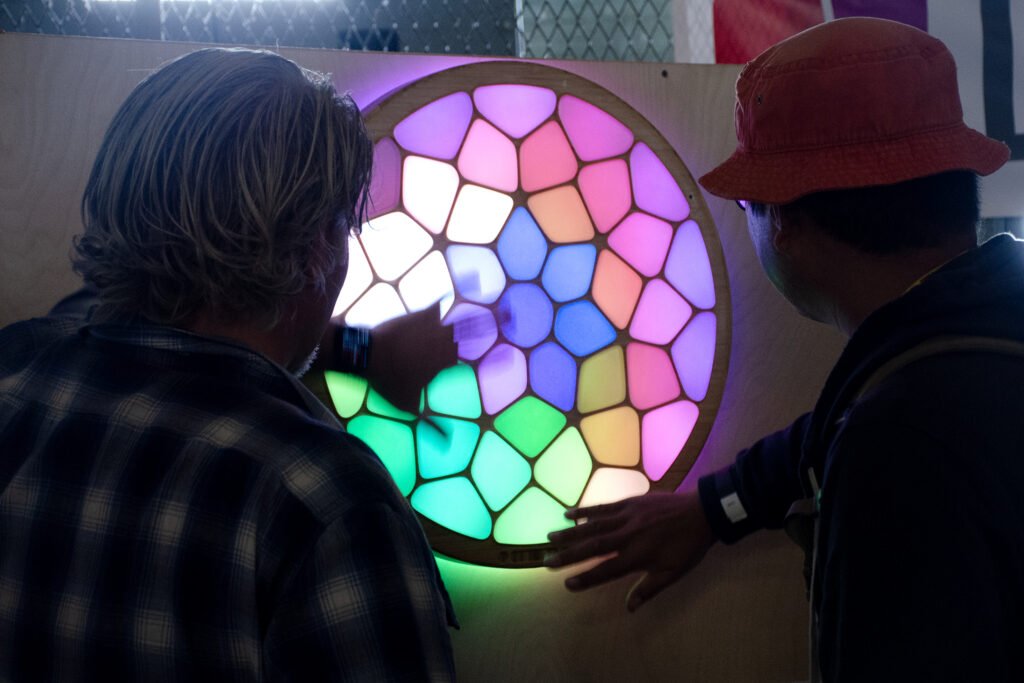

Step into the radiant world of Robert Quattlebaum, the brilliant mind behind Lumanoi, whose captivating LED artworks have redefined the boundaries of interactive sculpture. His creations, a mesmerizing dance of light and form, earned high praise at Maker Faire Bay Area, drawing onlookers into an immersive experience with a mere wave of the hand.
From Tech Giant to Artistic Visionary
Quattlebaum’s journey into the realm of interactive art is as fascinating as his creations. The spark ignited years ago, rooted in a deep-seated passion for making. His early forays included attending a workshop for building the YBox set-top box at Maker Faire Bay Area 2007, a project that eventually led him to co-develop YBox2 with Adafruit. This foundational experience with electronics laid the groundwork for future innovations.
A pivotal moment arrived in 2010 when he began experimenting with addressable LED Christmas lights from Costco. What started as a simple hack — his teardown post became a go-to resource for “hacking Christmas lights” — soon evolved into a surplus of components and a burgeoning idea. Despite a successful career at tech giants like Apple and Nest (later acquired by Google), Quattlebaum felt a pull towards a different path. “Life is short, so do things that you love,” he often reflects, articulating a desire for work that offered tangible creation and a sense of irreplaceable value in an AI-driven world. The oscilloscope on his desk, a symbol of hands-on creation, always brought him joy, pointing him back to those versatile LED lights.
The Genesis of Lumanoi: Discovering Patterns and Interaction
With a renewed sense of purpose, Quattlebaum embarked on an exploratory phase, experimenting with various diffusion techniques and forms. His artistic inspiration came from the natural world, particularly the way bubbles coalesce to form intricate, straight lines. This observation led him to model patterns in software, delving deep into the complexities of Voronoi diagrams to generate cellular structures that would become the signature aesthetic of Lumanoi.
Initially, his explorations were without a defined goal, driven purely by curiosity and the joy of writing algorithms to create beautiful patterns. He meticulously selected the most appealing designs. However, as he delved deeper into hardware prototyping, a crucial realization struck him: the art needed to be interactive. The idea of waving a hand over the piece and having it respond became central to his vision. “After all,” he mused, “how hard could it be?”
Sweating the Details: Crafting Perfection
Having honed his skills at high-end tech companies, Quattlebaum understood that true value lies in meticulous attention to detail. He rigorously experimented with materials and techniques to achieve the desired effect. While glass diffusion panels were considered, laser-cut acrylic proved more forgiving and allowed for even tighter tolerances. He iterated through countless laser-cut and 3D-printed diffusers, tirelessly seeking the perfect balance of brightness, evenness, and finish, all while ensuring seamless interactive response.
Eight months of dedicated work culminated in a prototype that mirrored the stunning piece showcased at Maker Faire. This advanced iteration incorporated custom PCBs and a sophisticated sandwich of diffusion media. A key innovation was treating each
pair of cells as a proximity sensor, rather than individual cells, allowing for more nuanced and responsive interaction. “Concepts are easy, details are where it matters,” he states, underscoring his commitment to engineering excellence.
The Lumanoi project also served as an impetus for Quattlebaum to acquire a CNC router, a tool that opened new avenues for creativity. He embraces continuous learning, mastering the intricacies of feeds and speeds, understanding wood expansion, and even learning the hard way about the importance of speed in machining plastic. His philosophy is clear: “If you’re not learning, you’re dead.”
Artistry Recognized: The Community’s Embrace
While Lumanoi’s genesis was rooted in tech product design, the overwhelming feedback from the community quickly affirmed Quattlebaum’s identity as an artist. His presentation evolved to reflect this, showcasing more of the creative process than a typical tech company might. He believes in transparency and sharing knowledge: “If secrets are all I have, then I don’t deserve to be in the space.” This open approach has resonated with many, contributing to the growth of his YouTube channel.
The positive reception at Maker Faire Bay Area was particularly validating. Being surrounded by fellow makers, all united by a passion for creation, solidified his sense of belonging. “If people start doing the same stuff then more power to them. It makes the world more interesting,” he says, embodying a spirit of collaborative innovation.
Robert Quattlebaum’s Lumanoi creations are more than just art; they are a testament to the power of curiosity, persistence, and the joy of bringing light to life. Explore more of his work by following @vorialabs on Instagram or visiting his website, voria.com.
For more details, visit our website.
Source: Link