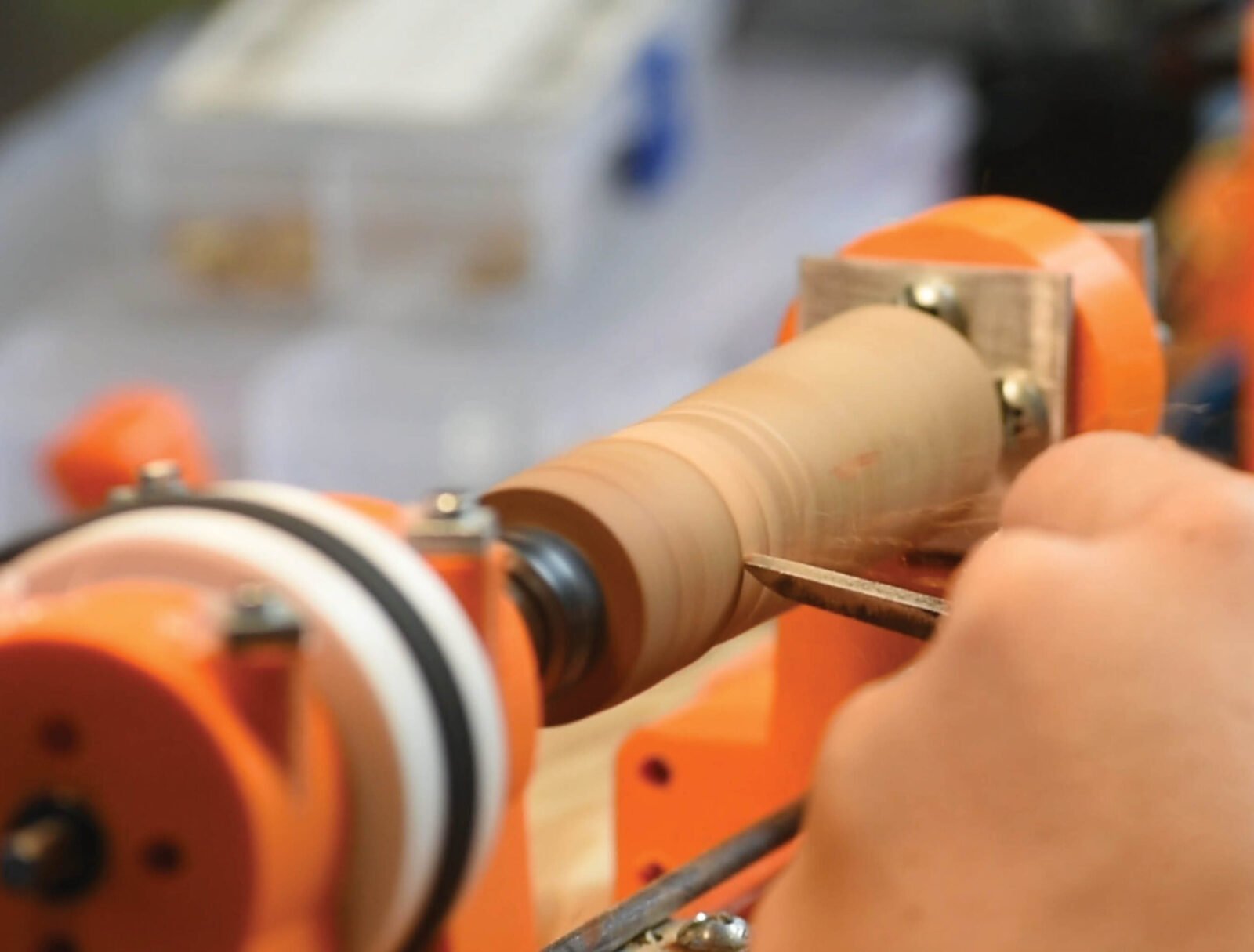

In an age where digital fabrication meets traditional craftsmanship, the possibilities for makers are boundless. Wood turning, an ancient and deeply satisfying art form, has long captivated artisans with its ability to transform raw timber into elegant, functional pieces. Now, thanks to the accessibility of 3D printing, this intricate hobby is more within reach than ever before. Imagine crafting bespoke tool handles, unique kitchen utensils, or decorative elements from timber you’ve personally gathered – all from your own custom-built lathe.
This article, inspired by the innovative spirit of Make: Magazine Vol. 79, guides you through the creation of an affordable yet remarkably capable wood turning lathe, predominantly constructed from 3D-printed parts and readily available hardware. While the 3D printing itself requires a significant time investment, the assembly is a rewarding endeavor, blending modern technology with hands-on skill. Dive in and discover how to bring this versatile tool to life in your own workshop.
Project at a Glance
- Time Required: 2–3 Hours (Assembly) + 50 Hours (3D Printing)
- Difficulty: Moderate
- Estimated Cost: $15–$50
A comprehensive video tutorial and all necessary print files are available online at Printables, ensuring you have every resource needed to succeed. Here, we’ll delve into the critical design and assembly notes for each major component.
The Foundation: Building a Stable Base
The base of your lathe, constructed from a few simple pieces of lumber, is paramount to its stability and functionality. Beyond the obvious dimensional considerations, two key design elements are crucial: a central gap running down the middle of the boards and a secondary gap beneath them. These strategically placed voids are not merely aesthetic; they facilitate the adjustment and clamping mechanisms for both the tailstock and tool rest. Each of these components utilizes a threaded rod that securely clamps beneath the lathe via a knob, ensuring a firm, wobble-free operation. Early iterations without this robust clamping system proved frustratingly unstable, highlighting the importance of this design choice. While a fixed tailstock setup directly bolted to a bench is an option, it severely limits the length of timber you can work with, potentially leading to material waste on smaller projects. The adjustable base offers unparalleled versatility.
The Backbone: Crafting the V-Bed
The lathe’s bed comprises four essential components. Two end pieces (often highlighted in orange in design schematics) attach to the distinctive V-shaped bed (typically red) using four threaded inserts. This assembly then serves as a template for drilling the mounting holes into the base. Once secured, the headstock is temporarily removed, and a specialized headstock template guides the alignment of the final four mounting holes. This streamlined assembly process ensures precision and ease of construction.
The ingenious V-shape of the bed is not just for aesthetics; it’s a functional design choice. When the tailstock clamps down, the V-bed is compressed, creating a remarkably firm and secure hold for the workpiece. The only minor trade-off for this enhanced stability is a slightly increased difficulty in cleaning, though this is a negligible concern in practice.
The Powerhouse: Assembling the Headstock
Once the headstock template is removed and the headstock is permanently affixed, it’s secured with two wood screws and four robust 3/16″ threaded rods. These rods are critical, running the entire length of the headstock and clamping it down securely to the base. The headstock is, by design, the strongest part of the entire lathe – and for good reason. As the primary point of attachment for the workpiece, it must withstand the bulk of the forces generated during turning. Given that 3D prints are inherently weaker along their layer lines, these threaded rods are a vital reinforcement, preventing layer separation and significantly enhancing the lathe’s overall strength. For complete failure to occur, the nuts on these rods would also have to give way, a testament to the design’s resilience. While alternative printing orientations might be considered, they carry the risk of splitting the print when tightening the rods, which remain essential for maintaining headstock rigidity regardless of orientation.
Beyond its structural integrity, the headstock incorporates four bearings, a 5mm stainless steel rod, a pulley, and an ER11 collet chuck. The ER11 collet chuck was chosen for its affordability and versatility, allowing for a wide range of mounting options. For most workpieces, a simple wood screw with the head removed proves to be an effective and reliable mounting solution.
The Stabilizer: Engineering the Tailstock
The tailstock proved to be the most challenging component to perfect, undergoing several iterations before achieving its current, highly effective design. This crucial part consists of three aluminum plates, two bearings, a sharpened rod serving as the center, and a threaded rod for clamping. Its rigidity is further enhanced by the ability to apply pressure from behind, a feature absent in earlier designs that often led to instability and premature failure during operation. The immediate feedback of a wobbling or breaking tailstock quickly guided the design improvements.
A significant hurdle encountered during development was the overheating of the tailstock bearings, which would melt their plastic housing – an issue notably absent in the headstock. The solution came in the form of the three aluminum plates. These plates not only provide a stronger guide for the tailstock but also cleverly act as heat sinks, effectively dissipating thermal energy. This innovative setup has completely eliminated tailstock failures, ensuring smooth and reliable operation.
The Support: Designing the Tool Rest
To complete your turning setup, two versions of the tool rest are available. The first is a straightforward 8mm rod designed to run the length of the workpiece, offering continuous support. The second, a newer and more compact design, is an adjustable “T rest,” providing enhanced flexibility for various turning tasks. Both options ensure comfortable and precise tool manipulation, allowing you to focus on the artistry of wood turning.
Embark on Your Turning Journey
With this detailed guide, you’re well-equipped to embark on the rewarding journey of building your own 3D-printed wood lathe. This project not only offers a practical tool for your workshop but also serves as a testament to the power of combining modern manufacturing techniques with timeless craft. Happy turning!
For more details, visit our website.
Source: Link