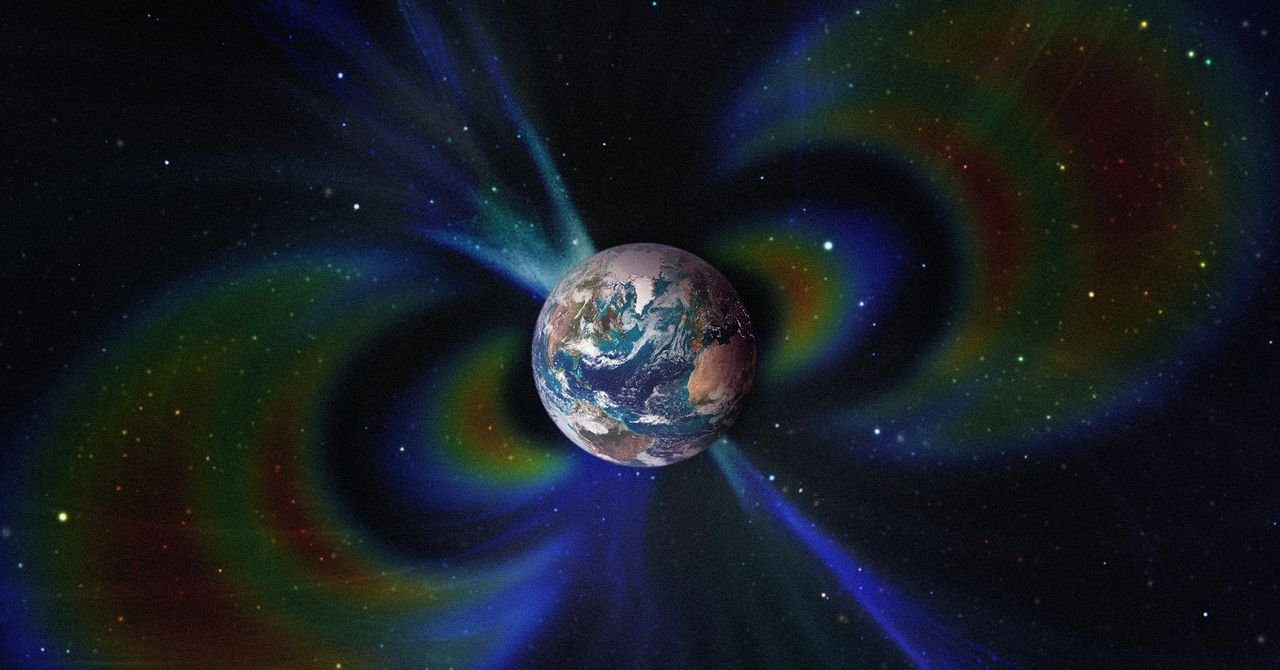

Deep beneath our feet, two colossal, continent-sized structures have been quietly orchestrating one of Earth’s most vital phenomena: its magnetic field. For the first time, a team of geologists has uncovered compelling evidence that these ancient, ultrahot masses have profoundly shaped the planet’s magnetic shield for an astonishing 265 million years, challenging long-held scientific assumptions.
Unveiling Earth’s Deepest Mysteries
These enigmatic masses are known as Large Low-Shear-Velocity Provinces (LLSVPs). They represent some of the most enormous and mysterious objects within our planet’s interior. Buried approximately 2,900 kilometers deep – almost halfway to Earth’s center – each LLSVP is estimated to be comparable in size to the entire African continent. Far from being solid blocks, these regions are irregular areas within the Earth’s mantle where the material is significantly hotter, denser, and chemically distinct from the surrounding mantle. Intriguingly, they are often encircled by a “ring” of cooler material, through which seismic waves travel at a faster pace.
Scientists first suspected the existence of these deep-seated anomalies in the late 1970s, with their presence confirmed two decades later. Now, after another decade of dedicated research, geologists are directly attributing to LLSVPs the remarkable ability to modify Earth’s magnetic field.
The Core Connection: Reshaping the Magnetic Shield
The groundbreaking study, recently published in Nature Geoscience and spearheaded by researchers at the University of Liverpool, illuminates the mechanism behind this profound influence. The significant temperature disparities between the LLSVPs and the adjacent mantle material directly impact the flow of liquid iron within Earth’s outer core. This dynamic movement of molten iron is, in essence, the engine that generates our planet’s protective magnetic field, a phenomenon known as the geodynamo.
The interplay between these ultrahot and cooler zones within the mantle creates an asymmetry, either accelerating or decelerating the liquid iron’s flow depending on the specific region. This resulting imbalance is a key factor in the irregular, complex shape of the magnetic field we observe today.
To arrive at these conclusions, the research team meticulously analyzed existing mantle evidence and conducted sophisticated simulations using supercomputers. They compared models of how the magnetic field would behave if the mantle were uniform against scenarios incorporating these heterogeneous LLSVP structures. Crucially, when these simulated outcomes were contrasted with real-world magnetic field data, only the model that included the LLSVPs accurately replicated the observed irregularities, tilts, and patterns. Furthermore, these geodynamo simulations revealed that while some aspects of the magnetic field have remained remarkably stable over hundreds of millions of years, others have undergone significant transformations.
Profound Implications for Our Planet’s Past
The implications of these findings extend far beyond geomagnetism. As Andy Biggin, the study’s lead author and Professor of Geomagnetism at the University of Liverpool, explained in a press release, “These findings also have important implications for questions surrounding ancient continental configurations—such as the formation and breakup of Pangaea—and may help resolve long-standing uncertainties in ancient climate, paleobiology, and the formation of natural resources.”
He further elaborated, “These areas have assumed that Earth’s magnetic field, when averaged over long periods, behaved as a perfect bar magnet aligned with the planet’s rotational axis. Our findings are that this may not quite be true.” This research fundamentally challenges the long-held assumption of a perfectly aligned, stable magnetic field over geological timescales, offering new perspectives on Earth’s dynamic history and the forces that have shaped it.
For more details, visit our website.
Source: Link