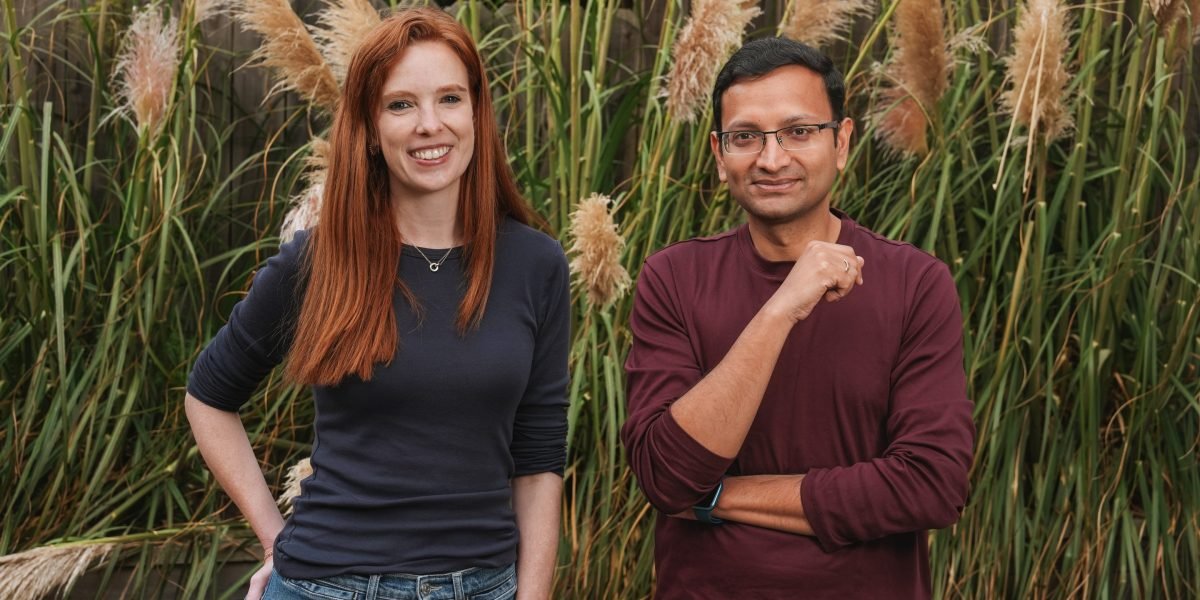

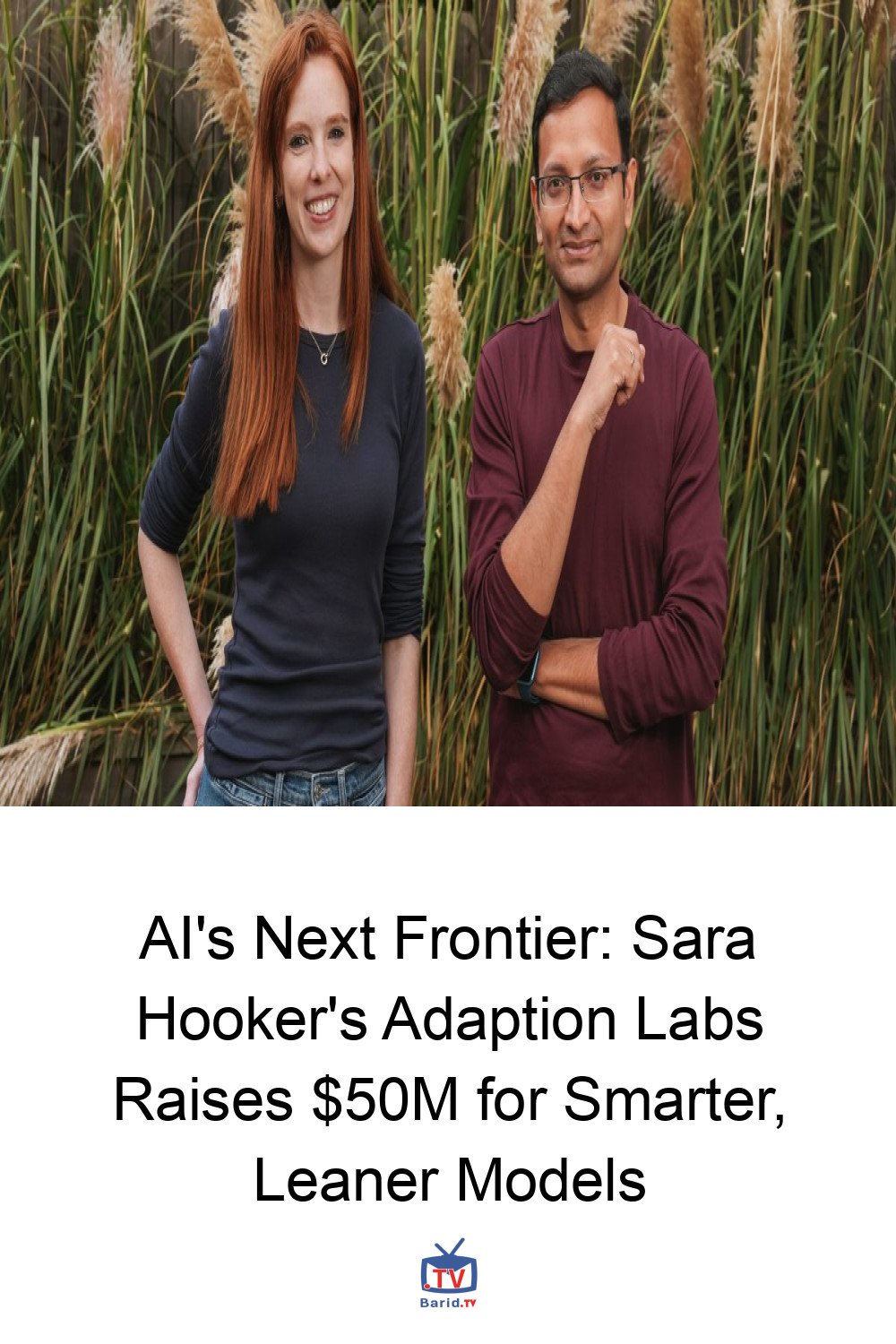
In a significant move poised to redefine the trajectory of artificial intelligence, Sara Hooker, a formidable AI researcher and a vocal proponent for more efficient, less resource-intensive AI systems, has officially launched her ambitious new venture, Adaption Labs. The San Francisco-based startup has successfully secured a substantial $50 million in seed funding, signaling a strong vote of confidence in its innovative approach to AI development.
A Bold Bet Against AI’s ‘Bigger is Better’ Dogma
Hooker, formerly the Vice President of Research at AI powerhouse Cohere and a distinguished veteran of Google DeepMind, is not merely entering the competitive AI landscape; she’s actively challenging its dominant paradigm. Alongside co-founder Sudip Roy, who previously served as Director of Inference Computing at Cohere, Adaption Labs is dedicated to engineering AI systems that demand significantly less computing power and are more cost-effective to operate than the colossal models currently leading the industry. Their vision extends to creating models that are inherently more “adaptive” to specific tasks, utilizing a diverse array of techniques – a philosophy deeply embedded in the company’s very name.
Pioneering Continuous Learning
At the heart of Adaption Labs’ mission is the pursuit of continuous learning. Hooker envisions models capable of evolving and improving without the prohibitively expensive retraining, laborious fine-tuning, or extensive prompt and context engineering that most enterprises currently undertake to tailor AI to their unique needs. This capability, widely regarded as one of AI’s most formidable outstanding challenges, is what Hooker describes as “probably the most important problem that I’ve worked on.”
This approach stands in stark contrast to the prevailing industry wisdom, which often dictates that the path to more capable AI lies in building ever-larger Large Language Models (LLMs) trained on exponentially more data. While tech giants pour billions into these massive training runs, Hooker contends that this strategy is yielding diminishing returns. “Most labs won’t quadruple the size of their model each year, mainly because we’re seeing saturation in the architecture,” she explains, asserting that the AI industry has reached a “reckoning point” where true progress will stem from adaptability and efficiency, not sheer scale.
The Three Pillars of Adaption Labs
Adaption Labs’ groundbreaking work is structured around three core pillars, designed to foster truly intelligent and flexible AI systems:
- Adaptive Data: This pillar focuses on empowering AI systems to dynamically generate and manipulate the data required to solve a problem in real-time, moving beyond reliance on vast, static pre-trained datasets.
- Adaptive Intelligence: Here, the goal is to enable AI to automatically gauge the difficulty of a given problem and adjust the computational resources expended accordingly, optimizing efficiency.
- Adaptive Interfaces: This involves creating systems that learn and refine their performance based on how users interact with them, fostering a more intuitive and responsive AI experience.
A Legacy of Challenging Convention
Sara Hooker’s stance against the “scale is all you need” dogma is not new. Her reputation within AI circles has long been that of a thoughtful contrarian. Her widely cited 2020 paper, “The Hardware Lottery,” provocatively argued that the success or failure of AI ideas often hinges on their compatibility with existing hardware, rather than their intrinsic merit. More recently, her research paper “On the Slow Death of Scaling” posited that smaller models, when coupled with superior training techniques, can indeed outperform their much larger counterparts.
During her tenure at Cohere, Hooker spearheaded the Aya project, an ambitious global collaboration involving 3,000 computer scientists from 119 countries. This initiative successfully extended state-of-the-art AI capabilities to dozens of languages where leading frontier models typically underperformed, achieving this remarkable feat with relatively compact models. This work powerfully demonstrated that innovative approaches to data curation and training can effectively compensate for raw scale.
The Rise of the “Neolabs”
Adaption Labs is part of an emerging wave of “neolabs” – a new generation of frontier AI companies following in the footsteps of established giants like OpenAI, Anthropic, and Google DeepMind. These startups are actively exploring novel AI architectures aimed at cracking the continuous learning challenge.
Notable contemporaries include Jerry Tworek, a former senior OpenAI researcher who founded Core Automation with a similar focus on continuous learning, and David Silver, a former Google DeepMind top researcher, who launched Ineffable Intelligence to explore reinforcement learning as a path to continuously learning AI models.
Exploring Gradient-Free Learning
Among the advanced concepts Adaption Labs is investigating is “gradient-free learning.” Traditional neural network training, which underpins today’s massive AI models, relies on “gradient descent.” This technique can be likened to a blindfolded hiker meticulously feeling their way down a slope to find the lowest point, making tiny adjustments to billions of internal “weights” that govern how neurons interact. Gradient-free learning seeks alternative, potentially more efficient, methods to optimize these complex networks, moving beyond the incremental, computationally intensive adjustments of gradient descent.
The Future is Adaptive
With $50 million in funding and a clear vision, Adaption Labs is poised to make significant strides in developing AI that is not only more efficient and accessible but also truly intelligent and adaptable. Sara Hooker’s leadership marks a pivotal moment in the AI landscape, advocating for a future where innovation is measured not by size, but by ingenuity and impact.
For more details, visit our website.
Source: Link