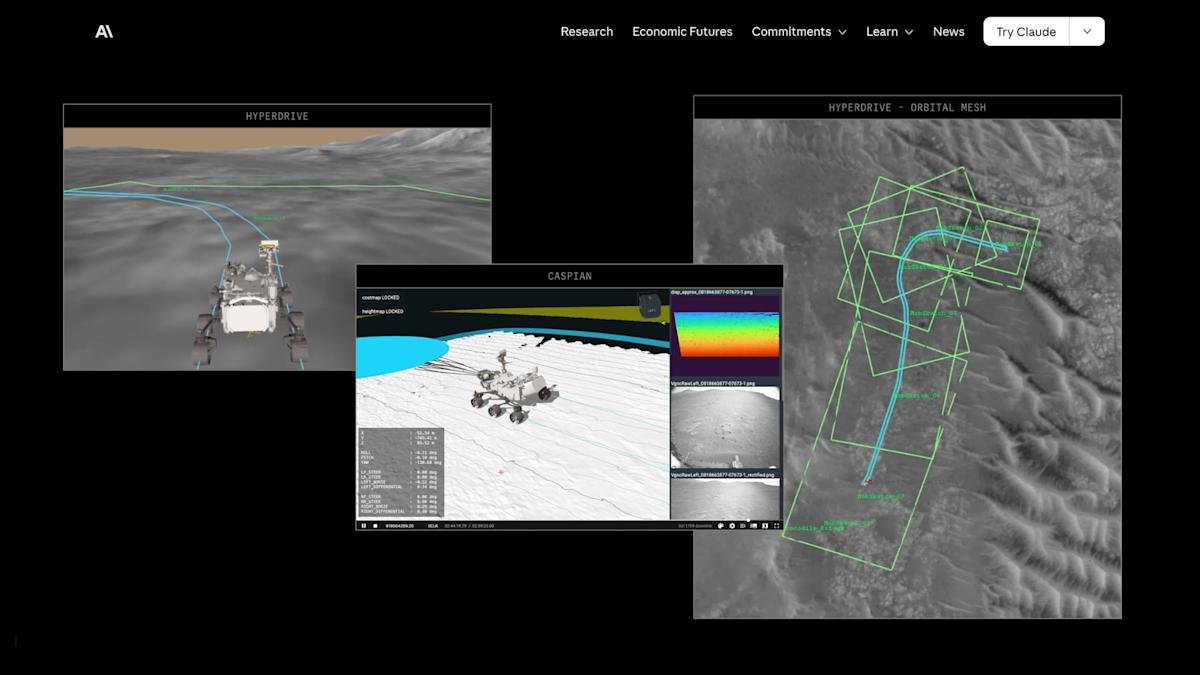

NASA’s Perseverance rover, a titan of Martian exploration, has added another groundbreaking achievement to its impressive resume. Since its landing in 2021, the car-sized robot has delivered historic firsts, from sending back the inaugural audio recordings of the Red Planet to meticulously collecting samples. Now, nearly five years into its mission, Perseverance has successfully navigated a challenging section of Mars’ Jezero Crater using a route meticulously plotted by Anthropic’s Claude chatbot. This milestone marks the first time NASA has leveraged a large language model (LLM) to guide one of its extraterrestrial explorers.
AI Takes the Wheel: Claude Charts a Course on Mars
Between December 8 and 10, Perseverance traversed approximately 400 meters (about 437 yards) across a rocky Martian landscape, following a path devised by Claude. This wasn’t a simple “ask AI to plot a route” scenario; the complexities of Martian terrain demand unparalleled precision.
The Intricacies of Martian Navigation
Guiding a rover across Mars is an endeavor fraught with peril, even for seasoned human operators. NASA emphasizes the critical nature of each drive: “Every rover drive needs to be carefully planned, lest the machine slide, tip, spin its wheels, or get beached.” Traditionally, human teams at the Jet Propulsion Laboratory (JPL) painstakingly lay out a “breadcrumb trail” of waypoints, utilizing a combination of orbital imagery and the rover’s onboard cameras to ensure a safe passage.
How Claude Steered Perseverance
To empower Claude with this monumental task, NASA first equipped Anthropic’s programming agent, Claude Code, with years of contextual data gleaned from the Perseverance mission. Armed with this extensive knowledge base, Claude embarked on the mapping process with methodical precision. It meticulously strung together waypoints in ten-meter segments, a process it could then critique and iterate upon to refine the optimal path.
Human Oversight: The Essential Safety Net
While Claude’s capabilities are impressive, human expertise remains paramount. Engineers at JPL rigorously double-checked the AI’s proposed route. They fed Claude’s generated waypoints into their daily simulation environment, the very same system used to validate all commands sent to the rover. Ultimately, NASA reported only “minor changes” were needed, with one notable adjustment stemming from the JPL team’s access to ground-level images that Claude had not seen during its initial planning phase.
Accelerating Discovery: The Promise of AI in Space
The implications of this successful collaboration are profound. NASA engineers estimate that integrating Claude into their planning workflow could halve the route-planning time and enhance the consistency of the rover’s journeys. This efficiency gain is not merely about saving time; it’s about maximizing scientific output.
“Less time spent doing tedious manual planning — and less time spent training — allows the rover’s operators to fit in even more drives, collect even more scientific data, and do even more analysis. It means, in short, that we’ll learn much more about Mars,” NASA stated.
NASA’s Resourceful Innovation Amidst Challenges
In an era where productivity gains from AI are often debated, for an agency like NASA, any tool that boosts efficiency is invaluable. The agency has faced significant workforce reductions in recent years, including a loss of approximately 4,000 employees (20% of its workforce) due to past administration cuts. Despite Congress rejecting a proposed near-halving of its science budget for 2026, NASA operates with funding levels just below those of 2025. Tasked with ambitious goals like returning to the Moon with less than half the workforce of the Apollo era, innovative solutions like AI-assisted navigation are not just welcome—they are essential.
Anthropic’s Meteoric Rise
For Anthropic, the company behind Claude, this achievement represents a remarkable leap. It was less than a year ago that Claude struggled to conquer the rudimentary challenges of Pokémon Red. Now, its models are successfully plotting complex courses for a sophisticated rover on another planet. This rapid evolution underscores the accelerating pace of AI development and its burgeoning real-world applications.
The Future of Autonomous Exploration
NASA is clearly enthusiastic about the potential for future collaborations, envisioning a future where “autonomous AI systems could help probes explore ever more distant parts of the solar system.” This successful Martian navigation by Claude is not just a single feat; it’s a significant step towards a new era of AI-driven space exploration, promising faster discoveries and deeper insights into the cosmos.
For more details, visit our website.
Source: Link