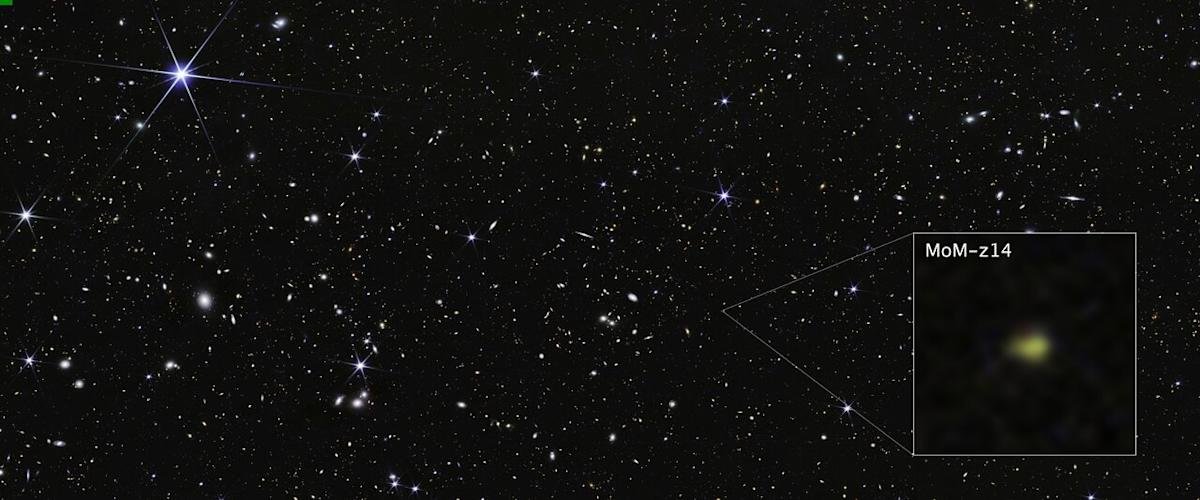

The cosmos continues to unveil its deepest secrets, thanks to the unparalleled gaze of the James Webb Space Telescope (JWST). Astronomers have recently announced a groundbreaking discovery: a remarkably bright galaxy, designated MoM-z14, which existed a mere 280 million years after the universe’s fiery birth, the Big Bang. This ancient celestial beacon is providing unprecedented data, challenging long-held theories and offering a direct window into the universe’s infancy.
A Glimpse into Cosmic Infancy
While 280 million years may seem an eternity, in the grand timeline of the universe’s estimated 13.8 billion-year existence, MoM-z14 is one of the closest cosmic entities ever observed to the Big Bang. Its extreme antiquity makes it an invaluable cosmic fossil, capable of revealing the conditions and processes that shaped the nascent universe. “With Webb, we are able to see farther than humans ever have before, and it looks nothing like what we predicted, which is both challenging and exciting,” stated Rohan Naidu, lead author from the Massachusetts Institute of Technology, whose team’s findings were published in the Open Journal of Astrophysics.
The Webb Telescope’s Near-Infrared Spectrograph (NIRSpec) instrument was crucial in dating MoM-z14. By meticulously analyzing how the galaxy’s light stretched and shifted wavelengths during its immense journey across billions of light-years, scientists could precisely determine its age and distance.
Unveiling Unexpected Secrets
The Nitrogen Enigma
One of the most intriguing surprises presented by MoM-z14 is its chemical composition. Early galaxies, including this newly discovered marvel, exhibit higher concentrations of nitrogen than scientists had previously thought possible. This unexpected abundance prompts new questions about the stellar processes and nucleosynthesis occurring in the universe’s earliest stars, potentially rewriting our understanding of how elements were forged in the cosmic crucible.
Reionization: Lighting Up the Cosmos
Another critical area of study illuminated by MoM-z14 is the epoch of reionization. This pivotal period in cosmic history saw the first stars and galaxies produce enough energetic light to ionize the dense, neutral hydrogen fog that permeated the early universe, making it transparent. Understanding how and when this “cosmic dawn” occurred is fundamental to piecing together the universe’s evolutionary puzzle. MoM-z14, with its intense brightness, offers vital clues about the sources responsible for this transformative process.
“It’s an incredibly exciting time, with Webb revealing the early Universe like never before and showing us how much there still is to discover,” remarked Yijia Li, a graduate student from Pennsylvania State University and a key team member.
As the James Webb Space Telescope continues its mission, each new observation promises to deepen our comprehension of the universe’s origins, challenging existing paradigms and igniting further scientific inquiry into the vast, unexplored reaches of space and time.
For more details, visit our website.
Source: Link