
Bitcoin’s Persistent Plateau: A Weekend of Woe
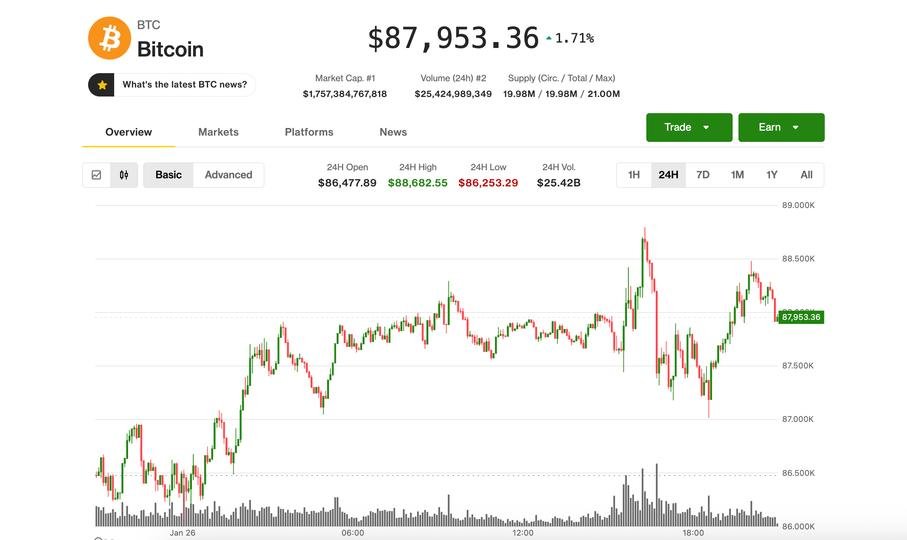
As the financial world grapples with a complex tapestry of economic signals, Bitcoin (BTC) finds itself in a precarious position, hovering stubbornly near the $88,000 mark. This stagnation comes despite a brief respite from the weekend’s panicked selling, which saw the digital asset dip close to the year’s low of $87,700. The leading cryptocurrency, which had briefly touched $90,000 late Friday, retreated sharply, largely influenced by the escalating odds of a government shutdown slated for January 31st and the potential liquidity crunch it could trigger.
Gold and Silver’s Blistering Rally Meets Resistance
In stark contrast to Bitcoin’s struggles, precious metals embarked on a spectacular, record-breaking ascent. Gold surged past the unprecedented thresholds of $5,000 and then $5,100 over Sunday and Monday, while silver mirrored this astonishing performance, racing as high as $118. This dramatic rally prompted crypto analyst Will Clemente to quip, “Gold and silver casually adding an entire bitcoin market cap in a single day,” perfectly encapsulating the mood of many Bitcoin investors.
However, even the most robust rallies face gravity. Signs of exhaustion began to emerge as both metals pulled back from their peaks. Gold retreated to $5,043, still up 1.3% for the day, while silver pared its gains to $108, maintaining a 7% increase. This quick retreat suggests that while their ascent was formidable, the precious metals market might be entering a period of consolidation.
Macro Headwinds and Legislative Hurdles
Dollar Weakness Fails to Ignite BTC
Adding another layer of complexity to the market dynamics, the U.S. dollar index (DXY) weakened to its lowest level since September. Reports indicate that the U.S. Federal Reserve and the Bank of Japan collaborated to intervene in currency markets, aiming to bolster the yen against the greenback. Despite the dollar’s decline, Bitcoin failed to demonstrate any significant bullish follow-through, a development that has left traders increasingly cautious.
Government Shutdown & The Clarity Act
Analysts are pointing to several key factors that continue to cast a shadow over crypto prices. The looming government shutdown is a primary concern, not only for its potential impact on broader market liquidity but also for its implications for critical crypto legislation. Jim Ferraioli, Schwab’s director of crypto research and strategy, highlights the passage of the Clarity Act as a significant catalyst for Bitcoin. However, a government shutdown could further delay this vital legislation, keeping major institutional players on the sidelines and confining BTC to a narrow trading range between the low $80,000s and mid-$90,000s.
Analyst Outlooks: Range-Bound and Cautious
The prevailing sentiment among market analysts is one of caution. Swissblock analysts noted that recent price action has “reinforced the bearish outlook,” warning that a decisive breakdown below the $84,500 support level could trigger a deeper correction towards $74,000. Conversely, they suggest that if this support holds and risk metrics cool, it could present a compelling entry point for bulls.
Echoing this cautious tone, Bitfinex analysts predict that BTC will likely remain range-bound between $85,000 and $94,500. Their analysis of the options market indicates that traders are tactically responding to short-term risks, “pricing transitory risk rather than a sustained disruption to market structure.”
ETF Outflows Add Pressure
Further compounding Bitcoin’s challenges are persistent outflows from spot Bitcoin ETFs. Cumulative outflows have exceeded $1.3 billion over the past week, a clear indicator of a diminished risk appetite among investors. Without a significant pickup in on-chain activity, ETF flows, derivatives positioning, or miner participation, a sustained move beyond current levels appears unlikely, according to experts like Ferraioli.
In essence, the crypto market remains in a delicate holding pattern, awaiting clear catalysts and the resolution of macroeconomic and legislative uncertainties before a definitive direction can be established.
For more details, visit our website.
Source: Link