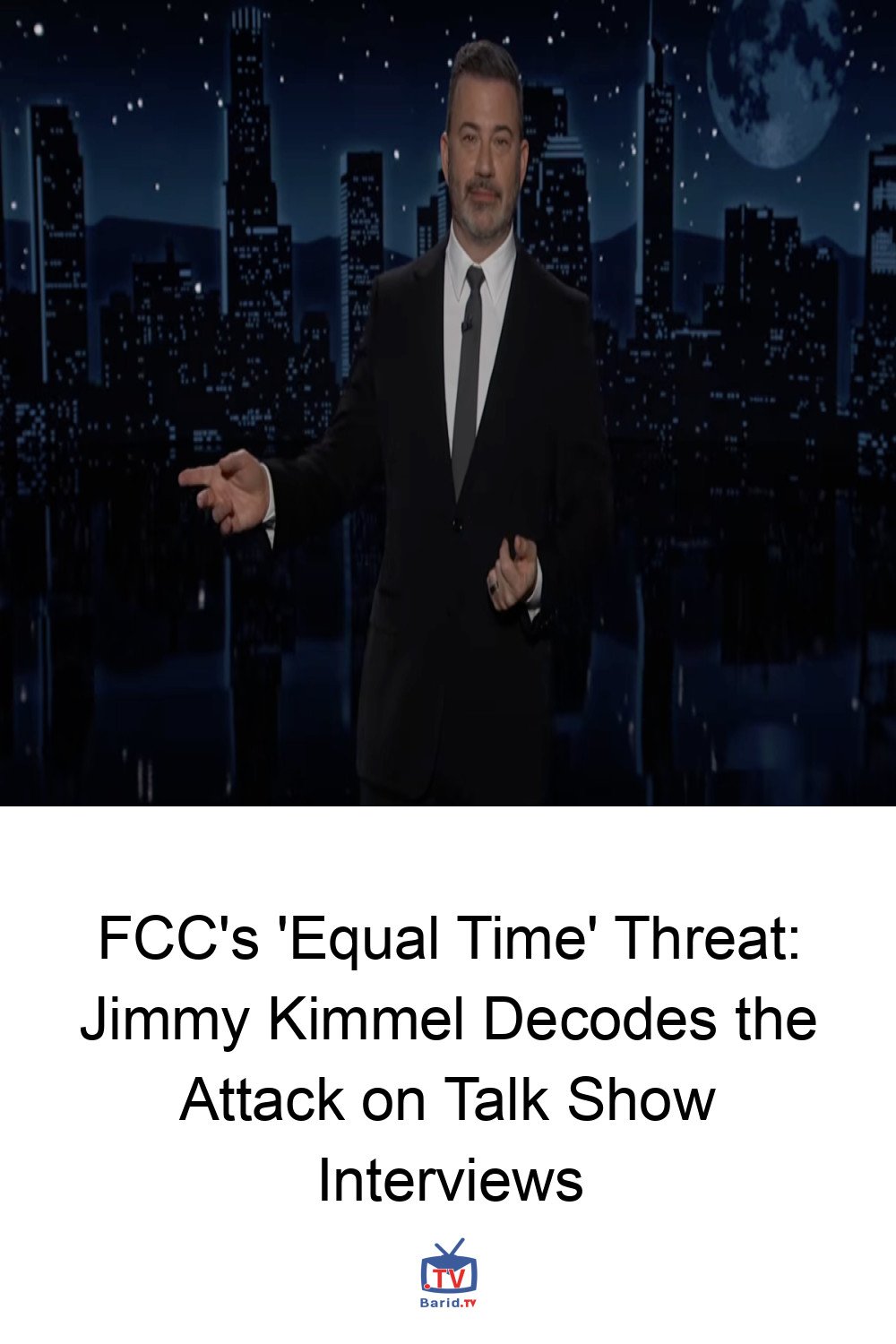
Late-night television host Jimmy Kimmel has once again found himself at the forefront of a brewing controversy, this time dissecting what he describes as the Federal Communications Commission’s (FCC) latest assault on free speech and the traditional role of talk shows in political discourse. The FCC’s new guidance on “equal time” rules for broadcast interviews with political candidates has sent ripples through the industry, prompting Kimmel to dedicate a significant portion of his monologue to unpacking the complex regulations and their potential ramifications.
The FCC’s Renewed Scrutiny on Talk Shows
On a recent Thursday night, Kimmel articulated his concerns, pointing directly at Donald Trump’s appointed FCC chair, Brendan Carr, whom he characterized as launching a “latest attack on free speech.” This isn’t Carr’s first run-in with Kimmel’s show; previous threats led to a temporary pulling of Jimmy Kimmel Live! off the air in September. Kimmel alleges that the FCC is “now trying to use equal time rules to prevent shows like ours and The View from conducting interviews with candidates. They’re reinterpreting long agreed upon rules to stifle us.”
Understanding the “Equal Time” Doctrine
To fully grasp the gravity of the situation, Kimmel walked his audience through the historical evolution of the “equal time” rules. The journey begins with the 1927 Radio Act, a foundational piece of legislation that mandated broadcasters “to give equal time for legally qualified camps, meaning, if you put one candidate on the air, you had to offer the same amount of airtime to all the other candidates.” This provision aimed to ensure fairness and prevent broadcasters from unfairly favoring one candidate over others.
However, the landscape shifted significantly with a 1959 amendment. This crucial change introduced an exemption for “bonafide newscasts and bonafide news interviews” from the stringent equal time requirements. As Kimmel elaborated, this amendment allowed major networks like ABC, CBS, and NBC to interview a single candidate without being compelled to offer identical airtime to all their rivals. Initially, this exemption primarily benefited traditional news programs.
From News Desks to Late-Night Couches: A Historical Precedent
Over time, the interpretation of “bonafide news interviews” broadened, extending its reach to include talk shows. Kimmel cited several landmark examples:
- John F. Kennedy’s 1960 appearance on The Tonight Show with Jack Paar: A pivotal moment demonstrating a presidential candidate engaging with a broader audience outside conventional news formats.
- Bill Clinton’s 1992 interview on The Arsenio Hall Show: Another instance of a presidential hopeful connecting with voters through entertainment programming.
- Arnold Schwarzenegger’s 2006 interview on The Tonight Show with Jay Leno: While campaigning for governor of California, Schwarzenegger’s appearance prompted a complaint from Democratic rival Phil Angelides, who demanded equal time. Crucially, the FCC denied Angelides’ request, affirming that Schwarzenegger’s interview qualified as a “bona fide news interview” despite being on a talk show. This ruling effectively solidified the exemption for talk shows, a precedent that has stood for decades.
“They ruled that Arnold appearing on Leno, this was a bona fide news interview, even though it was a talk show and therefore not subject to those equal time rules,” Kimmel explained, underscoring how this interpretation has guided talk show operations ever since.
Brendan Carr’s Challenge and the Future of Political Discourse
The status quo, however, is now under threat. Kimmel highlighted Brendan Carr’s recent efforts to challenge this long-standing exemption. “Until this week, when Trump’s little ferret in the FCC, Brendan Carr, who, as you know, is doing everything he can to shut us up the easy way or the hard way, is trying to say we no longer qualify for the bona fide news exemption when it comes to interviewing candidates, which is a sneaky little way of keeping viewpoints that aren’t his off air.”
Kimmel’s strong words reflect a deep concern that this reinterpretation is not merely about regulatory adherence but about stifling dissenting voices and controlling the narrative. The potential outcome remains uncertain, but Kimmel’s message was clear: “I wanted to point it out, because it is another example of this administration trying to squash anyone who doesn’t support them.”
This evolving situation raises critical questions about the intersection of entertainment, journalism, and political campaigning, and the extent to which regulatory bodies can influence the platforms available for public discourse.
For more details, visit our website.
Source: Link