
Unveiling the Violent Birth of a Nova: A New Era in Stellar Observation
For centuries, astronomers have marveled at novae – the sudden, brilliant appearance of a ‘new star’ in the night sky. These spectacular events, born from the dramatic interactions within binary star systems, have long been a source of fascination and mystery. Now, thanks to groundbreaking observations by the Center for High Angular Resolution Astronomy (CHARA Array) at Georgia State University, scientists are gaining an unprecedented, high-resolution look into the immediate aftermath of these cosmic explosions, revealing a complexity far beyond previous understanding.
A nova occurs when a dense white dwarf star, part of a binary system, siphons hydrogen-rich gas from its companion. This accumulated material eventually ignites in a runaway thermonuclear reaction on the white dwarf’s surface, releasing an immense burst of energy. While the sudden brightening is easily detectable, the initial ejecta are incredibly small and fleeting, making direct observation of their early stages a formidable challenge. Until now, astronomers could only infer these crucial first moments through indirect means.
Seeing the Unseen: The CHARA Array’s Breakthrough
Utilizing near-infrared interferometry – a sophisticated technique that combines light from multiple telescopes to achieve the resolution of a much larger single instrument – the CHARA Array has successfully captured detailed images of the early phases of two nova explosions detected in 2021: V1674 Herculis and V1405 Cassiopeiae. These observations provide a crucial ‘close-up view’ of how material is violently expelled from the star.
As Gail Schaefer, CHARA Array director, explains, “The images give us a close-up view of how material is ejected away from the star during the explosion. Catching these transient events requires flexibility to adapt our night-time schedule as new targets of opportunity are discovered.”
Explosive Revelations: Two Novas, Two Stories
V1674 Herculis: A Rapid, Asymmetrical Blast
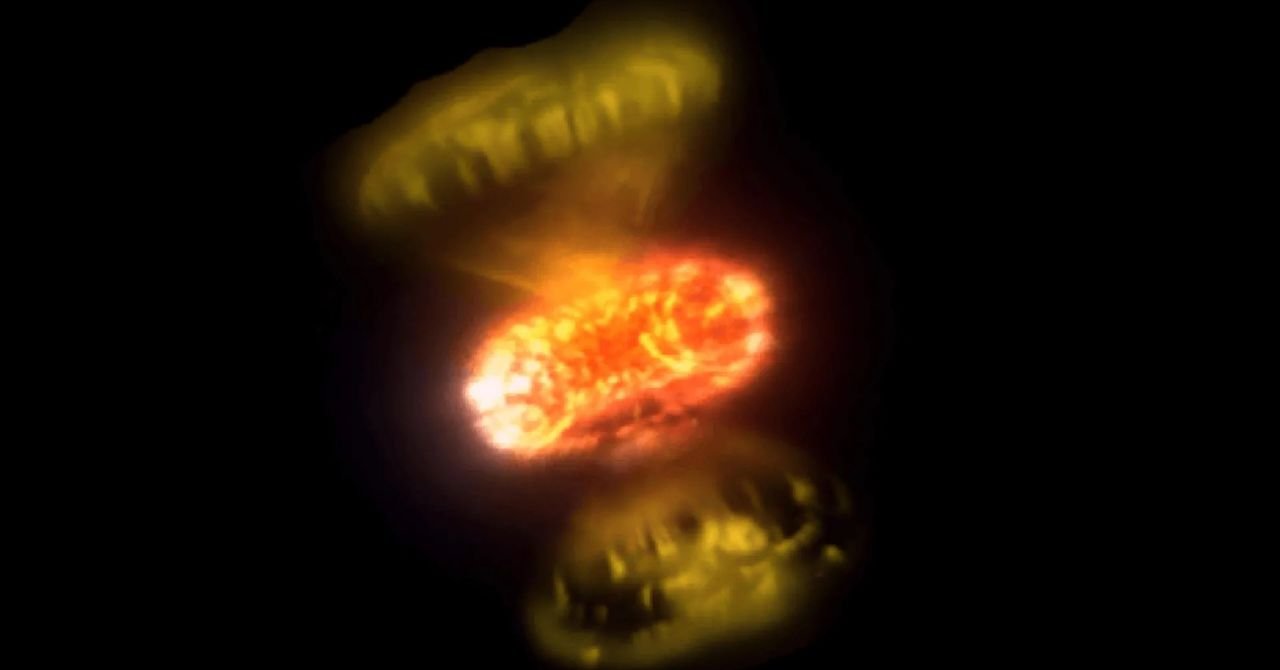
The nova V1674 Herculis, located in the Hercules constellation, proved to be one of the fastest ever recorded. It reached peak brightness in less than 16 hours and faded dramatically within days. Images captured just 2.2 and 3.2 days after its discovery revealed a startling truth: the explosion was far from spherical. Instead, two distinct ejecta flows were observed – one to the northwest and another to the southeast – accompanied by an elliptical structure radiating almost perpendicularly. This direct evidence confirms that nova explosions involve multiple, interacting ejecta streams.
Further spectroscopic observations supported this finding, detecting different velocity components in the hydrogen Balmer series. While absorption lines before the peak showed velocities of approximately 3,800 km/s, components appearing after the peak reached a staggering 5,500 km/s. Crucially, the emergence of this new, faster ejecta flow coincided with the detection of high-energy gamma rays by NASA’s Fermi Gamma-ray Space Telescope, indicating that the collision of these differing velocity streams generated powerful, gamma-ray emitting shock waves.
The Puzzling Case of V1405 Cassiopeiae: A Slow Burn
In stark contrast to V1674 Herculis, V1405 Cassiopeiae in Cassiopeia presented an even more enigmatic picture. This nova took 53 days to reach its peak brightness and remained luminous for about 200 days. Initial observations during its peak period showed only a bright central light source with minimal surrounding ejections. The central region’s diameter was measured at approximately 0.99 milliarcseconds, translating to a radius of about 0.85 astronomical units (AU).
This measurement posed a significant puzzle: if the accumulated hydrogen-rich gas had been fully ejected at the explosion’s onset, it would have expanded to a radius of 23-46 AU over 53 days. The huge discrepancy suggests that the majority of the outer layer was not fully expelled even after 50 days. Instead, scientists hypothesize that V1405’s outer layer entered a “common envelope phase,&rdquo engulfing the entire binary system until the visible light peak.
During the third observation, the structure had dramatically transformed. The central light source accounted for only about half of the total radiation, with the remainder emanating from the expanded region. A broad emission component of approximately 2,100 km/s also appeared, indicating the release of new material and the generation of subsequent shock waves and high-energy emissions.
Novae: More Than Just a Flash in the Pan
Cosmic Laboratories for Extreme Physics
These discoveries fundamentally alter our understanding of novae, revealing them to be far more complex than simple explosions. Over the past 15 years, the Fermi telescope has detected gigaelectronvolt-range gamma rays from more than 20 novae, solidifying their role as natural laboratories for studying shock waves and particle acceleration in extreme environments.
The observations of V1405 Cassiopeiae further suggest that the orbital motion of its binary system might actively contribute to expelling the expanded outer layers. In slowly evolving novae, the state where the expanded outer layers envelop the entire binary system can persist for several weeks. Such phenomena offer invaluable opportunities to directly observe the intricate dynamics of two stars in close proximity – a process believed to occur in over 10 percent of stars in the universe. While detailed mechanisms still require further investigation, the new window of direct imaging provided by near-infrared interferometry promises to unlock many more secrets of these spectacular cosmic events.
For more details, visit our website.
Source: Link