
Trump’s Arctic Ambition: A Tariff Threat Over Greenland
President Donald Trump has dramatically escalated his controversial pursuit of Greenland, suggesting punitive tariffs against nations that fail to support a U.S. takeover of the vast Arctic territory. This bold declaration comes amidst a concerted effort by a bipartisan Congressional delegation to soothe diplomatic tensions in Copenhagen, highlighting a stark divergence in U.S. foreign policy approaches.
The Unacceptable Proposition
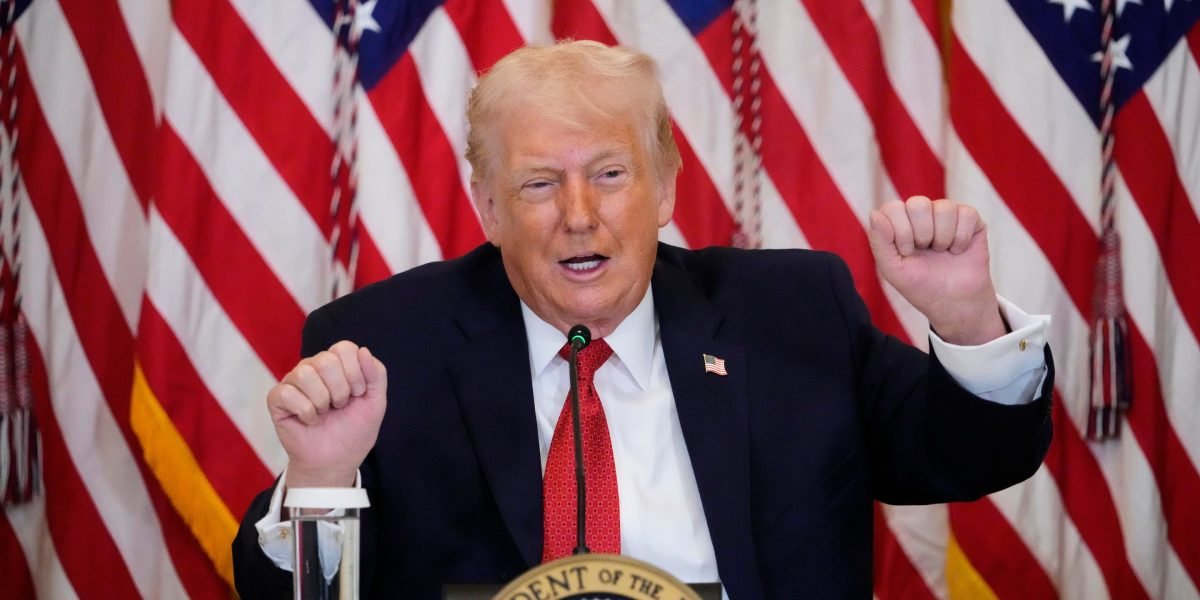
For months, Trump has openly expressed his desire for the United States to acquire Greenland, a self-governing territory of NATO ally Denmark. Earlier this week, he branded any outcome short of U.S. control as “unacceptable.” Speaking at a White House event on rural health care, the President drew parallels to past tariff threats against European pharmaceutical companies, stating, “I may do that for Greenland too… I may put a tariff on countries if they don’t go along with Greenland, because we need Greenland for national security.” This marks a significant escalation, as tariffs had not previously been cited as a means to force the issue.
Diplomatic Fault Lines and Diverging Views
The President’s aggressive stance stands in stark contrast to ongoing diplomatic efforts. Recent meetings in Washington between Danish and Greenlandic foreign ministers and U.S. Vice President JD Vance and Secretary of State Marco Rubio failed to bridge the “deep differences” surrounding Greenland’s future. While an agreement to establish a “working group” was announced, its precise purpose immediately became a point of public contention between Denmark and the White House. European leaders have consistently affirmed that Greenland’s future is a matter solely for Denmark and Greenland to determine. In a clear signal of resolve, Denmark recently announced an increased military presence in Greenland, undertaken in cooperation with its allies.
Congressional Diplomacy: Nurturing Alliances, Not Acquiring Assets
In a notable counter-narrative to the White House, a bipartisan delegation of U.S. senators and representatives visited Copenhagen, engaging with Danish Prime Minister Mette Frederiksen and Greenlandic lawmakers. Senator Chris Coons (D-Delaware), leading the delegation, underscored “225 years of being a good and trusted ally and partner,” emphasizing a desire for “strong and robust dialogue.” Senator Lisa Murkowski (R-Alaska) echoed this sentiment, asserting, “Greenland needs to be viewed as our ally, not as an asset.” She highlighted widespread American public disapproval of a Greenland acquisition, with approximately 75% opposing the idea. Murkowski, alongside Senator Jeanne Shaheen (D-New Hampshire), has introduced legislation to prevent the use of U.S. funds for annexing Greenland or any NATO member’s sovereign territory without consent.
Greenlandic Voices: A Refusal to be Re-colonized
The dispute has profound implications for the people of Greenland. Greenland’s Prime Minister, Jens-Frederik Nielsen, unequivocally stated, “if we have to choose between the United States and Denmark here and now, we choose Denmark. We choose NATO. We choose the Kingdom of Denmark. We choose the EU.”
Sara Olsvig, chair of the Inuit Circumpolar Council, representing 180,000 Inuit across the Arctic, voiced deep concern over the White House’s persistent rhetoric. She described it as revealing “a clear picture of how the US administration views the people of Greenland, how the U.S. administration views Indigenous peoples, and peoples that are few in numbers.” Olsvig stressed that Indigenous Inuit in Greenland have no desire to be colonized again, highlighting the power imbalance inherent in the U.S. administration’s approach.
A Fragile Future in the Arctic
The escalating rhetoric from the White House, coupled with the diplomatic pushback from Denmark, Greenland, and a segment of the U.S. Congress, paints a picture of a deeply strained alliance. As the U.S. administration continues to float the idea of a forceful takeover, justified by claims of Russian and Chinese designs on Greenland’s critical minerals, Greenlandic politician Aaja Chemnitz bluntly stated, “Mostly, I would say the threats that we’re seeing right now is from the U.S. side.” The future of this strategically vital Arctic territory remains a flashpoint, testing the bonds of international partnership and the principles of self-determination.
For more details, visit our website.
Source: Link