
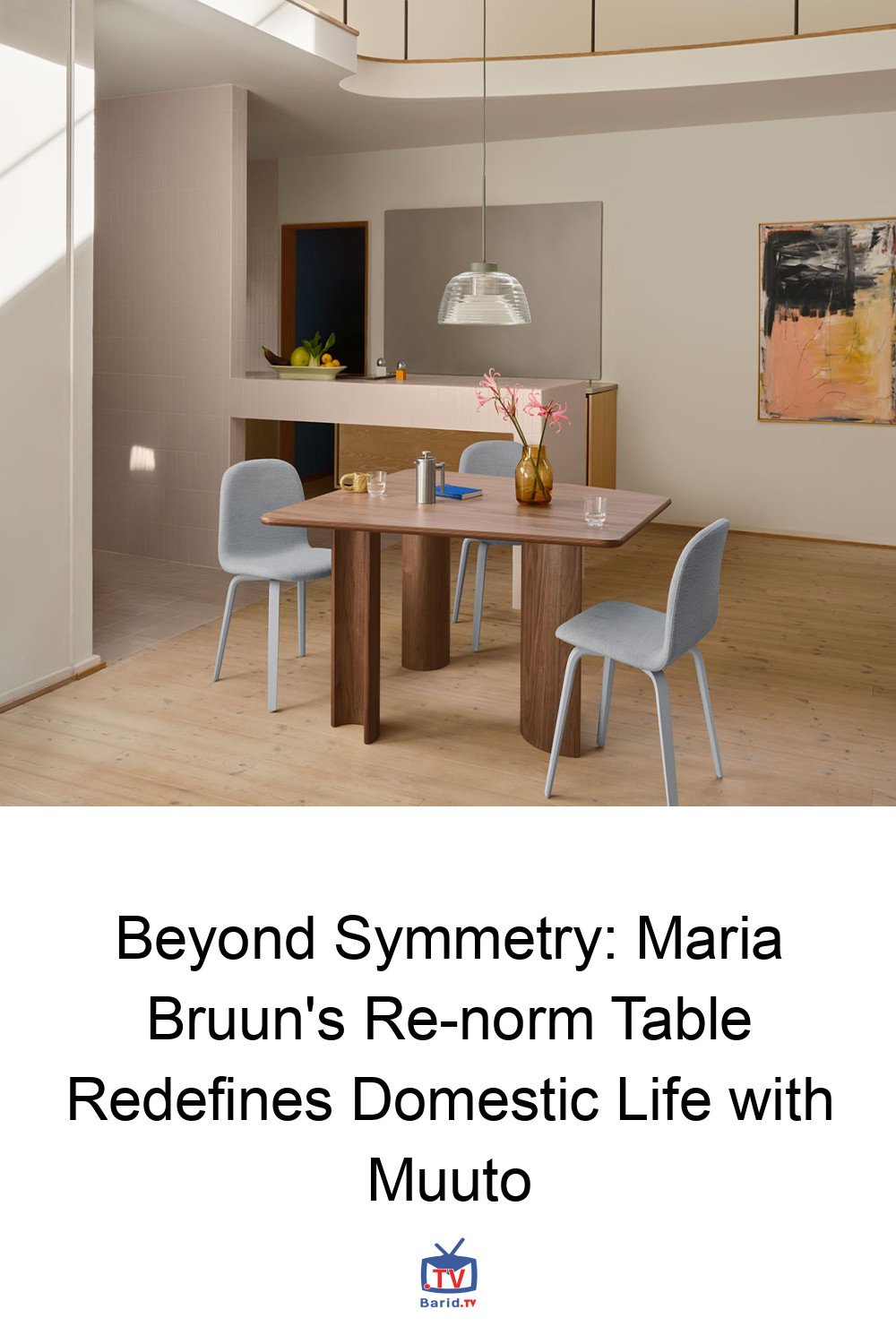
In the realm of furniture design, where rigid symmetry and idealized scenarios often dictate form, Danish designer Maria Bruun presents a refreshing counter-narrative. Her Re-norm Table, crafted for Muuto, isn’t merely a piece of furniture; it’s a quiet revolution, a profound re-evaluation of how domestic objects can genuinely serve the ebb and flow of human life.
Rethinking the Dining Experience
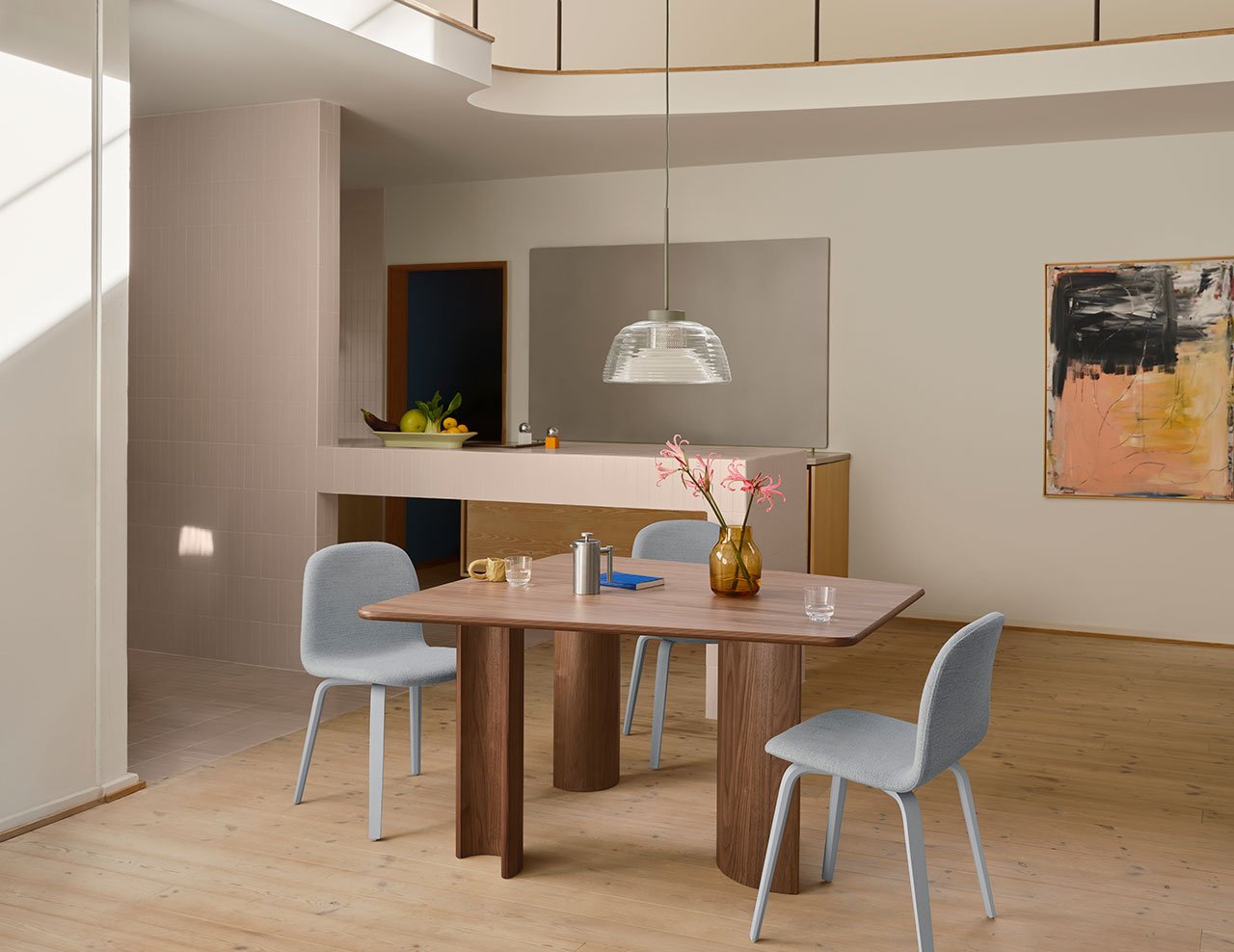
At first glance, the Re-norm Table captivates with its sculptural presence. Its distinctive sail-like silhouette, subtly uneven sides, and gently convex legs immediately challenge the conventional straight lines and perfect balance we’ve come to expect from dining furniture. But for Bruun, this isn’t just an aesthetic flourish; it’s a deliberate provocation. The Re-norm table dares to question the long-held assumption that function must be optimized for a singular, perfect moment.
Instead, Bruun envisions the table as a dynamic, living surface – one that effortlessly accommodates the beautiful messiness of real life. “I dreamed of designing a table that takes its point of departure in how life around the table actually unfolds,” Bruun explains. “Dynamic, sometimes messy, sometimes organized; often alone, other times with more people than the space was meant to hold. A life that can be loud and chaotic…”
Breaking the Mold: Asymmetry and Freedom
The name “Re-norm” itself is a powerful statement, signifying both a critique of existing norms and a call for a fresh start. Traditional tables often impose a sense of hierarchy and order, with designated head positions and evenly spaced seating. Bruun’s response is a bold embrace of asymmetry. With sides of varying lengths and no single dominant orientation, the Re-norm table subtly dismantles these hierarchies, inviting users to sit closer or farther apart, to cluster informally, or to find moments of solitude within a shared space.
Design Rooted in Reality
This innovative departure wasn’t born from abstract formal experimentation. The design journey for Re-norm was deeply empirical, emerging from extensive observation rather than adherence to historical archetypes. Bruun and the Muuto design team meticulously studied how people truly interact with tables – whether alone, in groups, distracted, or deeply focused. Through full-scale cardboard mockups and models, they explored the nuances of conversation flow, foot placement, and how shared surfaces temporarily transform into personal territories, ensuring the design resonates with authentic human behavior.
The Poetic and the Practical: A Seamless Blend
Despite its expressive and unconventional form, the Re-norm table remains steadfastly grounded in usability. It masterfully navigates the delicate balance between intimacy and openness, ensuring its sculptural presence never compromises practical concerns like reach, stability, and support. Every curve and transition is thoughtfully linked to how the human body moves around the table, embodying Bruun’s core philosophy: that emotional intention and functionality are not opposing forces, but rather intertwined elements of exceptional design.
Sustainable Craftsmanship and Material Story
Materiality plays a pivotal role in articulating this balance. The Re-norm is constructed from form-pressed birch plywood, with its tabletop gracefully supported by three convex arches that serve as both structural anchors and visual rhythm. The connections between the top and legs are intentionally visible, manifesting as three subtle ‘smiles’ that punctuate the surface, revealing the table’s ingenious construction.
Form-pressed plywood allows Bruun to achieve a unique blend of softness and strength. Thin layers of veneer are laminated and pressed around a mold, yielding continuous, organic curves that maintain remarkable structural clarity. This material choice also imbues the table with a sense of tension and movement, perfectly echoing its conceptual focus on fluid social dynamics. Furthermore, the table’s production using FSC™-certified wood and a water-based lacquer free from intentionally added PFAS underscores Bruun’s foundational commitment to sustainability – a non-negotiable baseline for any truly contemporary design.
A Spectrum of Expression
Available in oak, walnut, and a striking light blue finish, the Re-norm table adapts its character with each material expression. The natural wood options exude warmth and familiarity, while the light blue introduces a cooler, more expansive spatial quality, subtly altering how the form is perceived within a room. Here, color transcends mere decoration; it becomes an integral component in how the table’s volume, weight, and emotional tone are interpreted.
Freedom at the Table
Ultimately, the Re-norm table isn’t about radically reinventing the dining table; it’s about profoundly rethinking its potential. If it communicates a single value, Bruun hopes it is freedom. “Not in a grand or performative way, but as a quiet permission,” she states. “To move, to shift, to gather differently, and to inhabit the shared space on your own terms.”
In this sense, Re-norm doesn’t impose a new ideal. Instead, it mirrors life as it truly is – layered, informal, and perpetually in motion – suggesting that perhaps this authentic, dynamic reality is the norm truly worth designing for.
To explore the Re-norm table by Maria Bruun for Muuto, visit muuto.com. Photography by Benjamin Lund.
For more details, visit our website.
Source: Link