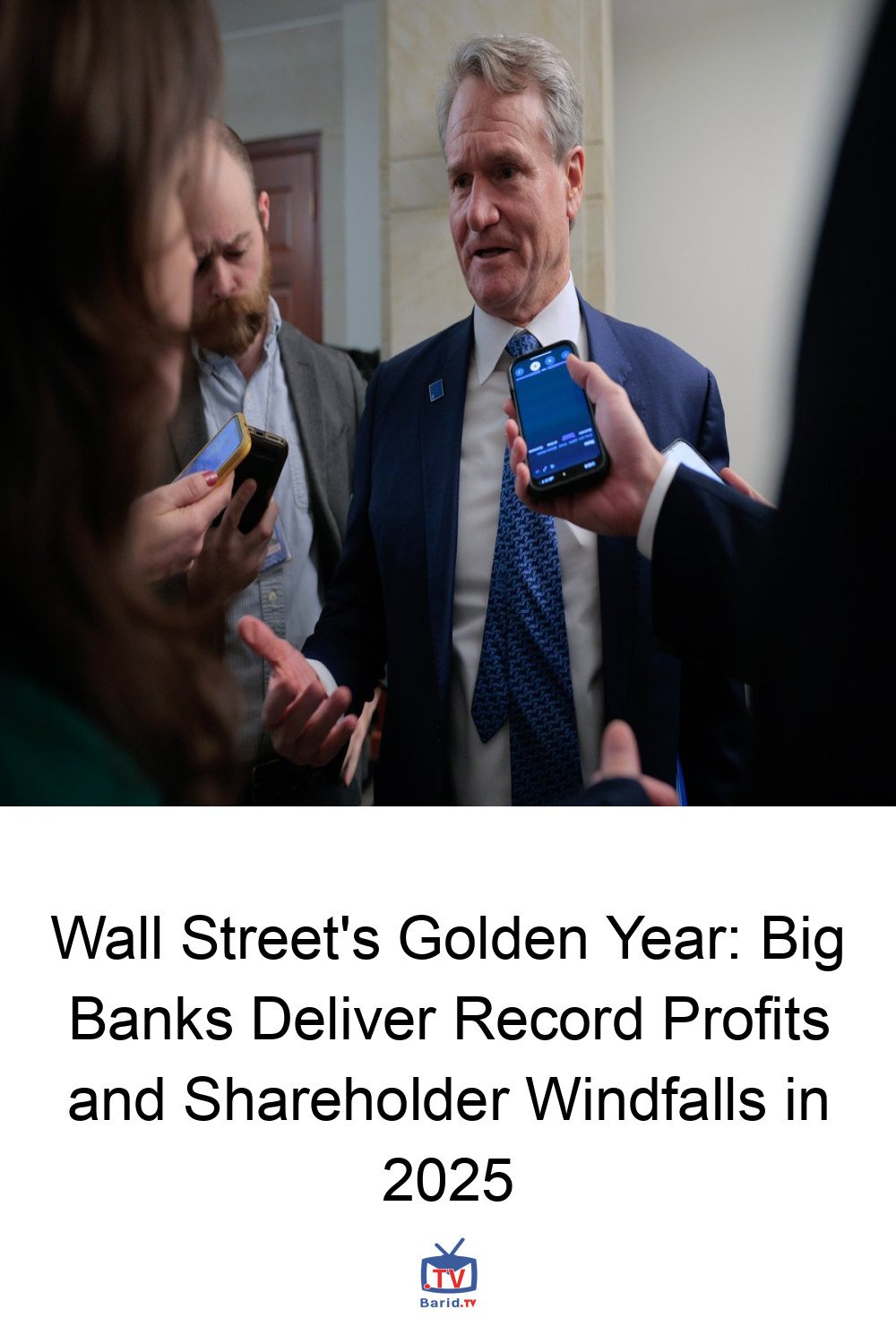
Wall Street’s titans celebrated a truly remarkable 2025, with major U.S. banks reporting robust profits and delivering substantial returns to their shareholders. Fueled by a landscape of elevated interest rates, appreciating asset values, and resilient consumer spending, the financial sector experienced a banner year, culminating in soaring stock prices across the board.
A Year of Unprecedented Gains for Banking Giants
As the curtain closed on 2025, the narrative for America’s largest financial institutions was overwhelmingly positive. High interest rates proved to be a significant tailwind, boosting net interest income, while a generally strong economic environment encouraged affluent consumers to maintain their spending habits despite lingering uncertainties. This confluence of factors translated directly into healthy bottom lines for the industry’s heavyweights, delighting investors.
However, as the earnings season for 2026 begins to unfold, new complexities are emerging. Political headwinds, notably the discussion around potential caps on credit card interest rates, introduce an element of unpredictability for the year ahead. Yet, for now, the focus remains firmly on the impressive capital distributions made by banks like Wells Fargo, Bank of America, and Citigroup, each navigating their unique strategic paths.
Wells Fargo: Shedding Constraints and Eyeing Growth
Wells Fargo concluded 2025 with a solid fourth quarter, but the true significance lies beyond the impressive numbers. The bank reported net income of $5.4 billion, or $1.62 per share, marking a 13% increase year-over-year, alongside a 4% rise in revenue. Credit quality remained robust, expenses were tightly managed, and returns continued their upward trajectory.
The pivotal development for Wells Fargo, however, is the lifting of the Federal Reserve’s long-standing asset cap and the resolution of multiple consent orders. This regulatory freedom marks a new era, empowering the bank to expand its balance sheet and pursue growth initiatives without prior approval. Management’s renewed optimism is palpable, underscored by the $23 billion returned to shareholders in 2025 through dividends and buybacks. CEO Charlie Scharf encapsulated the sentiment: “We have built a strong foundation and have made great progress in improving growth and returns though we have operated with significant constraints. We are excited to now compete on a level playing field and are able to dedicate even more resources to growth with the ability to grow our balance sheet.” The cleanup phase, it seems, is officially over.
Bank of America: Broad-Based Strength and Consistent Returns
Bank of America also delivered a powerful performance in the fourth quarter, driven by robust net interest income and comprehensive balance-sheet expansion. The bank saw its revenue climb 7% to exceed $28 billion, with net income surging 18% from the previous year to reach $7.6 billion.
Credit quality remained exemplary, with a reduction in net charge-offs and the normalization of credit card losses. While expenses saw a modest increase, BofA effectively improved its efficiency ratio. Across its diverse operations, the bank showcased strength: consumer banking remained steadfast, wealth management thrived amidst rising markets and client inflows, and equities trading revenue soared by an impressive 23%. Mirroring its peers, Bank of America prioritized shareholder returns, distributing over $8 billion in dividends and buybacks during the fourth quarter alone.
Citigroup: Restructuring Amidst Record Revenues
Citigroup captured headlines not just for its financial results but also for its ambitious restructuring plans, which include the elimination of approximately 1,000 jobs as part of a broader strategy to cut tens of thousands by the end of 2026. This latest overhaul is another chapter in Citi’s multi-decade saga of continuous transformation under various leadership teams.
Despite the significant organizational changes, Citi, like its counterparts, remained committed to rewarding shareholders. The bank directed approximately $17 billion to shareholders last year, with $13 billion allocated to buybacks. CEO Jane Fraser highlighted record revenues, positive operating leverage across all five major business lines, and “visible momentum” for the coming year, signaling confidence even as the restructuring unfolds.
Looking Ahead: Navigating New Currents
While 2025 proved to be a golden era for major U.S. banks and their investors, the path forward into 2026 is not without its challenges. The specter of political intervention, particularly concerning consumer lending, alongside evolving economic conditions, will test the resilience and adaptability of these financial behemoths. Nevertheless, the strong foundation laid in 2025, marked by robust profitability and strategic adjustments, positions them to navigate the complexities of the future, albeit with varying degrees of optimism and strategic focus.
For more details, visit our website.
Source: Link