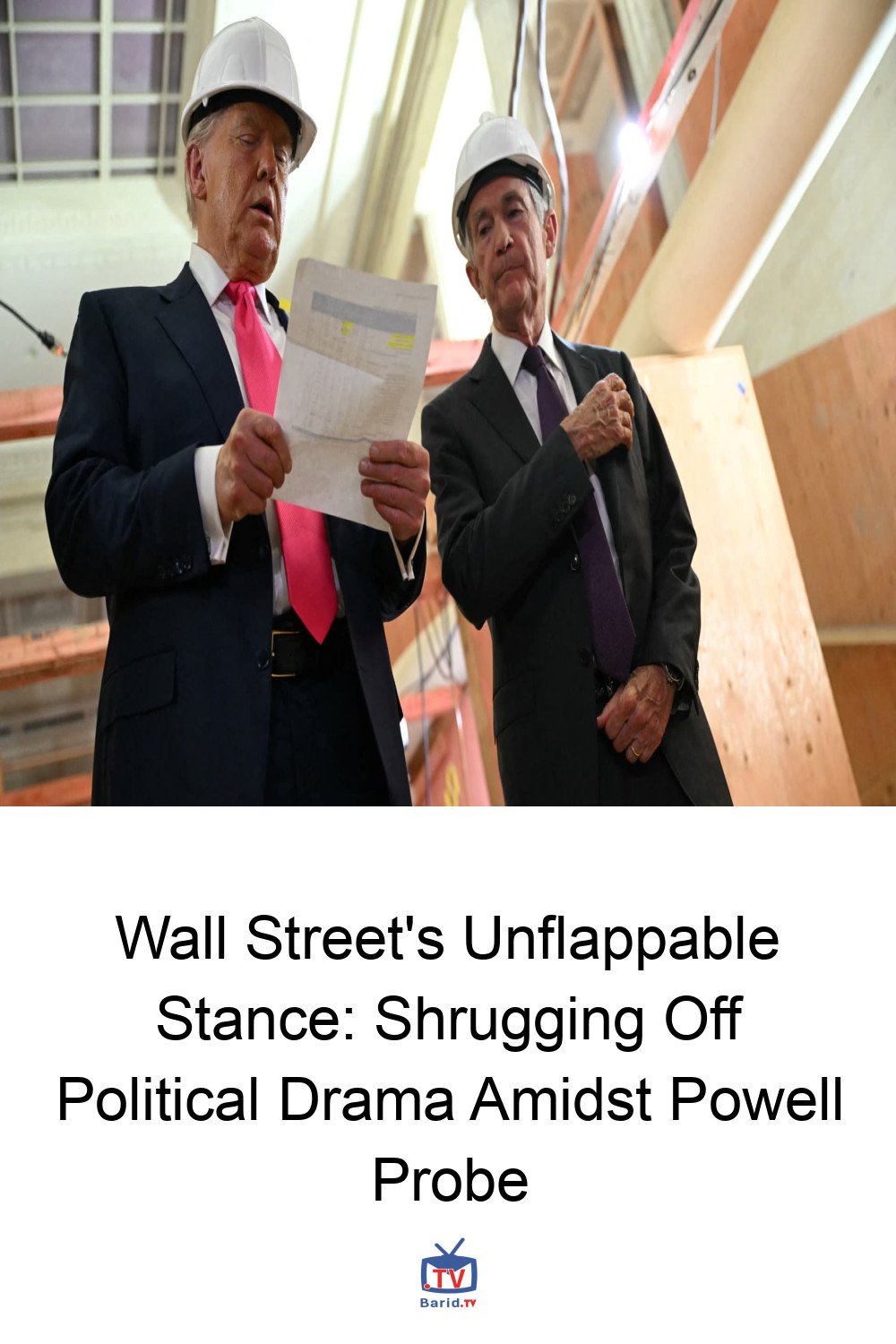
In a week marked by political turbulence, the U.S. stock market delivered a surprising performance, largely shrugging off a criminal investigation into Federal Reserve Chair Jerome Powell. Despite initial jitters, major indices like the S&P 500 not only recovered but closed at all-time highs, challenging conventional wisdom about political risk and market stability.
Defying Conventional Wisdom: A Resilient Market
Monday began with a jolt as news of the Powell investigation broke, sending the Dow Jones Industrial Average tumbling nearly 500 points. Investors initially feared the probe, perceived as a move by President Donald Trump to undermine the central bank’s autonomy, could destabilize interest rate policy. However, as the trading session progressed, a remarkable turnaround unfolded. The Dow, S&P 500, and even the small-cap focused Russell 2000 clawed back losses, ending the day at unprecedented levels.
This resilience bucked traditional market expectations, which often predict a near-term downturn in the face of significant political turmoil. The “Sell America” trade, a concept where U.S. assets carry a higher risk premium due to political uncertainty, seemed poised for a resurgence. Yet, the market held firm.
Why Wall Street Remained Unflappable
A Passing Flare-Up, Not a Fundamental Shift
Several factors contributed to the market’s ability to look past the political noise. Crucially, Federal Reserve Chair Powell received vocal support from leading economists globally. This, coupled with swift and clear opposition from some Republicans in Washington D.C., helped reassure investors that the investigation was likely a temporary political skirmish rather than a fundamental assault on the Fed’s independence.
Economists, echoing Powell’s own framing, suggested the probe was less about the central bank’s operational integrity and more about the pace of interest rate adjustments, which Wall Street had hoped would be faster. Former Fed Chair Janet Yellen even expressed surprise at the market’s relative calm, highlighting the unusual nature of the situation.
Political Opposition Provides Security
The growing Republican opposition played a significant role in calming nerves. Senator Thom Tillis (R-N.C.) publicly stated he would block any of Trump’s nominees to the central bank following the investigation’s announcement, signaling a bipartisan resistance to perceived political interference with the Fed. This firm stance likely provided traders with confidence that the situation would not escalate into a prolonged institutional crisis.
Beyond Equities: A Mixed Picture
While U.S. stocks demonstrated remarkable fortitude, other asset classes offered a more nuanced view of investor sentiment. The U.S. dollar experienced a slide against its major peers, suggesting some flight from the currency. Conversely, traditional safe-haven assets like gold and silver climbed to new highs, indicating that a segment of investors was indeed seeking refuge from uncertainty. Furthermore, U.S. stocks underperformed international counterparts, and the CBOE Volatility Index (VIX), Wall Street’s “fear gauge,” saw a jump, though it remained within its recent trading range. This suggested caution, but not outright panic.
As Siebert Financial CIO Mark Malek observed, “Investors expect all this to blow over, or that they simply don’t want to focus on this as we enter Q4 earnings season.”
Shifting Focus: Earnings and Inflation Take Center Stage
Indeed, the market’s attention quickly pivoted. By Tuesday, the political drama had largely faded from the forefront, replaced by the more immediate concerns of the latest inflation data and the impending corporate earnings season. This rapid shift underscores the market’s pragmatic nature, prioritizing economic fundamentals and corporate performance over transient political headlines.
The episode serves as a powerful reminder of the stock market’s complex psychology, its capacity to filter out noise, and its unwavering focus on the underlying economic narrative.
For more details, visit our website.
Source: Link