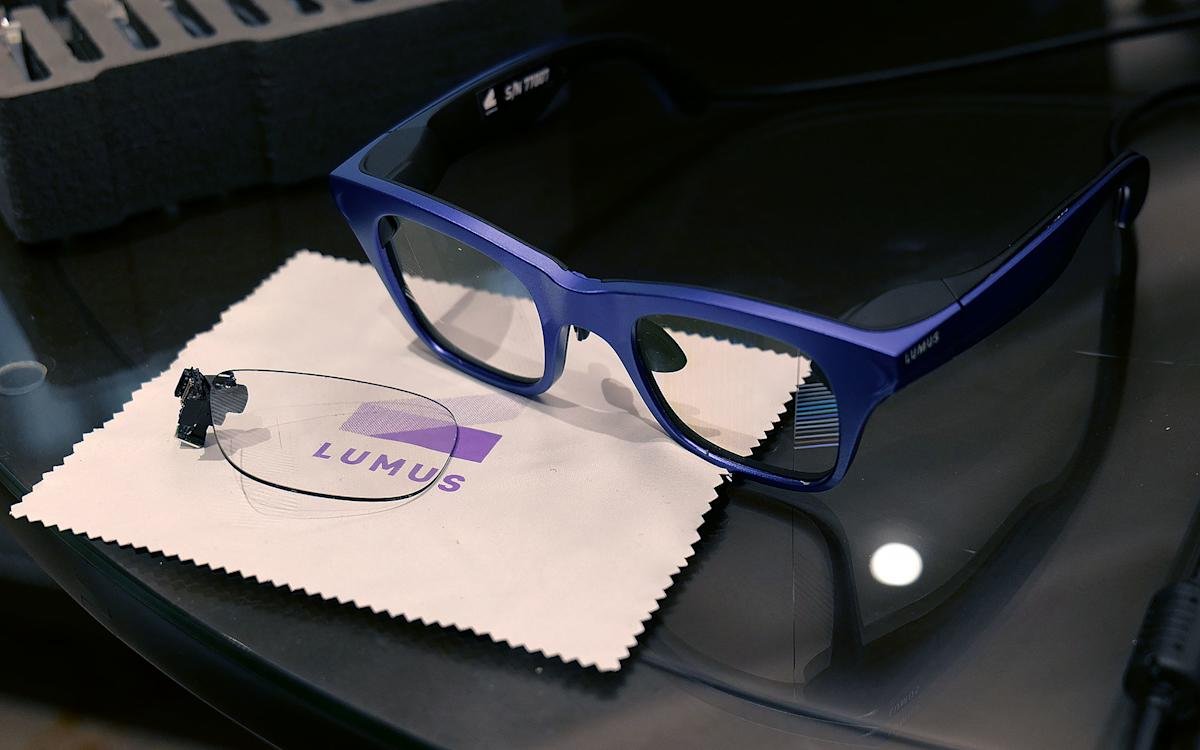

The future of smartglasses just got a whole lot clearer – and significantly wider. Lumus, a name increasingly synonymous with cutting-edge display technology, made waves at CES 2026, showcasing innovations that promise to redefine the smartglasses experience. Building on the success of its waveguides in devices like the Meta Ray-Ban Display glasses, Lumus unveiled components that are not just an upgrade, but a monumental leap forward in optical quality for the next generation of high-end smartglasses.
A Glimpse into the Future: The Z-30 Waveguides
When the Meta Ray-Ban Displays first emerged, they captivated users with their full-color in-lens display and a respectable 20-degree field of view (FOV). However, Lumus’ newest waveguides are poised to push these boundaries dramatically. The first model I experienced featured Lumus’ optimized Z-30 waveguides, which boast a much wider 30-degree FOV. Beyond the increased immersion, these components are also 30 percent lighter and 40 percent thinner than previous generations. Crucially, Lumus reports they are more power-efficient, capable of hitting over 8,000 nits per watt – a significant advancement given the battery constraints of sleek, all-day wearable smartglasses. Despite being limited to 720 x 720 resolution, the Z-30s dazzled with their brightness and sharpness. The increase in FOV felt far more substantial than a mere 10 degrees, and colors, including the notoriously difficult-to-reproduce white, were remarkably rich.
Beyond Expectation: The Mind-Blowing 70-Degree FOV
Even after being impressed by the Z-30s, nothing prepared me for Lumus’ astonishing 70-degree FOV waveguides. Viewing test images and videos through these prototypes was a truly immersive experience; the display covered virtually the entire central portion of the lens, leaving only minimal unused areas around the corners. While I did observe some pincushion distortion along the sides, a Lumus representative assured me this would be corrected in final retail units. Make no mistake: these waveguides delivered some of the sharpest, brightest, and most visually stunning optics I’ve ever encountered in any smartglasses, be they retail models or prototypes. It almost made me question how much wider FOV these devices truly need, though it’s clear we haven’t yet reached the point of diminishing returns.
Engineering Brilliance: Lumus’ Geometric Reflective Advantage
Lumus’ geometric reflective waveguides offer several distinct advantages. They boast better overall efficiency compared to their refractive counterparts and, critically, allow for optical bonding directly to smartglasses lenses. This innovative approach means that, unlike many rivals, Lumus’ waveguides can be paired with transition lenses, eliminating the need for cumbersome clip-on sunglass attachments when moving between indoors and outdoors. Furthermore, Lumus claims its design simplifies the manufacturing process, leading to even thinner waveguides – as slender as 0.8mm – and generally higher production yields.
While capturing high-quality photographs of content displayed through smartglasses, especially delicate prototypes, remains incredibly challenging, the potential of Lumus’ advancements is undeniable. With production of these new waveguides ramping up through strategic partnerships with industry giants like Quanta and SCHOTT, it’s clear that smartglasses manufacturers will be clamoring for these components. As momentum continues to build around smartglasses as the industry’s next “big thing,” Lumus stands at the forefront, poised to deliver the optical quality that will truly bring augmented reality to life.
For more details, visit our website.
Source: Link