
Unearthing Humanity’s Deep Roots in Morocco
A groundbreaking discovery in Morocco is poised to redefine our understanding of early human evolution. Researchers have unearthed fossil remains that represent one of the earliest stages of the human lineage, pushing back its timeline by hundreds of thousands of years. Dating back an astonishing 773,000 years, these findings from Thomas Quarry I in Casablanca provide compelling new evidence for the African origins of modern humans and challenge long-held theories about our ancestral tree.
Published in the prestigious Nature
journal, this research supports a robust pan-African model of human evolution. It not only reinforces insights from the 315,000-year-old Jebel Irhoud remains but significantly extends the period of human diversification, suggesting that
Homo sapiens may have emerged far earlier than previously assumed.
The Thomas Quarry I Discovery
An international team, spearheaded by renowned paleoanthropologist Jean-Jacques Hublin, meticulously excavated the fossils. The collection includes two partial mandibles, several teeth, and vertebrae, all offering crucial insights into human evolution during the late Early Pleistocene period. These specimens paint a vivid picture of our ancient ancestors, revealing a complex morphology that hints at a lineage more intricate than once believed.
Challenging Conventional Wisdom
For decades, the scientific community largely accepted Homo heidelbergensis as the last common ancestor of modern humans, Neanderthals, and Denisovans. However, the Moroccan fossils present a compelling counter-narrative. They suggest that this ancestral lineage is both older and more complex, with roots reaching deeper into Africa’s past. As the researchers note, “The ThI-GH hominins provide insights into African populations predating the earliest H. sapiens individuals discovered at Jebel Irhoud in Morocco and provide strong evidence for an African lineage ancestral to our species.”
Decades of Dedicated Excavation
This monumental discovery is the culmination of three decades of systematic excavations at Thomas Quarry, a site celebrated as one of North Africa’s richest hominin records. The quarry, formed during a marine high stand and subsequently filled by successive marine and continental deposits, boasts multiple stratigraphic levels that preserve a dense paleontological and archaeological archive.
A Rich Archaeological Tapestry
Thomas Quarry encompasses two distinct archaeological zones. Its oldest area, ThI-L, has yielded one of Africa’s most extensive early Acheulean stone-tool assemblages, dated to approximately 1.3 million years ago. This represents the earliest confirmed evidence of human toolmaking in northwest Africa, underscoring the region’s pivotal role in technological and cognitive development.
The Grotte à Hominidés Legacy
The new study focuses on a limited number of fossil specimens recovered over the past three decades from Grotte à Hominidés, a cave within the quarry. This cave first gained prominence in 1969 when amateur collector Philippe Beriro uncovered a partial human mandible, revealing the site’s immense hominin significance and sparking decades of scientific investigation. Subsequent controlled excavations between 1994 and 2015 uncovered additional hominin remains, Acheulean tools, and a diverse faunal assemblage, all preserved within a secure stratigraphic context. These modern investigations resolved earlier uncertainties caused by quarrying disturbances, firmly anchoring the fossils within the Early-Middle Pleistocene record and establishing the site as a central pillar in debates on early human evolution in Africa.
Portraits of Our Ancient Relatives
The newly analyzed fossils represent both adult and juvenile individuals, offering a rare glimpse into the development and characteristics of these ancient hominins.
Insights from Mandibles and Teeth
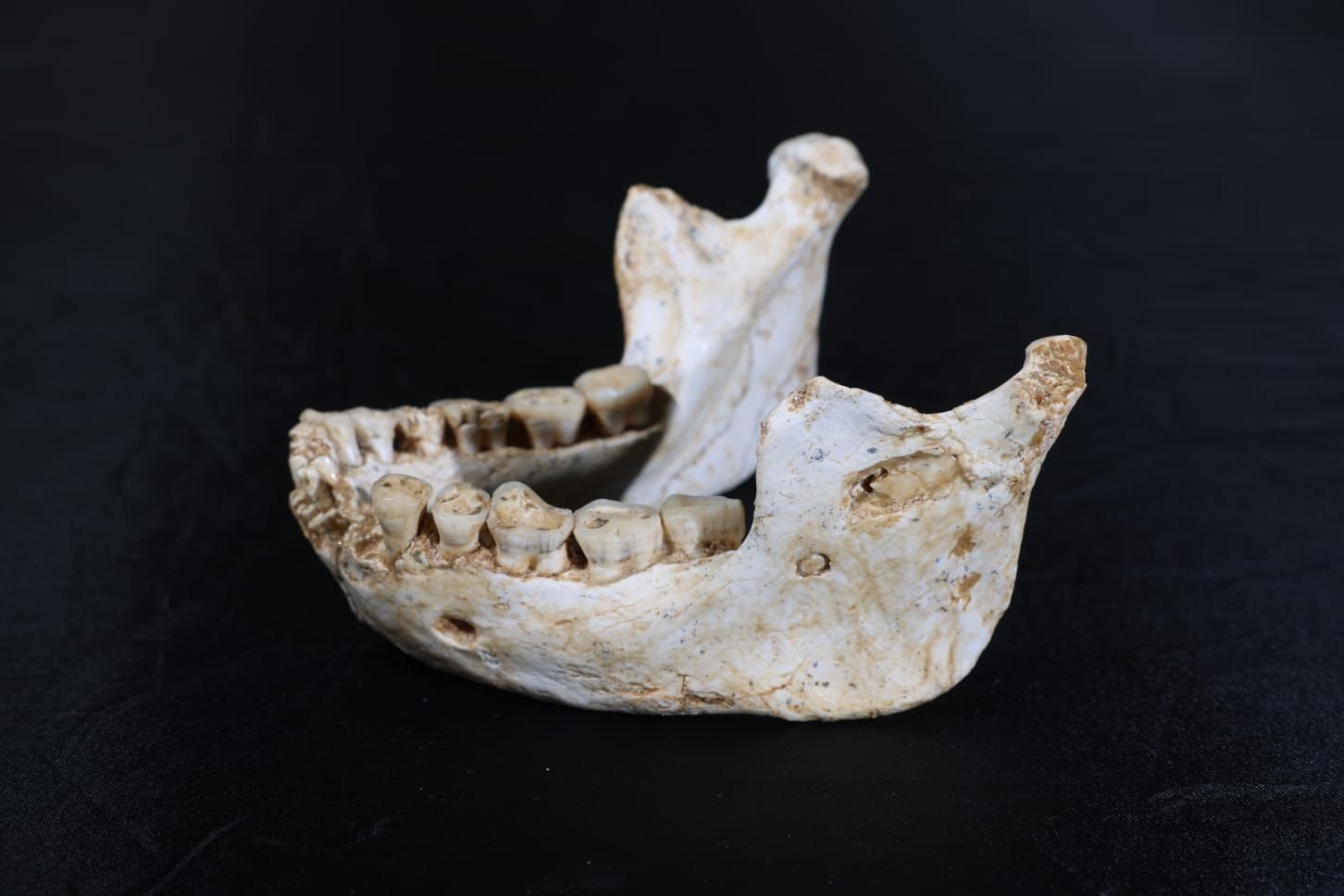
The fossil mandibles display a fascinating combination of primitive and derived characteristics. The adult mandible ThI-GH-10717 belonged to a gracile, small-bodied individual, featuring a long, low, and narrow corpus with nearly complete, though heavily worn, dentition. A second adult specimen, ThI-GH-1, represents a more robust individual, preserving a partial mandible with teeth from the fourth premolar to the third molar.
The juvenile remains, designated ThI-GH-10978, belonged to a child who died at most 1.5 years of age. This fragmentary mandible provides invaluable information about early human development, with micro-CT scans used to analyze the calcification stages of the child’s deciduous and forming permanent teeth, precisely determining the age at death.
Vertebrae and Early Human Morphology
Eight vertebrae were discovered directly underneath the adult mandible ThI-GH-10717, including six cervical and two thoracic vertebrae. Their small size and close spatial proximity strongly suggest they belonged to the same small-bodied adult individual. Intriguingly, these vertebrae exhibit morphological features more similar to Homo erectus than to more recent human species, adding another layer of complexity to their evolutionary placement.
To establish the fossils’ precise age, the research team employed multiple advanced dating techniques, ensuring the robustness of their 773,000-year estimate.
A New Chapter in Human Evolution
These Moroccan fossils are not just ancient bones; they are critical pieces of a grander puzzle, reshaping our understanding of where, when, and how our species truly began. They underscore Africa’s unparalleled role as the cradle of humanity and invite us to reconsider the intricate pathways that led to the emergence of Homo sapiens.
For more details, visit our website.
Source: Link