
A New Era of Computing: The Framework Laptop 16 with RTX 5070
In a world increasingly grappling with electronic waste, Framework has carved out a unique and commendable niche. Renowned for its commitment to repairability and upgradability, the company stands as a beacon for sustainable technology. Their latest and most ambitious offering, the Framework Laptop 16, pushes these boundaries further, promising not just faster chips and more versatile ports, but a truly revolutionary concept: upgradable laptop graphics.
When first unveiled in early 2024, the idea of swapping out a laptop’s GPU seemed like a distant dream for PC enthusiasts. Laptops, by their very nature, have historically been closed systems, with internal components largely fixed beyond memory. Yet, with the introduction of the RTX 5070 Graphics Module, Framework has transformed that ambitious promise into a tangible reality, setting a new benchmark for what’s possible in portable computing.
The Utopian Upgrade System: Design for Evolution
A Chassis Built for Tomorrow
The core design of the Framework Laptop 16 remains consistent since its initial launch, a deliberate choice that underscores its purpose. While Framework doesn’t explicitly market it as a gaming machine, several cues hint at its performance capabilities: per-key RGB backlighting, a robust 0.71-inch chassis, and noticeable bezels. Crucially, the rear of the laptop features a dedicated Graphics Module compartment, reminiscent of the ‘thermal shelves’ found on high-performance gaming laptops. This isn’t just for ventilation; it’s the ingenious housing for the GPU, designed to be swapped out independently of the mainboard.
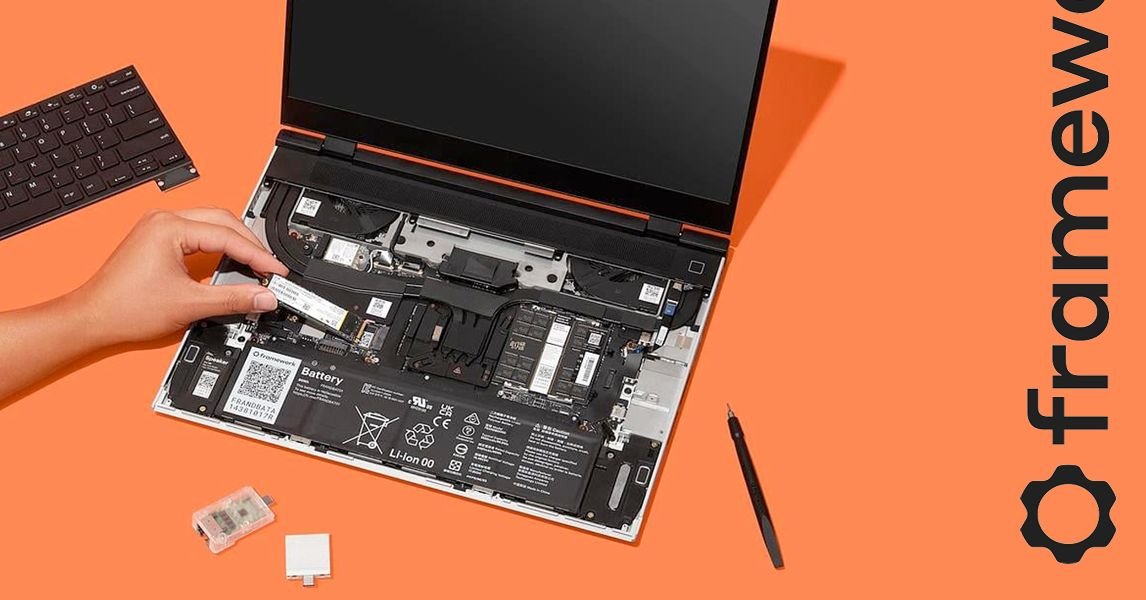
Our experience upgrading a 2024 Framework Laptop 16 with both the new mainboard and the RTX 5070 Graphics Module was remarkably smooth. Framework’s thoughtful engineering and comprehensive guides make the process surprisingly accessible. Disassembly begins innovatively: unlocking spacers flanking the touchpad, which, along with the touchpad and keyboard, lift away without a single screw or fiddly ribbon. Beneath lies a metal plate secured by 16 screws and a single ribbon connector. Once removed, a few more screws free the battery, bringing you tantalizingly close to the core components.
Seamless Modularity: Graphics, Storage, and Ports
Storage options are generous, with two M.2 slots stacked atop each other. The secondary slot accommodates a smaller M.2 2230 SSD, while the primary takes the standard M.2 2280 format. True to Framework’s ethos, the laptop boasts six hot-swappable expansion slots, allowing users to configure their port selection to their exact needs. The new graphics module even adds an extra USB-C port at the rear, bringing the total to an impressive seven.
While upgrading the entire mainboard involves a few delicate ribbon connections for the power button and speakers, and the occasional struggle with tiny Wi-Fi antenna cables, the overall process remains impressive. The speed at which a complete motherboard swap can be achieved speaks volumes about Framework’s design philosophy.
But the real star of the show is the new graphics module, now featuring the potent Nvidia RTX 5070. This upgrade is astonishingly simple. After removing the spacers, keyboard, and touchpad (a matter of seconds), three screws hidden beneath the compartment release the old module. There’s no need to even remove the main metal plate. The new module snaps into place with a satisfying click, instantly transforming the laptop from integrated to discrete graphics. This represents an unprecedented and highly successful implementation of upgradable discrete graphics in a laptop.
Quality Where It Counts: Performance and Practicality
Input and Display Excellence
The brilliance of Framework’s modularity would be moot without high-quality core components. Fortunately, the touchpad and keyboard are exceptional. The touchpad offers a smooth, responsive experience, while the keyboard provides a satisfying typing feel. The per-key RGB backlighting, though not for everyone, is consistent and offers three brightness levels.
Keyboard customization is a neat feature, allowing for the addition of a number pad or an RGB macropad module. However, there’s still significant untapped potential here. We hope to see more diverse options in the future, perhaps different keyboard layouts with full-size arrow keys or dedicated macro keys, truly realizing the promise of this modular input system. The display itself is equally impressive, offering a bright, color-accurate screen with a fluid 165Hz refresh rate, making it suitable for both creative work and enjoyable gaming.
Balancing Innovation and Cost
Despite its many triumphs, the Framework Laptop 16 isn’t without its trade-offs. The design, while functional for modularity, can appear somewhat clunky with its thick bezels and chassis compared to sleeker competitors. Furthermore, for the raw performance it delivers, the initial investment can feel steep. However, this perspective often overlooks the long-term value proposition: the ability to upgrade key components like the GPU and mainboard extends the laptop’s lifespan significantly, potentially offering greater value over time by mitigating the need for frequent full system replacements.
The Verdict: A Bold Step Towards a Sustainable Future
The Framework Laptop 16 (RTX 5070) is more than just a laptop; it’s a statement. It’s a testament to Framework’s unwavering commitment to fighting e-waste and empowering users with true control over their hardware. While it has areas for refinement, particularly in fully realizing its keyboard customization potential and streamlining the mainboard upgrade, its core innovation—truly upgradable discrete graphics—is a game-changer. For those who value longevity, repairability, and the sheer satisfaction of upgrading their own machine, the Framework Laptop 16 isn’t just a dream come true; it’s the blueprint for the future of personal computing.
For more details, visit our website.
Source: Link