
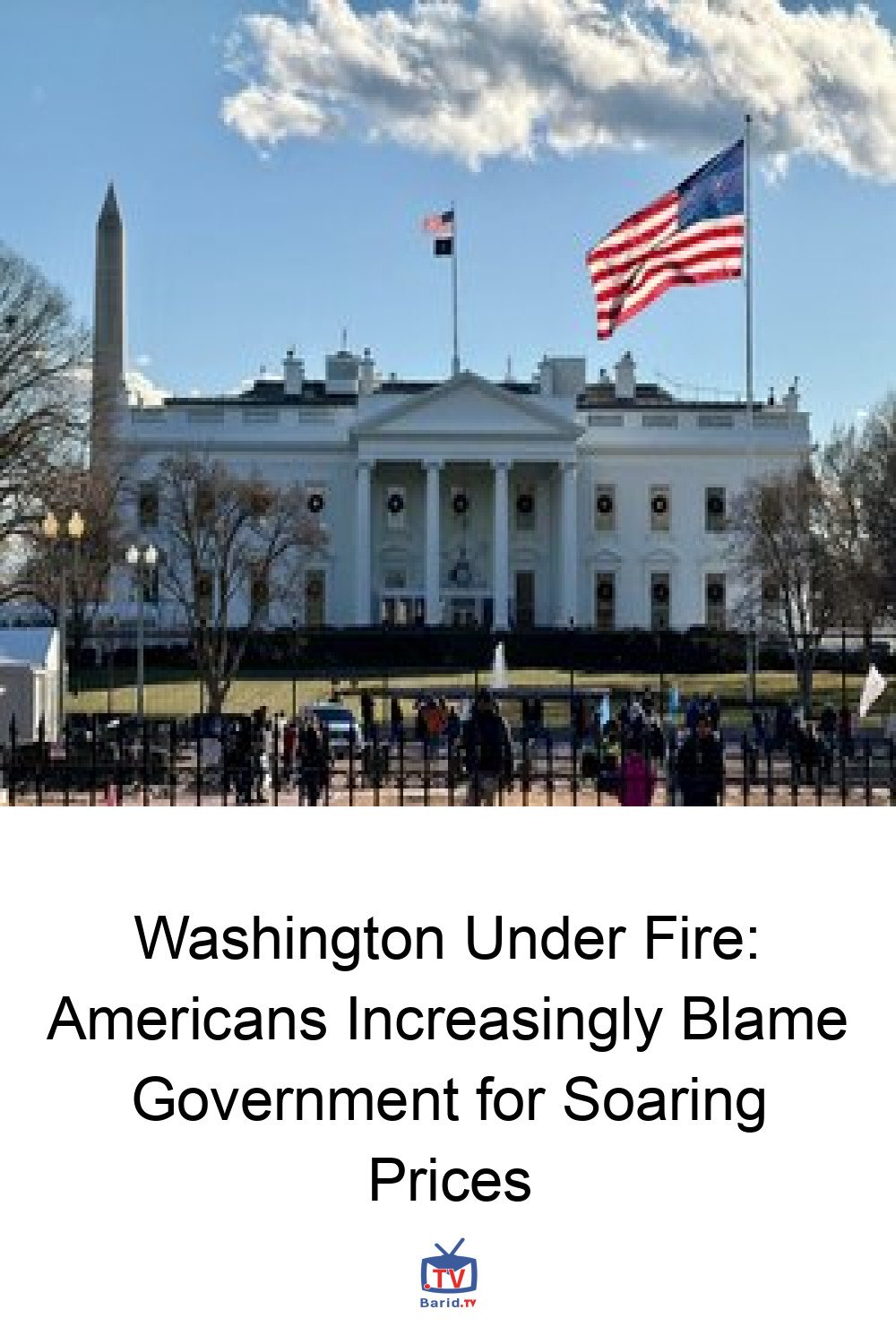
The Shifting Scapegoat: Americans Point Finger at Washington for High Prices
A striking new poll reveals a dramatic realignment in American public opinion regarding the culprits behind persistent high prices and economic strain. Across the political spectrum, citizens are increasingly pointing the finger at the federal government, rather than corporations, for their financial woes.
This significant shift, highlighted by a recent Harris poll conducted for The Guardian, underscores a growing disconnect between official economic narratives and the lived experiences of everyday Americans.
A Dramatic Shift Across the Political Spectrum
The data from mid-December paints a clear picture of evolving blame. Among Democrats, a substantial 76% now identify government management of the economy as the primary driver of rising prices – a notable 17 percentage point increase since February. Independents show a similar sharp pivot, with 72% attributing blame to Washington, marking a 14-point jump.
Even Republicans, traditionally more inclined to favor corporate interests over government regulation, have joined the chorus, with 55% now primarily blaming the federal government, compared to 45% who point to corporate practices. This bipartisan consensus on government culpability represents a profound change in how voters assign responsibility for their economic struggles.
The Great Economic Disconnect: Data vs. Lived Experience
The poll also uncovers a pervasive sense of financial insecurity. Nearly half of American adults believe their financial security is deteriorating – more than double the proportion who report improvement. Furthermore, a majority of respondents are convinced the U.S. is currently in a recession, despite official data indicating continued GDP growth and an economy that doesn’t technically meet the definition.
This chasm between macroeconomic indicators and personal reality has been a defining characteristic of the past year. Robust growth, a buoyant stock market, and record investments in AI have coexisted uneasily with stubbornly high prices, steep borrowing costs, and rising anxiety about job security among both blue- and white-collar workers. Consumer confidence has been on a downward trend for five consecutive months, and the optimism felt by top-tier earners and wealthy asset owners has failed to translate into broader comfort.
A Widening Chasm: Demographic Disparities
Economic sentiment is far from uniform across demographics. Women, for instance, report significantly darker economic outlooks than men, with 62% believing the country is in recession compared to 52% of men. Black and Hispanic respondents are considerably more likely than their white counterparts to perceive an economic contraction. Income gaps also play a stark role: nearly 60% of households earning under $50,000 report deteriorating financial security, a sentiment shared by only 37% of those earning over $100,000.
This confirms that economic inequality is fostering divergent experiences – a phenomenon economists have tracked for years. It’s no surprise that higher-income Americans express greater confidence while lower-income households describe stretching budgets and making difficult trade-offs. The divide is not merely perceptual; it is profoundly material.
Searching for a Lexicon: Naming the Divide
The poll underscores the inadequacy of current economic terminology to capture this complex reality. Terms like “K-shaped economy” are accurate but lack emotional resonance. “Vibecession” aptly describes the feelings-versus-data mismatch but overlooks the critical class divide. Whatever the label, the underlying reality persists: roughly half the country experiences economic expansion while the other half endures contraction. And for this deepening divide, the blame is increasingly landing squarely on Washington.
For more details, visit our website.
Source: Link