
This Startup Wants to Build Self-Driving Car Software—Super Fast
Meanwhile, a new startup called HyprLabs is trying to answer a simple question: How quickly can a company build autonomous vehicle software today?
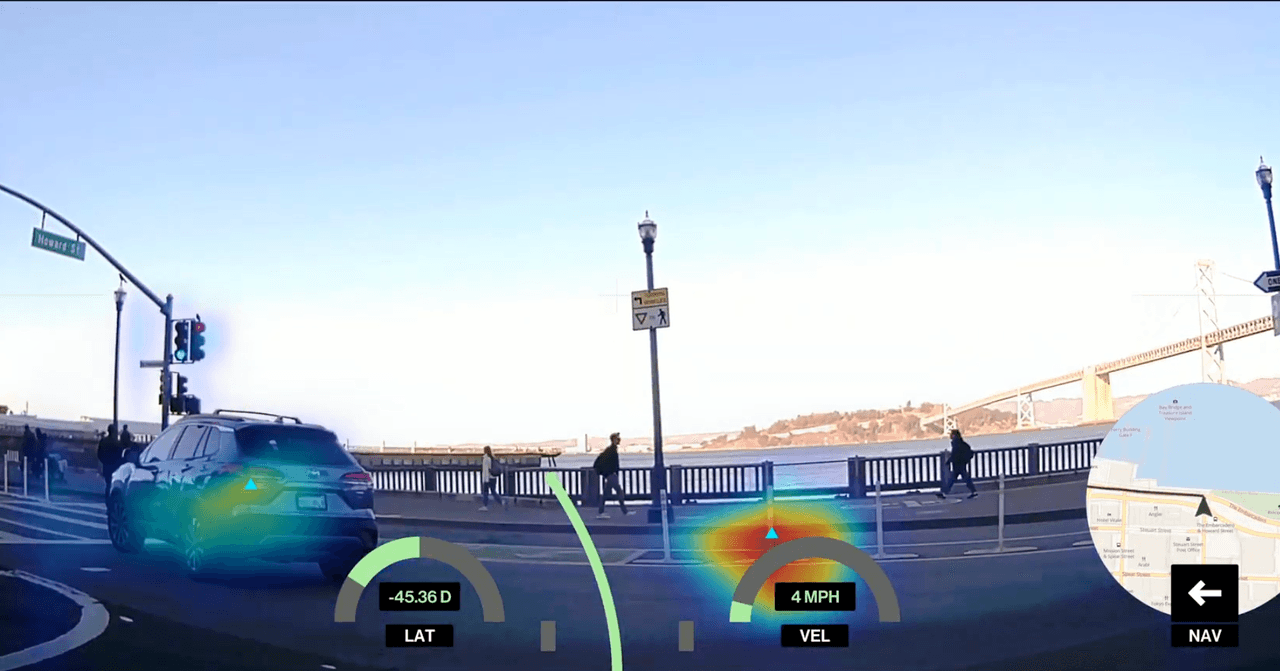
For the last year and a half, two hacked white Tesla Model 3 sedans have quietly cruised around San Francisco, each loaded with five extra cameras and one palm-sized supercomputer.
Old Tech, New Tricks
HyprLabs’ software training technique is a departure from other robotics startups‘ approaches to teaching their systems to drive themselves.
For years, the big battle in autonomous vehicles seemed to be between those who used just cameras to train their software—Tesla!—and those who depended on other sensors, too—Waymo, Cruise!
HyprLabs believes it can sort of do both, and thinks it can squeeze a last-mover advantage out of its more efficient approach.
The Startup’s Approach
The startup’s system, called Hyprdrive, can learn on the job, in real-time, with very little data.
It starts with a transformer model, a kind of neural network, which then learns as it drives under the guidance of human supervisors.
Only novel bits of data are sent back to the startup’s “mothership,” which is used to fine-tune the system.
The Future of Autonomous Vehicles
The startup’s real test might come next year, when it plans to introduce its untraditional robot.
“It’s pretty wild,” says Tim Kentley-Klay, the startup’s founder.
The company isn’t prepared to run a Waymo-style service on public roads, but it’s showing an impressive ability to drive with an excruciatingly small amount of computational work.
Source: Link